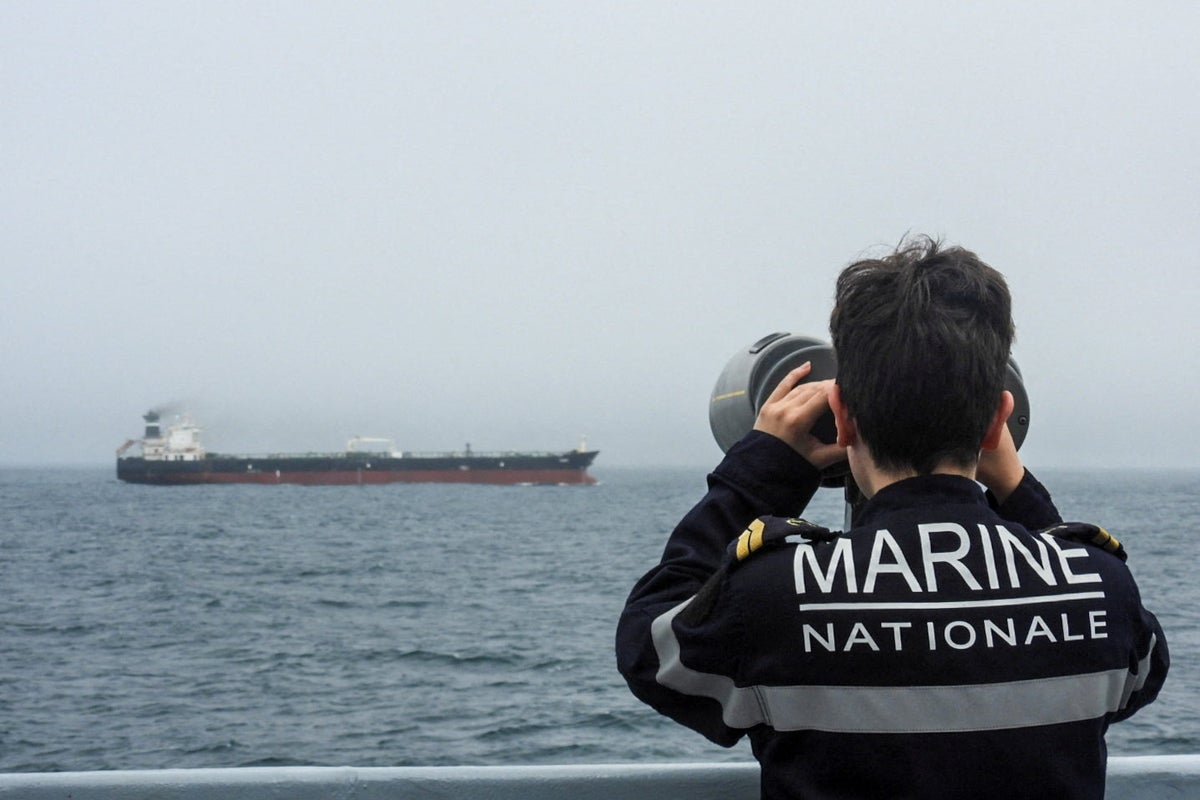
The North Atlantic does not care about geopolitics. It cares about wind, salt, and the crushing weight of grey water. When the gale blows off the coast of Brittany, it creates a rhythmic, deafening roar against the hull of a military vessel. It is a lonely place to do a dangerous job. But on a recent, biting morning, the grey expanse became the stage for a silent, high-stakes game of maritime chess.
Somewhere in the swell, a massive vessel slipped through the waves. On paper, it might have looked like any other commercial merchant ship. In reality, it was a phantom.
When French President Emmanuel Macron confirmed that British and French forces had intercepted a suspected Russian oil tanker in these waters, the news alerts read like standard diplomatic ledger entries. A brief flash on a smartphone. A dry statement from the Élysée Palace.
But behind the cold press releases lies a story of invisible wars, cloaked technology, and the immense human strain of policing a shadow world.
The Anatomy of a Phantom
To understand why a British warship and a French patrol vessel were cutting through the Atlantic chop to corner a single tanker, you have to look past the steel. You have to look at the signal.
Every modern ship of significant size relies on the Automatic Identification System, or AIS. It is the digital heartbeat of global shipping. It broadcasts a vessel's identity, position, speed, and course to anyone listening. It keeps ships from slamming into one another in fog-choked shipping lanes. It is the ultimate tool of transparency.
Until someone turns it off.
When a captain toggles that switch, the ship vanishes from global tracking screens. It becomes a ghost. This practice, known as "going dark," is the calling card of the shadow fleet—a massive, loosely organized armada of aging tankers used to transport sanctioned oil across the globe.
Think of it as driving a semi-truck down a crowded highway at midnight with the headlights switched off. The danger is immense. The environmental risk is catastrophic. Yet, for those operating in the margins of international law, the profit outweighs the peril.
The intercepted tanker was suspected of being part of this subterranean economy. It wasn't just carrying oil; it was carrying defiance. For months, Western nations have attempted to choke off the revenue funding the war in Ukraine by imposing strict price caps and sanctions on Russian crude. The shadow fleet is Russia's countermove. By using rusted, under-insured ships with obscured ownership, they keep the oil flowing and the cash coming.
But the Atlantic is a small place when the Royal Navy and the French Marine Nationale are looking for you.
The Hunt in the Grey
Imagine the command bridge of a European naval vessel. The air smells of recycled oxygen and strong coffee. The lighting is low, cast in the soft blue glow of radar screens and tactical displays.
For the crew, the mission isn't abstract. It is tedious, punctuated by moments of intense adrenaline. They are tracking a target that doesn't want to be found.
Finding a dark ship requires a masterclass in modern electronic warfare. You don't just look for a blip on a screen; you look for the absence of one. Satellite imagery catches a metallic glint where no ship should be. Synthetic aperture radar cuts through the heavy Atlantic cloud cover, mapping the wake of a vessel trying to hide in the dark.
Then comes the human element. The interception.
Close your eyes and hear the change in pitch as the naval engines thrum to life. The distance closes. The silhouette of the tanker emerges from the mist—a rusted leviathan, riding low in the water under the weight of millions of gallons of crude oil.
Naval boarding teams train for years for these moments. Descending from a helicopter or launching in rigid-hulled inflatable boats into a churning sea is a visceral, terrifying experience. The physical stakes are immediate. A single misstep on a slippery, oil-slicked ladder means falling into an ocean that kills a human being in minutes.
The confrontation is rarely cinematic. There are no Hollywood gunfights. Instead, it is a battle of bureaucracy and nerves. Naval officers hail the bridge of the tanker over the radio. Voices crackle through the static. Questions are asked. Logbooks are demanded. Passports and shipping manifests are scrutinized.
On the other side of that radio is likely a crew of merchant mariners from developing nations, caught in the crossfire of a geopolitical struggle they have no stake in. They are tired, underpaid, and operating a vessel that might not survive a major storm. The tension on both sides is thick enough to cut with a knife.
Why the Atlantic Is the New Front Line
For decades, we viewed geopolitical conflict through the lens of land borders. We looked at maps with hard red lines. But the real friction points of the modern era are fluid. They are written in water.
Consider what happens next if these ships are left unchecked. The shadow fleet is not composed of pristine, state-of-the-art vessels. These are older tankers, many nearing the end of their operational lifespans. They often operate without standard international insurance. If one of these ghosts tears its hull open on a reef off the coast of France or Cornwall, the resulting ecological disaster would devastate local communities for a generation.
The interception by the UK and France was a message. It was a physical manifestation of a political line in the sand.
By cooperating seamlessly in the Atlantic, London and Paris demonstrated that despite the political static of the post-Brexit era, the fundamental security architecture of the West remains intact. The channel between them might be wide politically, but at sea, their navies speak the exact same language.
They proved that the shadow fleet cannot operate with impunity. The oceans are vast, but they are no longer an lawless vacuum.
The Weight of the Silent Victory
The tanker was halted. The inspection was carried out. The machinery of international law ground forward.
Eventually, the headlines faded, replaced by the next cycle of breaking news. The political commentators moved on to the next press conference.
But out in the Atlantic, the grey water keeps churning. The wind still bites. The crews of those British and French vessels go back to their patrols, staring into the radar screens, watching for the blips that disappear.
They know the truth that the rest of us easily forget. Security isn't a permanent state of being. It is a grueling, continuous effort. It is maintained by young men and women standing on rolling decks in the middle of the night, watching the horizon, waiting for the ghosts to show themselves.