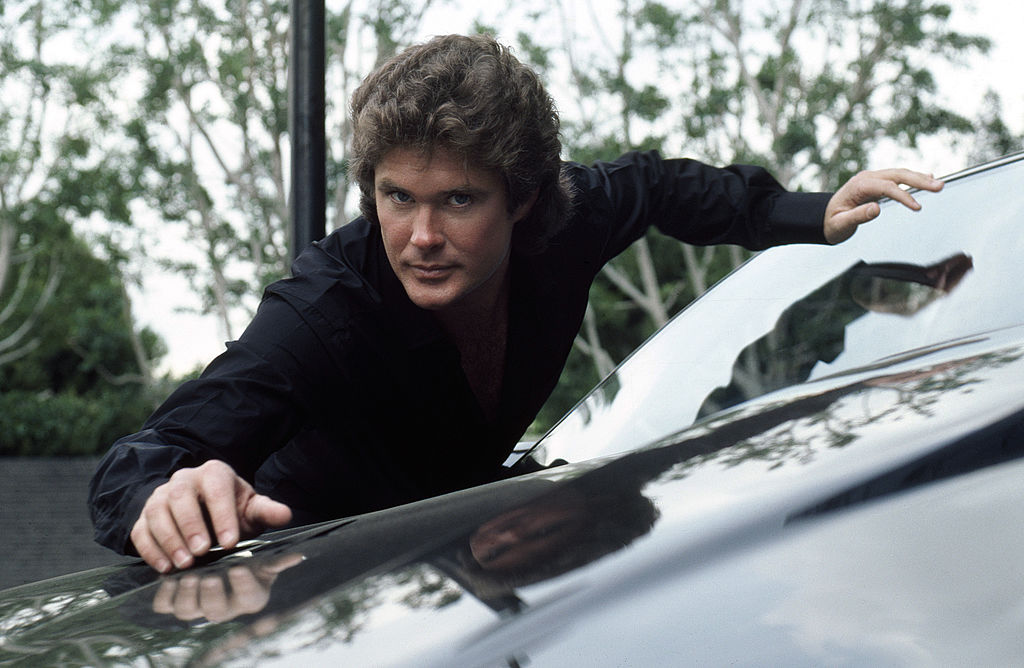
The black paint of the 1982 Pontiac Trans Am doesn't just sit on the metal. It swallows the light. For anyone who grew up in the eighties, this isn't just a car; it is KITT, the sentient partner to Michael Knight, a silicon-brained hero that could outrun bullets and outwit villains. It lives now within the climate-controlled stillness of the Volo Auto Museum in Illinois, its red scanner light dark, its tires resting on polished concrete that hasn't seen a road in years.
Then the mail arrived.
Inside a standard government envelope sat a speeding ticket. It wasn't a clerical error or a misplaced decimal point in a ledger. It was a formal accusation from the British transport authorities. According to a speed camera in North West England, this specific Knight Rider replica—a car currently stationed behind velvet ropes thousands of miles away—had been caught hurtling down a rainy road at a clip that would make a traffic warden’s head spin.
The museum staff didn't laugh. Not at first. They felt that cold, prickling sensation of a reality glitching.
The Geography of the Impossible
Brian Grams, the museum’s director, knows every inch of his collection. He knows the oil weights, the battery levels, and exactly which cars are capable of turning a wheel. The KITT replica in question is a masterpiece of fiberglass and nostalgia, but it possesses one glaring flaw for a getaway driver: it has no engine. It is a shell. A beautiful, iconic, immobile hollow.
Consider the logistics of the accusation. To believe the ticket, one must believe that a car with the aerodynamic profile of a brick and the internal guts of a mannequin somehow sprouted a powertrain, crossed the Atlantic Ocean in total secrecy, and decided to go for a joyride through a British speed trap before returning to its pedestal in Illinois without disturbing a single grain of dust.
It is a story about data becoming more "real" than the physical world.
We live in an era where the digital record is treated as the ultimate truth. If the computer says you were there, you were there. If the sensor registers a pulse, there is a heart. But in this instance, the system looked at a grainy photo of a license plate and bypassed every law of physics to produce a fine. The authorities weren't tracking a car. They were chasing a ghost made of alphanumeric characters.
The Vanishing Human Element
The beauty of the Knight Rider legend was always the bond between man and machine. Michael Knight provided the soul; KITT provided the logic. They balanced each other. But in the case of the Volo Museum ticket, the logic has become untethered from the soul.
When a speed camera flashes, there is no human judgment involved. There is no officer smelling the air, checking the weather, or looking the driver in the eye to see if they are rushing to a hospital or simply being reckless. There is only a shutter, a sensor, and an algorithm.
This is the "invisible stake" we all gamble with daily. We have automated our accountability. We have outsourced our skepticism to databases that do not know how to dream or how to doubt. The UK authorities saw a plate—likely a fraudulent clone or a bizarre coincidence of lettering—and the automated system did the rest. It didn't pause to ask if a famous movie car from a different continent could possibly be the culprit. It simply generated a bill.
Bureaucracy is a momentum machine. Once the ticket is printed, the burden of proof shifts. The museum wasn't just defending a car; they were fighting a digital hallucination that had been codified into law.
The Art of the Clone
To understand how this happened, you have to understand the shadowy world of "cloning." In the digital age, a car’s identity is its license plate. Criminals or pranksters often scan images of famous cars online, print out the corresponding plates, and slap them onto a similar make and model.
It is a form of automotive identity theft.
Imagine a hypothetical enthusiast in a drizzly suburb of Manchester. He spends his weekends tinkering with a battered Trans Am, trying to recapture a piece of his childhood. He sees a photo of the Volo Museum’s KITT online. He mimics the plate. He feels a surge of rebellion as he enters the highway, pretending he’s on a mission for the Foundation for Law and Government.
But when he hits the gas and the camera flashes, he isn't the one who pays. The data points back to Illinois. The system doesn't see the man in Manchester; it only sees the record in the cloud. The museum becomes a victim of its own accuracy, punished because their replica is so perfect that it invited imitation.
A Static Hero in a Moving World
There is something deeply poetic about KITT being the center of this storm. The show was a prophecy of a world where cars drove themselves and talked back to us. Today, our cars are computers on wheels, constantly transmitting our location, our speed, and our habits to unseen servers.
We are moving toward a future where "The Ticket from Nowhere" won't be a fluke; it will be a feature.
When Brian Grams looked at that ticket, he wasn't just seeing a mistake. He was seeing the friction between the physical objects we love and the digital shadows they cast. The museum eventually cleared the matter up, of course. It’s hard to argue with a car that lacks a transmission. Yet, the incident lingers like a faint scent of burnt rubber in an empty garage.
It serves as a reminder that as we automate our world, we lose the ability to recognize the absurd. A machine cannot laugh at the idea of a teleporting Trans Am. It can only process. It can only fine. It can only demand.
The car remains in Volo. It is still black. It is still silent. It sits under the fluorescent lights, a relic of a time when we thought the machines would be our partners, not our silent accusers. Outside, the world moves faster and faster, caught in the relentless shutter-click of a thousand cameras, all of them looking for a plate, but none of them looking for the truth.