Silence.
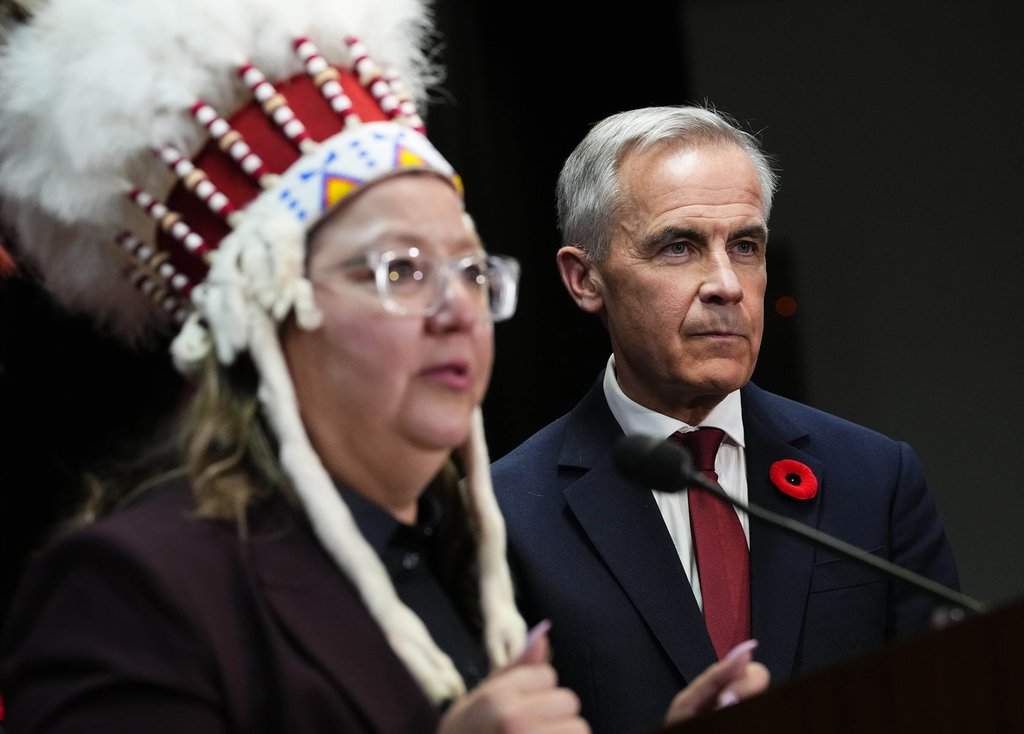
That is what greets a room in Ottawa when someone dares to speak the three words that have haunted Canadian politics for a century and a half: abolish the Indian Act. You can watch the air leave the lungs of seasoned policy analysts, watch deputy ministers suddenly find their water glasses fascinating, and watch elected officials pivot with Olympic agility toward safer vocabulary like "modernization," "co-development," or "incremental reform." Everyone agrees the 1876 statute is a relic of Victorian colonialism, a paternalistic straitjacket designed to erase Indigenous identity and assimilate First Nations into the Canadian body politic. Yet when Assembly of First Nations National Chief Cindy Woodhouse Nepinak stood before reporters and dropped a quiet truth bomb, she exposed the massive gulf between political rhetoric and actual intent. Aside from Mark Carney and Manitoba Premier Wab Kinew, she noted, nobody in power is actually talking about tearing the whole thing down.
Think about that for a second.
We live in an era of relentless political disruption, where leaders routinely promise to blow up tax codes, scrap environmental frameworks, and overhaul healthcare systems before breakfast. Still, the single most racist piece of active legislation in the Western world remains bolted to the floorboards of Canadian law, untouched in its foundational architecture since the days when Alexander Graham Bell was still tinkering with the telephone. Why? Because the Indian Act is not merely a bad law. It is a structural load-bearing wall in a house that nobody knows how to rebuild without the roof caving in on the people living inside.
To understand why Woodhouse Nepinak’s observation cuts so deep, you have to step away from the marble corridors of Parliament Hill and imagine a Tuesday morning in a small First Nation community three hundred miles north of Winnipeg. Let us call our hypothetical resident Clara. Clara wants to build a modest extension onto her family home because her aging father needs a ground-floor bedroom. In any regular Canadian municipality, Clara would walk into a bank, offer her house and the land beneath it as collateral, sign a mortgage, and hire a local contractor. Simple. Routine. Invisible.
Under the Indian Act, Clara owns neither the house nor the dirt it sits on. Reserve land is held in trust by the Crown, meaning it cannot be seized by a bank if a borrower defaults. Without collateral, there is no standard mortgage. Without a mortgage, Clara must apply for a ministerial loan guarantee, entering a bureaucratic labyrinth managed by Indigenous Services Canada that can stretch from months into years, requiring signatures from band councils, regional offices, and federal officials who have never seen her driveway. Her father waits. The lumber prices climb. The winter freezes the ground before a single shovel hits the dirt.
That is the daily friction of a statute written when Ottawa viewed Indigenous people as wards of the state who needed permission to sell a bushel of wheat, hire a lawyer, or leave their reserve. Even after the worst overtly authoritarian clauses were stripped away in the 1950s and 1980s, the underlying machinery remained intact. It governs who gets recognized as a "Status Indian," how band councils are elected, how wills are probated, and how reserve lands are managed. It is an all-encompassing operating system running on corrupted code from 1876.
The Trap Inside the Cage
So why hasn't every politician in the country lined up behind Mark Carney and Wab Kinew to consign this monstrosity to the shredder?
Here is where the story gets uncomfortable, and where outsider commentary usually veers off a cliff. To a casual observer, keeping the Indian Act looks like sheer bureaucratic inertia or residual malice. The reality is far more tangled. Over 150 years, the Indian Act accidentally became both a cage and a shield.
Picture a prisoner who has spent his entire life inside a concrete cell. The walls are cold, damp, and suffocating, built by people who wanted him gone. Yet outside those walls, a violent storm is raging, and the cell is the only structure standing between him and the elements. If someone walks up with a sledgehammer and knocks down the walls without first building a proper house, the prisoner doesn't get freedom. He gets hypothermia.
For First Nations across Canada, the Indian Act contains the explicit statutory recognition of their distinct legal status, their reserve lands, and specific tax exemptions that flow from historical treaty relationships. When Prime Minister Pierre Trudeau and his Indian Affairs Minister Jean Chrétien tried to abolish the Act overnight in 1969 through the infamous White Paper, Indigenous leaders rose up in unified fury. Harold Cardinal, a Cree leader from Alberta, called it a thinly disguised program of extermination through assimilation. Scrapping the Indian Act without replacing it with constitutionally protected, nation-to-nation frameworks doesn't liberate First Nations; it simply turns them into ordinary municipalities, dissolving their inherent rights and absolving the federal government of its historical treaty obligations.
I have sat in community halls from northern Ontario to coastal British Columbia listening to elders debate this exact dilemma, and the fear in the room is never abstract. You can smell the stale coffee and feel the draft coming off the gymnasium doors while grandmothers ask the question that policy wonks in Toronto rarely consider: If Ottawa tears up the Act tomorrow, what happens to our treaty healthcare? What happens to our land base when developers come knocking? Nobody trusts the Crown enough to hand back the keys without seeing the blueprint for the new building first.
The Political Cost of Honesty
This brings us back to Cindy Woodhouse Nepinak’s pointed remark about who is actually willing to say the quiet part out loud.
When Mark Carney entered the political arena, he brought the mindset of a central banker accustomed to looking at systemic risk rather than short-term electoral cycles. To an economist looking at Canada’s long-term ledger, the Indian Act is an anchor dragging down human potential and creating tens of billions of dollars in contingent legal liabilities. Talking about replacing it aligns with a worldview that sees structural overhaul as an investment rather than an expense.
Wab Kinew comes at the same problem from the opposite end of the telescope. As an Anishinaabe leader and the premier of Manitoba, Kinew doesn't read about the Indian Act in briefing binders; he carries its generational weight in his own family history. When Kinew speaks about moving beyond the Act, he isn't pitching a sterile administrative cleanup. He is articulating a vision where Indigenous governments exercise true jurisdiction over child welfare, economic development, and resource revenue without asking permission from a federal minister in Gatineau.
Everyone else? They look at the electoral math and quietly back away from the microphone.
Consider what happens next when a mainstream federal party leader whispers anything resembling "abolish the Indian Act." Immediately, two opposite political firestorms erupt simultaneously. From one flank, progressive critics and anxious community members accuse the politician of plotting a 1969-style termination of Indigenous rights. From the other flank, populist voices complain about endless constitutional negotiations, billions in settlement payouts, and special status. Every focus group lights up red. Every communications director advises sticking to safe talking points about clean drinking water, housing investments, and "walking the path of reconciliation."
Reconciliation has become a wonderfully elastic word in Ottawa precisely because it demands no structural surrender of power. You can fund a cultural center, rename a bridge, issue a heartfelt apology in the House of Commons, and keep the 1876 control mechanism humming along in the background. Abolishing the Indian Act, by contrast, requires Ottawa to actually give up jurisdiction, land, and fiscal control. It means transforming the Department of Indigenous Services from a massive administrative empire into an obsolete relic. Bureaucracies do not willingly vote for their own extinction.
What Replacement Actually Looks Like
If tearing the Act down overnight is reckless and leaving it standing is morally indefensible, how do you escape a trap that has held a nation hostage for six generations?
The answer isn't a single stroke of a legislative pen. It is already happening in jagged, uneven pieces across the country, largely out of sight of the national press. Look at the Nisga’a Final Agreement in British Columbia, or the Anishinabek Nation Governance Agreement in Ontario, or the dozens of First Nations that have opted out of the land management sections of the Indian Act through the First Nations Land Management Act.
Let us revisit Clara, our hypothetical homeowner in northern Manitoba, under one of these modern self-governance frameworks. Instead of waiting two years for a federal bureaucrat to approve a home renovation, Clara walks down the street to her own Nation’s lands office. Because her community wrote its own land code, approved by its own citizens, local administrators process her lease in three weeks. She secures financing through an Indigenous-led financial institution backed by community equity. Her father moves into his ground-floor room before the first snow falls.
No ministerial sign-off. No Victorian oversight. Just local people governing local life.
Yet scaling that reality across more than six hundred distinct First Nations requires staggering political will, patient capital, and an honesty that most politicians find terrifying. Every Nation has a different history, a different treaty relationship, and a different level of administrative readiness. A one-size-fits-all repeal would be catastrophic; a customized transition requires decades of sustained commitment that outlasts four-year election cycles.
Woodhouse Nepinak wasn't necessarily endorsing a sudden, reckless repeal when she pointed out that only Carney and Kinew were even broaching the subject. She was holding up a mirror to the political establishment. She was asking why the supposed champions of progress are so comfortable managing a colonial statute rather than doing the grueling, unglamorous work of replacing it with genuine self-determination.
The Weight of the Unspoken
I keep thinking about an old ledger book preserved in a regional archive in Saskatchewan—thick, yellowing pages bound in cracked brown leather, filled with neat, cursive ink from the 1890s. Inside are the entries made by an Indian Agent recording every permit granted to local Cree farmers: permission to sell two sacks of potatoes, permission to buy a used wagon wheel, permission to travel twelve miles to visit a sick cousin.
The ink has faded to a rusty brown, and the Indian Agents are long gone, buried in quiet prairie cemeteries. Yet the legal spine that gave them authority still sits upright on the shelves of the Parliament of Canada, updated with digital formatting and modern amendments, quietly dictating the boundaries of Indigenous life from coast to coast. Until more leaders find the nerve to step into the silence and actually talk about dismantling that spine—brick by deliberate brick, Nation by willing Nation—the ghost of 1876 will keep writing the ledger.