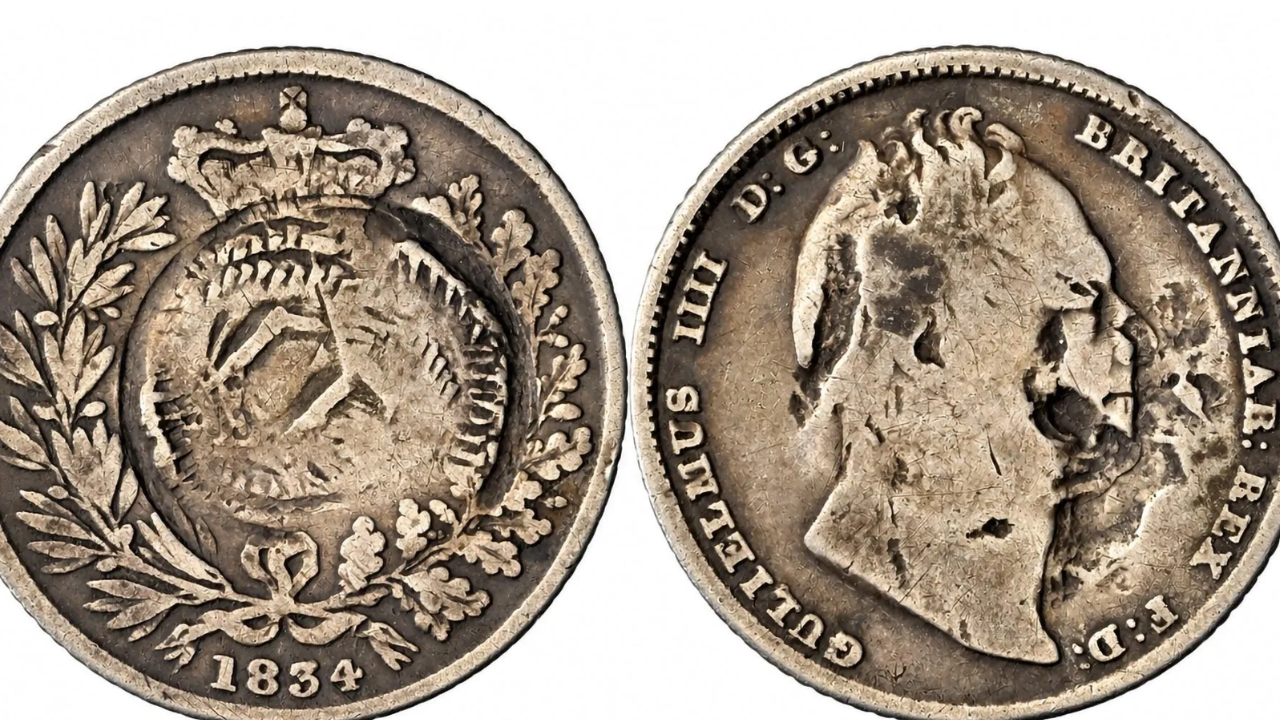
Hold a modern coin between your thumb and forefinger. Feel the milled edge, the crisp relief of the portrait, the cold certainty of industrial perfection. We take that perfection for granted because machines do not make mistakes like this anymore—and when they do, the error never leaves the factory floor.
Now imagine a coin that shouldn't exist. If you enjoyed this piece, you should check out: this related article.
It is small, thin, and silver-toned, a sixpence warped out of true geometry like a wax seal left too close to a hearth. For years, a piece of metal like this sits in a velvet tray or a plastic flip, dismissed by casual eyes as pocket trash—run over by a cartwheel, chewed by a vise, battered by centuries of rough human hands.
Until someone puts it under a laser. For another look on this event, check out the latest update from NBC News.
Recent three-dimensional surface scanning of a deformed sixpence has upended the easy assumption of post-mint damage. The topography of the metal—mapped down to fractions of a millimeter—tells a startling story: the distortion did not happen in a tavern brawl or beneath a carriage wheel. It happened in the violent, split-second embrace of the coining press itself. Yet even with modern metrology peering into the microscopic valleys of the silver, the exact mechanical culprit remains stubbornly inconclusive.
And that single word—inconclusive—is where the real story begins.
The Forensic Eye on Cold Metal
I have spent enough hours hunched over a jeweler’s loupe with a sore neck and dry eyes to know the intoxicating lie of certainty. When you collect or study historical coins, your brain aches for a clean narrative. You want every scratch, every off-center strike, every weird bulge in the flan to confess its autobiography on demand. Most of the time, the metal obliges. A gouge with displaced ridges at the edges means a spade hit it in the dirt. Smooth, flattened high points mean decades of circulation inside wool pockets.
A mint error, however, is a completely different animal. It is a fossilized millisecond of industrial failure.
To understand why 3D testing matters here, picture the difference between pressing a warm stick of butter with a signet ring versus hitting a frozen block of butter with a hammer after the design is already carved. In traditional numismatics, experts relied on raking light, stereo microscopes, and decades of gut instinct to tell the two apart. If the metal flowed into the lettering while bending, it happened during the strike. If the lettering was crushed after it was formed, someone damaged it later.
3D scanning strips away the guesswork of human eyesight. Using structured light or laser triangulation, researchers build a dense topographic point cloud of the coin's obverse and reverse. They can measure stress vectors, metal displacement, and curvature radii with cold, mathematical precision.
When they ran those models on this sixpence, the verdict was unmistakable. The deformation wasn't an afterthought imposed on a finished coin. The metal was already buckling, twisting, or misaligned at the exact instant tons of pressure slammed the upper and lower dies together. The design elements themselves conform to the warp rather than breaking across it.
It was born broken.
A Hypothetical Night at the Press
Step back in time for a moment—and let us be clear that this scene is a hypothetical reconstruction, an imaginative bridge built across the gaps where the archival record goes silent.
Picture a mint workshop centuries ago, lit by sputtering tallow or early gas lamps, thick with the smell of coal smoke, hot tallow grease, and metallic dust. The air vibrates. Every few seconds, a heavy fly-press or early mechanical coining engine drops with a bone-rattling thud.
Meet Thomas, a composite figure representing the thousands of anonymous press operators who fed silver blanks—called planchets—into the jaws of the machine for twelve hours a shift. His fingers are stained black with grease and oxide. His ears ring constantly. His job is rhythm: feed, strike, eject, repeat. Miss the beat by a fraction of a second, and you either lose a fingertip or jam a hardened steel die worth more than your annual wages.
In that relentless cadence, chaos waits in the margins.
Perhaps a silver blank failed to eject cleanly from the collar, sticking slightly tilted in the coining chamber as the next blank slid in. Perhaps the blank itself was unevenly annealed—heated and cooled improperly—leaving one half soft as lead and the other brittle as glass. Or maybe a tiny sliver of metal debris lodged beneath the lower die, creating an invisible fulcrum that bent the planchet the microsecond the upper die kissed its surface.
Thomas wouldn't have noticed. In the dim light and deafening roar, one warped sixpence drops into the catch-basket alongside five hundred normal ones. It passes through the weigh-room, slips past a tired inspector's eye, and tumbles out into the wider world—a silent witness to a momentary hiccup in state machinery.
Why the Cause Remains Elusive
So if 3D metrology is sophisticated enough to map the surface of Mars or reverse-engineer aerospace turbines, why can't it tell us exactly what went wrong in that press?
Because metal has a long memory, and time is a ruthless editor.
Think of a coin's surface like a crime scene left outdoors for two hundred years. The 3D scanner can prove beyond a shadow of a doubt that the window was broken from the inside. It can measure the exact angle of the glass fractures and the velocity of the impact. What it cannot always do is name the person who threw the chair, especially after wind, rain, and foot traffic have swept through the room for generations.
Three specific barriers stand between modern science and a definitive diagnosis of this sixpence:
- The Overlap of Mechanical Forces: Different minting malfunctions can leave nearly identical geometric signatures. A blank struck while partially jammed against the retaining collar can produce a curvature strikingly similar to a coin struck with a loose or tilted die. Without the original steel dies—which were routinely defaced and melted down once worn out—researchers are trying to deduce the shape of a key by studying a single wax impression.
- Post-Mint Wear Masking Micro-Evidence: Even if a coin was deformed inside the mint, it rarely went straight into a museum vault. Every year it spent clinking against copper pennies in a merchant's purse rounded off the microscopic striation lines—the tiny, telltale drag marks left by steel dies sliding across silver. Those striations are the fingerprints of the press. Once worn smooth, the exact direction of mechanical shear becomes blurry.
- Metallurgical Variables: Historical silver alloys were not the hyper-uniform sheets rolled by modern metallurgy. Trace impurities of copper, lead, or bismuth created localized pockets of varying hardness inside the same coin. Under extreme compressive force, an impure planchet warps unpredictably, mimicking mechanical misalignment even when the press itself was operating within tolerance.
Science, at its most honest, does not force a conclusion just to satisfy our craving for closure. Sometimes the highest form of expertise is drawing a sharp, bright line between what the data proves and where speculation begins.
The Invisible Stakes of Small Imperfections
It is tempting to look at a bent sixpence and shrug. It’s a tiny piece of old silver. Who cares whether it bent in 1750 or 1850?
That question misses the quiet power of material history.
Coins are the most democratic artifacts ever created. Kings, senators, and emperors commissioned them to project absolute authority, stability, and permanence. A flawless coin whispers a subliminal message to everyone who spends it: The crown is strong. The treasury is sound. The system works.
A mint error shatters that illusion. It is the human tremor inside the machine of state.
When researchers use 3D scanning to authenticate a minting accident, they are doing far more than settling a debate for wealthy collectors or museum curators. They are calibrating the very tools we use to read the past without destroying it. Every time a non-destructive 3D scan successfully separates a genuine mint error from a clever forgery or post-mint damage, it refines our understanding of historical manufacturing—how artisans solved engineering problems, where quality control failed, and how quickly industrial standardization actually took hold.
There is also a quieter, deeply personal stake for anyone who has ever held history in their hands. We live in an era of frictionless digital abstraction, where money is a number glowing on a glass screen and objects are molded by algorithms. Encountering a physical object that bears the scar of its own creation reminds us that human hands, flawed tools, and stubborn physics built the world we inherited.
Living With the Unanswered Question
I remember the first time I bought a coin I was sure was a rare mint error. I had read the forums, measured the diameter with cheap calipers, and convinced myself I had spotted a strike anomaly everyone else missed. When a veteran numismatist finally looked at it under proper magnification, he didn't even need ten seconds. He pointed to a tiny flat spot on the rim where someone had clearly tapped it with a small hammer centuries ago. My grand discovery was just an old piece of pocket damage.
That sting of being wrong teaches you humility fast. It teaches you to respect the difference between wishful thinking and hard evidence.
That is why the restraint shown in the 3D analysis of this sixpence resonates so deeply. In a culture addicted to hot takes and absolute certainty, there is something oddly comforting about watching cutting-edge optical technology examine a centuries-old anomaly, confirm its miraculous origin in the jaws of a coining press, and then quietly step back from the mystery it cannot solve.
Look closely at that warped silver disc again.
One side still carries the faint, ghostly impression of the authority that stamped it into being. The other bends away from symmetry, holding forever the exact shape of a fraction of a second when something inside the machine gave way. The lasers have mapped every micron of its curve, yet the coin keeps its final secret locked inside the silver—a small, crooked monument to the things even our sharpest eyes still cannot see.



