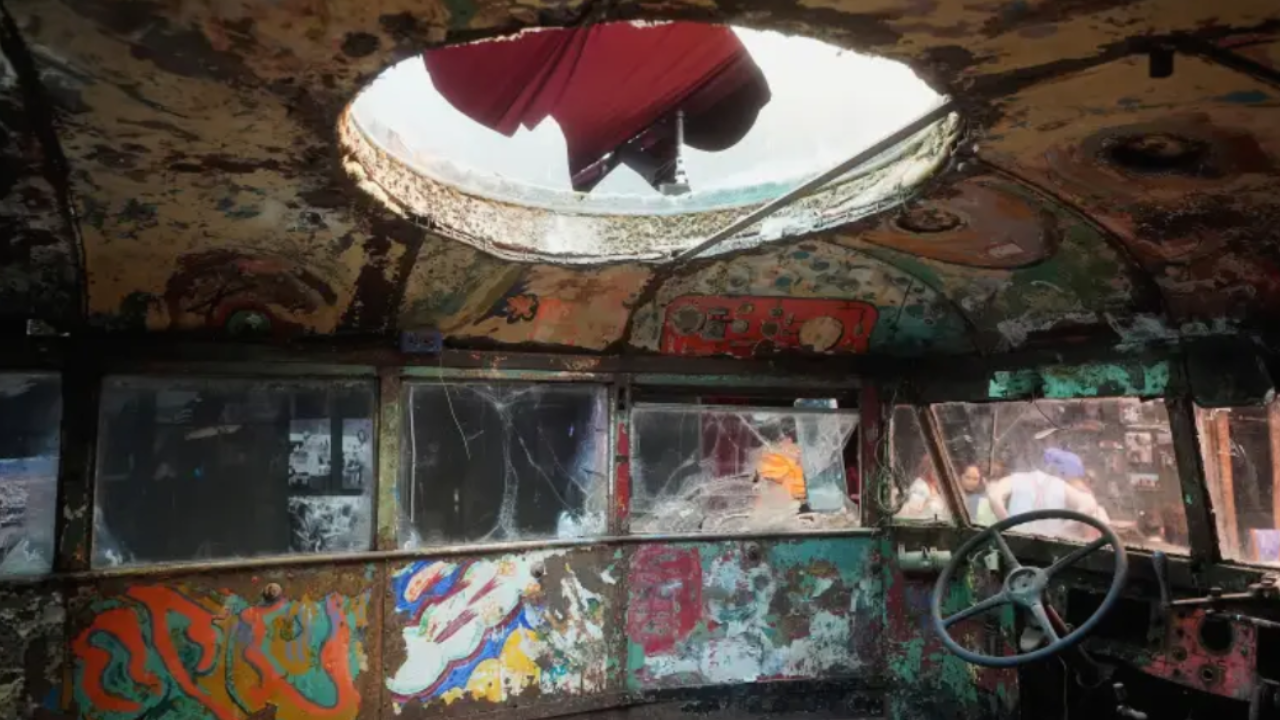
Rust smells like old pennies and wet dog. Ask anyone who has ever stuck their bare hand into the wheel well of a vehicle that stopped running before the internet had a name.
Sixty years ago, a 1939 International Harvester school bus rolled out of a garage in California coated in Day-Glo slop, carrying a handful of young men who intended to reinvent reality. They called it Furthur. Its destination was the New York World’s Fair, but its actual coordinates were somewhere out past the edges of map-making. Neal Cassady was at the wheel, grinding gears and grinning like a demon. Ken Kesey was in the back, watching the American landscape warp through a haze of improvised acoustics and neon paint.
Now, half a lifetime later, that rolling cathedral of counterculture has dragged its tired bones back to San Francisco.
It does not look triumphant. It looks like an artifact hauled up from the bottom of the Mariana Trench. The paint is flaking off in dry, curling scales. The tires are flat, sunken into asphalt like heavy boots in mud. Mice have nested in the wiring harness.
Yet people are weeping in the garage.
Why? Because human beings are desperate for things that refuse to stay dead. We spend our lives watching institutions crumble, promises evaporate, and heroes turn out to be accountants in cheap suits. But a rusted-out bus? That thing stayed weird. It stayed reckless. It stood as a monument to an era when a group of twenty-somethings could look at the rigid, gray architecture of mid-century America, pack themselves into a tin can, and decide to paint it orange.
To understand why a chunk of Detroit iron matters six decades later, you have to look past the tie-dye mythos. You have to look at the machinery of freedom.
Kesey bought the bus for fifteen hundred dollars in Sanauthorized cash from a dairy farmer. He wanted a mobile film studio to capture the trip east. He enlisted the Merry Pranksters—a rotating cast of artists, dropouts, and provocateurs—to deck it out with a primitive sound system, bunks, and an observation deck welded to the roof. They didn't travel; they broadcasted themselves. They dropped acid at rest stops, handed out Kool-Aid to bewildered tollbooth operators, and flashed a destination sign that read Further with a deliberate, rebellious misspelling.
Police stopped them constantly. Troopers stared at the psychedelic swirls, the rooftop lookout, and the lunatic driver, completely unequipped by training or statute to handle a crime wave consisting entirely of joy.
What are you boys doing? an officer might ask.
We are trying to get to the future, officer, they would reply.
And for a brief, shining window in 1964, it felt like they were.
Time, however, is an aggressive cleaner. By the seventies, the original bus had been abandoned in a swamp on Kesey’s Oregon farm. Vegetation choked the engine block. Poison oak crept through the floorboards. The psychedelic dream didn't die in a blaze of glory; it rotted quietly in the Pacific Northwest rain, ignored by a country that had traded its love beads for interest rates and oil embargoes.
A second bus, a newer model built to recreate the pilgrimage decades later, took over the mantle for a while, but the original relic remained where it fell, a ghost ship rusting in the pasture.
Until now.
Restoration is a strange kind of resurrection. It forces us to ask a brutal question: When you replace every rotting beam, every seized piston, and every patch of flaking steel, are you saving the object or building a replica?
Consider what happens when a museum conservator touches a painting by Rembrandt. They don't slap modern acrylic over the master’s brushstrokes. They use microscopes and micro-scalpels, stabilizing the decay without erasing the passage of time. But a bus is different. A bus is meant to move. A bus is utility disguised as art. If you leave the original rust, it disintegrates on the interstate. If you strip it down to bare metal and weld new steel into the chassis, you lose the exact atoms that bounced along Route 66 while Cassady howled at the moon.
The mechanics working on the rusted hulk in San Francisco know this tension intimately. They aren't just grease monkeys turning wrenches; they are secular monks tending to an altar. Every bolt they unfreeze is an argument against oblivion.
We live in an age of frictionless preservation. Digital files never fade. Songs from 1964 stream instantly in crystal-clear stereo, pristine and weightless. Nothing wears out anymore because nothing is physical enough to suffer friction. We have traded the grit of existence for the convenience of the cloud.
That is why people crowd around a dead engine.
The Furthur bus smells like reality. It carries the dents of bad turns, the faded ghosts of brushstrokes applied by hands that have long since turned to ash, and the stubborn refusal to be forgotten. It reminds us that history was not made by marble statues or committee reports. It was made by messy, confused, brilliant young people who were terrified of being ordinary.
When the restoration is complete, the bus won't go fast. It won't dominate modern highways choked with aerodynamic SUVs and electric crossovers that hum like refrigerators. It will leak oil. It will rattle your teeth loose at fifty miles per hour. It will smell of exhaust and old canvas.
And when it finally rolls down the street, trailing a cloud of blue smoke and mismatched colors, it will carry something far more powerful than nostalgia.
It will carry proof that once, just once, a few Americans looked at the highway ahead, grabbed the wheel, and dared to spell the future wrong.


