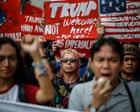
Mass demonstrations outside foreign embassies and government centers rarely stem from a single grievances. The convergence of civil unrest in Manila—triggered simultaneously by opposition to U.S. foreign policy in the Middle East, bilateral security agreements, and international AI integration agreements—demonstrates a textbook structural convergence of local sovereignty concerns and global power dynamics.
To evaluate the stability risks of these protests, international observers must move beyond surface-level reporting of arrest counts and examine the underlying structural forces driving mobilization, police escalation, and legislative friction.
The Tri-Factor Mobilization Framework
Civil discontent in the Philippines surrounding domestic alignment with Western foreign policy operates across three distinct strategic pillars.
1. External Geopolitical Friction
Protests directed against foreign military actions—specifically military escalation involving Iran and the United States—serve as a high-visibility catalyst for anti-interventionist coalitions. In the Philippine context, alignment with American military strategy frequently triggers historical opposition from nationalist blocs, left-leaning labor groups, and student unions. The mechanism at play is not merely ideological sympathy; it is a calculated pushback against perceived strategic exposure, where domestic populations fear becoming proxy targets in extra-regional conflicts.
2. Bilateral Security and AI Pact Resistance
The inclusion of artificial intelligence and defense technology frameworks into bilateral security architecture alters the classic protest dynamic. Modern technology pacts between sovereign nations frequently involve data-sharing protocols, autonomous systems integration, and surveillance infrastructure. Opponents frame these agreements around two core vulnerabilities:
- Sovereignty Dilution: The concern that foreign control over technological infrastructure compromises national command autonomy.
- Domestic Surveillance Infrastructure: Fear that dual-use AI capabilities transferred under defense umbrellas will be re-deployed internally against political dissent.
When defense pacts expand into digital domain integration, mobilization expands beyond traditional peace activists to include digital rights advocates and civil liberties organizations.
3. Economic and Domestic Pressure Points
Foreign policy protests rarely achieve critical mass without underlying domestic economic stress. Mass arrests typically occur when ideological demonstrations intersect with broad-based economic grievances, such as inflation, fuel price volatility, or labor displacement. Mobilization leaders leverage international events as visible lightning rods to channel systemic domestic dissatisfaction toward government authority.
The Operational Mechanics of Escalation and Arrest Dynamics
Understanding why demonstrations in urban centers like Manila escalate into hundreds of arrests requires examining public order tactical doctrines and crowd control feedback loops.
[Policy Shift / External Event]
              │
              ▼
[Coalition Formation: Labor + Students + Digital Rights]
              │
              ▼
[High-Density Public Demonstration]
              │
              ▼
[Perceived Security Perimeter Breach]
              │
              ▼
[Law Enforcement Dispersion Response]
              │
              ▼
[Mass Arrests & Institutional Friction]
Mass detainment occurs when three operational thresholds are crossed:
- Spatial Perimeter Violations: Security forces enforce rigid exclusion zones around critical infrastructure, foreign embassies, and executive centers. When protest volume exceeds physical containment capacity, perimeter breaches trigger systematic law enforcement interventions.
- Permit Constraints and Legal Mandates: Under existing public assembly regulations, demonstrations operating without municipal permits or exceeding designated "freedom park" boundaries face immediate legal dissolution, changing the enforcement standard from monitoring to active dispersal.
- Preventive Containment Tactics: Law enforcement doctrine in high-density urban environments prioritizes mass detainment over prolonged standoff to clear logistical corridors quickly. This operational strategy drives up arrest metrics rapidly, even when the vast majority of participants remain non-violent.
Risk Assessment for Foreign Policy Alignment
For policy planners and international analysts, civil unrest of this nature signals structural friction points that impact long-term diplomatic and technological execution.
First, public backlash against defense and AI treaties complicates legislative ratification and executive implementation. When bilateral agreements become politically radioactive domestically, implementation timelines stall, and compliance costs rise.
Second, the operational deployment of dual-use technologies creates ongoing governance challenges. International partners entering into technical or defense agreements must account for domestic political risk: technology transfers that lack clear governance standards face persistent public challenge and judicial scrutiny.
Strategic risk management requires policy architects to decouple technical integration agreements from broader geopolitical posturing. Securing public legitimacy for defense or AI initiatives requires transparent oversight mechanisms, clear boundaries regarding domestic application, and structured engagement with civil society stakeholders before formal treaty execution.


