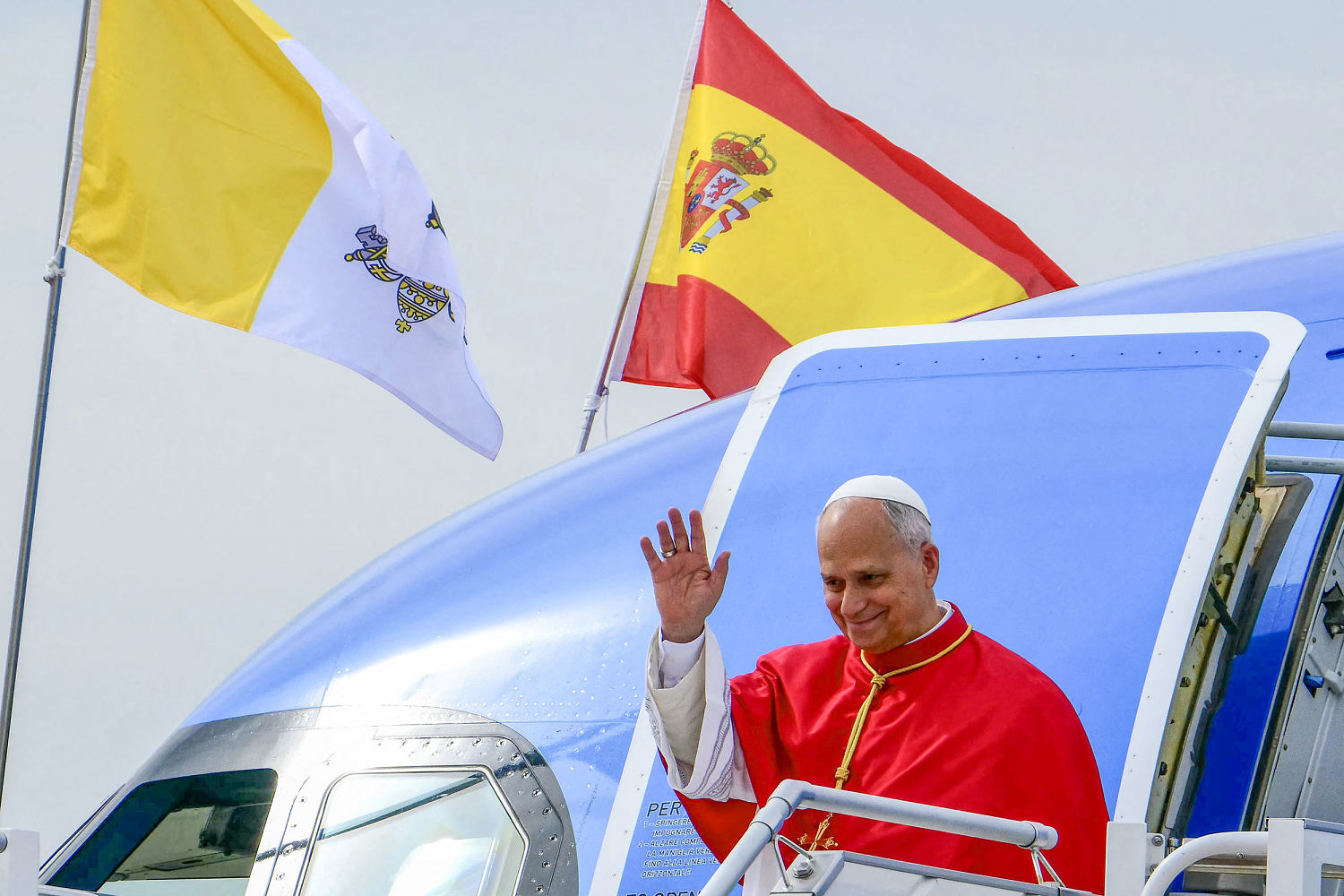
The diplomatic friction between Washington and the Holy See represents more than a clash of executive temperaments; it is a structural collision between hard power unilateralism and multilateral soft power maximization. When Pope Leo XIV commenced his June 2026 state visit to Spain, his public commendation of Madrid’s "faithful adherence to international law" served as a calculated counterweight to the transactional foreign policy paradigm currently executed by the United States administration. By analyzing this interaction through the lens of institutional incentives, international law compliance matrices, and the strategic deployment of moral authority, we can map the precise mechanics of modern papal diplomacy.
The strategic friction operates along two primary axes: the optimization of international law as a defensive shield for secondary powers, and the management of migratory inflows under divergent regulatory frameworks. Where the United States administration views international bodies as constraints on national sovereignty, smaller or mid-tier powers like Spain under Prime Minister Pedro Sánchez view these structures as force multipliers. The papal endorsement of Madrid is a deliberate effort to validate this multilateral framework, leveraging the Holy See’s unique, non-territorial sovereignty to alter the reputational payoff matrices of sovereign states.
The Tri-Polar Framework of Papal Diplomatic Leverage
To understand why a papal visit to Spain functions as an implicit critique of American foreign policy, one must deconstruct the Holy See's diplomatic toolkit into three distinct operational pillars.
[Moral Authority Assets] ---> [Multilateral Alignment] ---> [Sovereign State Validation]
         |                                                              |
         +--> (Alters Reputational Payoffs for Transgressor States) ----+
1. The Asymmetric Informational Asset
The Papacy possesses no military divisions or economic coercive mechanisms. Its utility in international relations depends entirely on its moral capital and its capacity to frame global narratives. When Pope Leo denounces "sterile simplifications" and "polarizing narratives," he is deploying an informational asset designed to increase the political cost for leaders who rely on populism or unilateral military action. This asset is highly effective when contrasted against the high-decibel, transaction-oriented messaging of the current US executive branch.
2. The Multilateral Network Effect
The Holy See operates as a permanent observer state at the United Nations and maintains formal diplomatic relations with 183 sovereign nations. This extensive institutional network allows the Vatican to act as a diplomatic clearinghouse. By choosing Spain—a nation currently clashing with Washington over military operations in Iran and Venezuela—as his first European Union state visit outside Italy, Pope Leo is reinforcing a specific node in the multilateral network. This alignment provides institutional cover to a European government facing both external pressure from the US and internal challenges from domestic conservative factions like the Vox party.
3. The Sovereign Validation Mechanism
Sovereign states require legitimacy to lower the long-term transaction costs of governance and international trade. A formal papal commendation acts as an external validation mechanism. For the Sánchez administration, which is managing internal political volatility due to domestic corruption allegations, the papal endorsement of its immigration policies and international law adherence provides a crucial buffer. It transforms a controversial domestic agenda into a globally validated moral stance, altering the domestic political calculus.
The Migratory Equilibrium: Spain's Structural Contrast to US Policy
The operational divergence between the United States and Spain regarding migration underscores a deeper systemic conflict in labor-supply economics and human rights compliance. The underlying mechanisms of these two approaches reveal distinct institutional goals.
| Operational Variable | The US Unilateral Containment Model | The Spanish Liberal Regularization Model |
|---|---|---|
| Primary Policy Objective | Border enforcement, deterrence, and minimization of demographic inflows. | Regularization of unauthorized labor pools to stabilize demographic deficits. |
| Economic Mechanism | Criminalization of informal labor, increasing local enforcement expenditures. | Formalizing 500,000 undocumented migrants to expand the tax base and funding structures. |
| Geopolitical Risk Vector | Strained bilateral relations with transit nations and reputational deprecation. | Maritime transit mortality crises (e.g., Canary Islands routes) and domestic political polarization. |
The Spanish model, characterized by its mass amnesty program for approximately 500,000 undocumented individuals, aims to absorb an informal workforce into the legal, tax-paying economy. Pope Leo’s scheduled itinerary—specifically targeting meetings with migrants in the Canary Islands—is designed to highlight the human cost function of alternative, restrictive models. More than 3,000 individuals perished in 2025 attempting to navigate the maritime route to the Canaries. By anchoring his moral rhetoric in these specific geographies, the Pope forces a comparison with the US administration's aggressive border enforcement and deportation strategies.
This creates a distinct structural bottleneck for conservative opposition parties within Spain. For instance, while Vox leader Santiago Abascal maintains a strict anti-immigration platform, the institutional weight of a visiting Pontiff forces domestic political actors to engage in performative alignment, as seen by Abascal's attendance and applause at the Royal Palace. The Papacy effectively manipulates domestic political incentives by framing immigration not as a security dilemma, but as an optimization problem of human dignity.
The Cost Function of Public Discord: Trump vs. Leo XIV
The rhetorical escalation between President Trump and Pope Leo XIV since January 2026 provides a clear case study in how public conflict affects political capital. The conflict began over US military interventions in Venezuela and Iran, and has since moved from policy disagreements to direct institutional attacks.
The American executive’s strategy relies on a cost-imposition model. By labeling the US-born Pontiff as "weak on crime," "terrible for foreign policy," and "catering to the radical left," the administration attempts to diminish the Pope's domestic approval rating among American Catholics—a key voting demographic. The ultimate escalation occurred when the president posted an AI-generated image depicting himself with Christ-like imagery. This was a calculated move to seize cultural authority from the institutional Church.
However, the data-driven reality of public opinion reveals a significant asymmetry in this exchange. Polling metrics from early 2026 indicate that Pope Leo XIV maintains a net favorability rating of +34 within the United States, whereas the president sits at -12.
[Pope Leo XIV: +34 Net Favorability]  =======> High Moral/Political Capital
[President Trump: -12 Net Favorability] =====> Depleted Reputational Capital
This differential means the president’s attacks carry a high risk of backfiring. For core constituencies, including the Catholic subset of the working-class electorate, direct attacks on the Papacy create a sharp conflict of loyalty. The subsequent removal of the AI-generated imagery after pushback from religious conservatives demonstrates the limits of using populist rhetoric against a deeply entrenched institutional authority.
The Pope's response strategy relies on institutional endurance rather than quick retaliation. By stating on the papal plane that he has "no fear of the Trump administration" and emphasizing that the Church operates from an "eternal perspective," Leo XIV shifts the conflict out of the immediate political cycle. This long-term framing weakens the effectiveness of short-term political attacks, allowing the Holy See to sustain its critique of US foreign policy without getting drawn into a standard media cycle.
Strategic Forecasting: The Emerging Institutional Realignment
The current diplomatic friction suggests a long-term shift in how the Holy See interacts with Western secular powers. As the United States continues to prioritize bilateral, transaction-based diplomacy, the Vatican is positioning itself as the institutional anchor for state and non-state actors committed to the post-WWII multilateral order.
We can expect the Holy See to increasingly use its diplomatic calendar to support middle powers that uphold international legal frameworks. The Pope’s address to the Spanish parliament—an unprecedented move for a Roman Pontiff in that venue—serves as a blueprint for this strategy. The Vatican is actively working to strengthen the resolve of European Union member states to maintain independent foreign policies, particularly regarding Middle Eastern and Latin American conflicts.
Furthermore, the Holy See's internal management of its own systemic liabilities will dictate its long-term moral authority. Pope Leo's acknowledgment of clerical sexual abuse as an "open wound" during his Spanish tour, alongside meetings with survivors, represents an essential risk-mitigation strategy. The Church recognizes that its capacity to critique the moral failures of sovereign states—whether regarding war or immigration—is tied to its transparency in handling internal institutional crises.
The strategic play for European leaders like Sánchez is to leverage these papal visits to build international credibility, using the shared rhetoric of solidarity and multilateralism to offset pressure from Washington. Conversely, the strategic vulnerability for the US administration lies in its growing isolation from traditional moral and institutional allies. By treating the Holy See as an ideological opponent rather than a sovereign diplomatic entity, the American executive risks losing a vital channel for back-channel mediation and long-term stability operations.
The evolution of international relations will not be driven by hard military metrics alone. It will be shaped by how effectively sovereign actors can align their strategic goals with recognized international laws and ethical frameworks. In this ongoing effort, the Holy See remains an influential institution capable of altering the geopolitical landscape without deploying a single soldier.