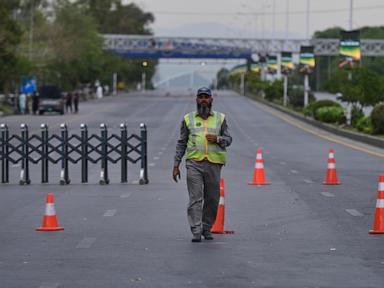
The decision to dispatch high-level envoys to Islamabad while Tehran maintains a rigid refusal of direct engagement marks a fundamental shift in the American approach to the Persian Gulf-South Asia corridor. This maneuver is not a simple diplomatic outreach; it is a calculated application of Geopolitical Arbitrage. By strengthening the link with Pakistan, the Trump administration seeks to bypass the Iranian diplomatic wall, utilizing Islamabad as a pressure valve, a secondary channel, and a regional stabilizer simultaneously.
The Triple-Axis Framework of the Islamabad Outreach
The administration’s strategy rests on three distinct operational pillars that categorize the intent behind the envoys' mission.
1. The Afghan Security Buffer
Pakistan remains the primary logistical and political gatekeeper for any sustainable resolution in Afghanistan. As the U.S. evaluates its footprint in Kabul, the necessity of a compliant Islamabad is a functional requirement. The envoys are tasked with securing "strategic depth" in reverse—ensuring that Pakistani intelligence and military assets prioritize the suppression of trans-border militant movements that could destabilize a post-U.S. transition.
2. The Iranian Containment Gradient
With Tehran ruling out direct talks, Washington is forced to operate on the periphery. Pakistan, sharing a 900-kilometer border with Iran, serves as a critical observation and influence point. The "Containment Gradient" logic dictates that if the U.S. can pull Pakistan closer into its security orbit, it effectively tightens the eastern flank of the "Maximum Pressure" campaign. This limits Iran’s ability to use its eastern neighbor as an economic or security escape hatch.
3. The CPEC Neutralization Strategy
The China-Pakistan Economic Corridor (CPEC) represents a significant variable in the U.S. cost-benefit analysis. Re-engaging Islamabad allows Washington to offer alternative financial instruments or security guarantees that compete with Beijing’s influence. If the U.S. can decouple Pakistani dependency on Chinese infrastructure projects, even slightly, it gains significant leverage in broader Indo-Pacific maneuvering.
The Iranian Refusal: A Calculus of Domestic Legitimacy
Tehran’s stated refusal to engage in direct talks is a rational response to the internal political economy of the Islamic Republic. The Iranian leadership operates under a Constraint Function where the cost of "conceding" to direct talks without pre-emptive sanctions relief outweighs the potential benefits of a diplomatic breakthrough.
- Ideological Path Dependency: The revolutionary narrative is built on resistance to "Arrogant Powers." Breaking this stance without a tangible victory would erode the Hardliners' domestic base.
- The JCPOA Trauma: The unilateral withdrawal from the 2015 nuclear deal created a massive trust deficit. In the view of Iranian strategists, a signature from Washington is no longer a bankable asset.
- Waiting Out the Cycle: Tehran is likely betting on the volatility of U.S. domestic politics, hoping that strategic patience will result in a more favorable negotiating environment or a change in administration.
Pakistan’s Balancing Act: The Utility of the Middle Ground
Islamabad finds itself in a position of "Asymmetric Leverage." While it desperately requires the financial stability that comes with Western institutional support (IMF, FATF compliance), it cannot afford to alienate Iran or China.
The Pakistani leadership treats this envoy visit as an opportunity to reset the "Transactional Bilateralism" that defined the Cold War era. However, the variables have changed. The second-order effect of this visit is to signal to New Delhi that Pakistan remains a central player in U.S. regional strategy, despite the growing U.S.-India defense partnership.
The Mechanics of the "Messenger Role"
While Iran rejects direct talks with the U.S., it does not necessarily reject communication via third parties. Pakistan has historically functioned as a "Post Office" for sensitive communications between Washington and Tehran.
- Deniability: Messages passed through Islamabad allow both sides to maintain their public stances while testing private concessions.
- De-escalation: In moments of maritime friction or proxy skirmishes, the Islamabad channel serves as a cooling mechanism to prevent accidental kinetic escalation.
The Economic Shadow: Sanctions and Trade Loops
The efficacy of sending envoys is limited by the hard reality of the U.S. Treasury Department's sanctions regime. Pakistan’s economy is fragile; it cannot risk "Secondary Sanctions" by engaging in significant energy or trade deals with Iran.
The U.S. utilizes this economic reality as a "Structural Barrier." By keeping Pakistan within the Western financial system's regulatory framework, it ensures that the Iran-Pakistan (IP) gas pipeline remains a dormant project. This energy strangulation is a core component of the broader Iranian containment strategy.
Operational Risks and Strategic Friction
The deployment of envoys carries inherent risks that could decouple the intended strategy from its outcomes.
- The India Variable: Any perceived tilt toward Pakistan risks cooling the U.S.-India strategic partnership. New Delhi views U.S. military or high-level diplomatic engagement with Islamabad through the lens of zero-sum regional security.
- The Proxy Paradox: While the U.S. asks Pakistan to control militant groups, those same groups are often seen by the Pakistani security establishment as essential tools for managing regional rivals. This creates a "Incentive Misalignment" where the U.S. offers rewards for actions that the Pakistani military perceives as detrimental to its long-term survival.
- Iranian Sabotage: If Tehran perceives that the U.S.-Pakistan rapprochement is becoming too effective, it may utilize its own proxy networks within Pakistan’s Balochistan province to create internal instability, forcing Islamabad to pivot back toward domestic security concerns.
The Shift from Multilateralism to Ad-Hoc Coalitions
The use of specific envoys rather than formal treaty-based frameworks signals the administration's preference for Ad-Hoc Coalitions. This is a rejection of the "Grand Bargain" philosophy in favor of "Micro-Targeted Gains."
The objective is not a comprehensive peace treaty for the Middle East or South Asia. Instead, it is the management of specific friction points:
- Securing a "conditions-based" withdrawal from Afghanistan.
- Freezing the Iranian nuclear breakout time through external pressure.
- Maintaining a maritime presence that ensures the free flow of energy through the Strait of Hormuz.
The Strategic Play
The administration must now move beyond the "Envoy Phase" and into the "Implementation Phase." To turn this diplomatic outreach into a tangible advantage, the following maneuvers are required:
First, Washington must formalize a "Security-for-Solvency" swap with Islamabad. This involves clear, quantifiable benchmarks for counter-terrorism in exchange for U.S. backing in international lending institutions. Vague promises of cooperation must be replaced by binary milestones.
Second, the U.S. should utilize the Islamabad channel to present Tehran with a "Non-Paper"—an unofficial document outlining a de-escalation roadmap that begins with small-scale humanitarian exemptions in exchange for verified freezes in enrichment. This bypasses the "no direct talks" rule while testing Iran's willingness to engage in "Backdoor Pragmatism."
Third, the U.S. must intensify its intelligence-sharing with India regarding these Pakistani engagements to prevent a "Security Dilemma" where New Delhi overreacts to the Islamabad-Washington thaw. Transparency with India is the only way to maintain the dual-track strategy in South Asia.
The window for this arbitrage is narrow. If the Iranian domestic situation stabilizes or if China increases its liquidity injections into Pakistan, the U.S. leverage will dissipate. The envoys must return not with "mutual understandings," but with a hard-coded operational agreement that ties Pakistani economic survival to the containment of Iranian regional ambitions and Afghan stability.


