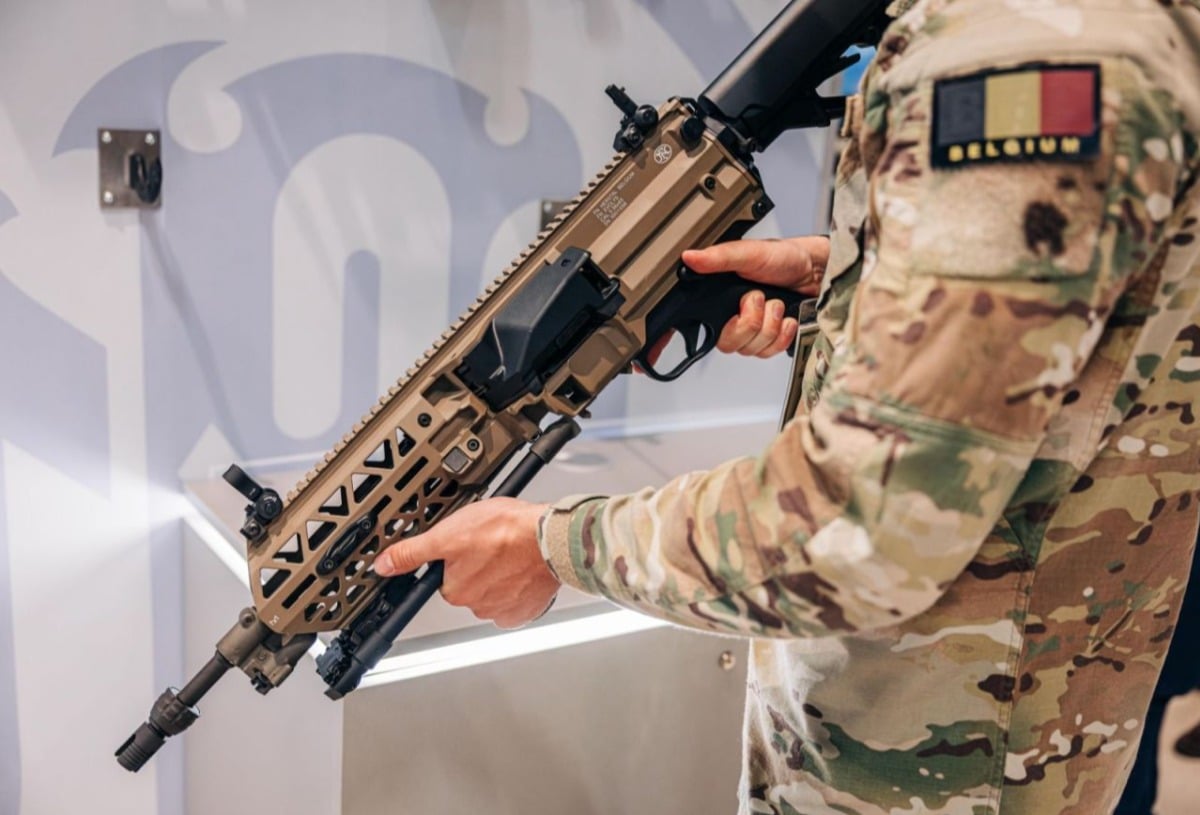
The French military just made a massive move that changes the equation for squad-level infantry firepower. At Eurosatory, France locked in an order for 5,000 units of the FN EVOLYS, the new ultralight machine gun built by Belgian arms manufacturer FN Herstal.
This isn't a minor equipment swap. It represents a fundamental shift in how infantry squads fight. For decades, the standard formula for a light machine gun meant a heavy, bulky system like the classic FN Minimi. France is completely rewriting that playbook.
By putting the EVOLYS into full production, Paris is signaling that traditional squad automatic weapons are too heavy for modern combat.
The Weight Problem of Modern Infantry
Infantry soldiers carry too much gear. Body armor, radios, batteries, and water already push physical limits. Hanging a nine-kilogram machine gun on top of that load tears down mobility fast.
That's the exact problem FN Herstal set out to fix with the EVOLYS.
The 5.56mm variant weighs roughly 5.5 kilograms. The heavier 7.62mm version comes in at just 6.2 kilograms. Compared to an older general-purpose machine gun or even a standard Minimi, you're looking at a weight reduction of up to 30 percent.
How did they shave off that much mass? Engineers heavily relied on advanced polymers and 3D printing for structural elements. They didn't just trim down existing metal components; they redesigned the entire architecture from scratch.
Two Calibers for One Modern Battlefield
France didn't just buy one flavor of this weapon. Their 5,000-unit order splits across two distinct configurations, though the bulk of the purchase leans heavily into the heavier caliber. Roughly two-thirds of the order consists of the 7.62x51mm NATO version.
This heavy skew toward 7.62mm tells us a lot about modern tactical realities. Recent combat zones show that 5.56mm rounds often lack the range and barrier penetration needed in open or heavily fortified environments. The French army wants squad-level weapons that can reach out to 1,000 meters effectively, which the 7.62mm model achieves easily.
The remaining third of the order fills out the 5.56x45mm NATO requirement, giving closer-range squads an incredibly nimble tool that tops out at a cyclic rate of 750 rounds per minute.
Bridging the Gap Between Rifle and Belt-Fed Firepower
The biggest design hurdle for classic machine guns involves ergonomics. If you've ever handled a Minimi or an M240, you know they feel like heavy metal iron bars. They balance poorly when firing from the shoulder.
The EVOLYS handles like an assault rifle. It uses a buttstock similar to the FN SCAR, meaning soldiers can instantly adjust length and height to clear body armor.
The feeding mechanism is where things get genuinely clever. Traditional belt-fed weapons require you to lift a massive top cover, which blocks your line of sight and ruins your optics setup. The EVOLYS uses a patented lateral feed mechanism. The feed cover opens down at a 45-degree angle on the side.
Because the top of the receiver stays completely solid, engineers ran a single, continuous monolithic Picatinny rail along the entire top of the weapon. You can mount high-end day optics, thermal sights, and night vision magnifiers inline without needing separate, unstable brackets.
Tactical Enhancements and Field Performance
Operating in urban terrain requires weapons to adapt instantly to suppressors. Older gas-operated machine guns tend to choke when you throw a silencer on them. The increased backpressure forces dirty gas straight into the receiver, causing rapid carbon buildup and annoying failures.
FN Herstal solved this by utilizing a short-stroke gas piston system designed from the ground up to handle suppressed fire. It mitigates excessive fouling and keeps the weapon running clean during intense, sustained engagements.
Furthermore, the weapon features a unique open-bolt operation utilizing an upside-down hammer mechanism inside the upper receiver. If the bolt accidentally slams forward due to dropped gear or rough handling, the weapon won't fire a round unless the trigger is actively pulled to release that hammer. It cuts out the risk of dangerous runaway gun scenarios.
The Franco-Belgian Defense Realignment
This purchase stretches beyond basic procurement logistics. It cements a deeper industrial defense relationship between Paris and Brussels.
Reports indicate that France and Belgium are actively discussing long-term co-production strategies for the EVOLYS platform. This move aligns with a broader push for European strategic autonomy and standardized equipment pools across neighboring allies. French Special Forces previously evaluated and quietly adopted early iterations of the weapon, paving the way for this massive conventional army contract.
Defense officials across Europe are watching this rollout closely. The British Army and the U.S. military have already secured early test batches of the EVOLYS for evaluation programs. If the French rollout proves successful under brutal field conditions, expect a massive domino effect across other NATO partners looking to shed weight without sacrificing firepower.
To track how this deployment changes small-unit tactics, defense analysts should monitor upcoming French army readiness exercises later this year to see exactly how fire teams distribute these lightweight systems compared to traditional heavy squad configurations.