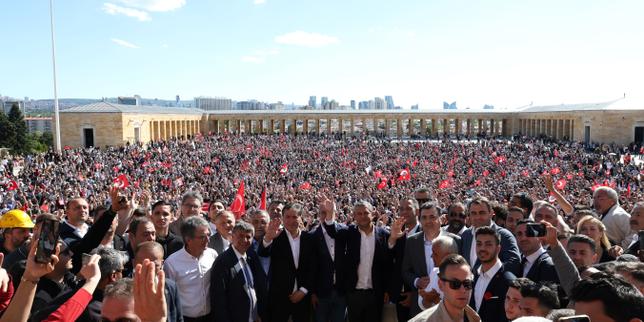
The Republican People’s Party (CHP), Turkey’s primary opposition force, stands at a structural breaking point. While mainstream political commentary attributes this vulnerability entirely to external autocratic pressure—specifically targeted judicial rulings—an objective systems analysis reveals a deeper, dual-causation model. The CHP is caught in a pincer maneuver between the ruling Justice and Development Party’s (AKP) weaponization of the judiciary and the opposition’s own irreconcilable internal factions. By examining the party’s current crisis through structural frameworks, we can isolate the specific mechanisms driving the CHP toward a functional rupture.
The current destabilization operates via three distinct systemic bottlenecks: judicial asymmetry, the mayoral power-duality trap, and ideological friction.
The Mechanism of Judicial Asymmetry
The primary external stressor on the CHP is not arbitrary suppression, but a highly calculated strategy of selective judicial targeting. This process operates as an asymmetric cost function designed to drain the opposition's political capital while introducing permanent strategic uncertainty.
[Judicial Input: Political Bans/Inquiries]
                  │
                  ▼
[Strategic Paralysis: Legal Defense vs. Campaigning]
                  │
                  ▼
[Factional Polarization: Moderates vs. Radicals]
                  │
                  ▼
[Systemic Fracture: Loss of Institutional Cohesion]
When a Turkish court issues a political ban or initiates a criminal investigation against a high-profile opposition figure—such as Istanbul Mayor Ekrem İmamoğlu or various district mayors—it triggers a predictable cascade of institutional friction.
- Resource Allocation Distortion: The party must shift its finite organizational energy, legal apparatus, and media focus away from nationwide economic critiques and toward localized defensive legal maneuvers.
- The Disqualification Horizon: By keeping legal threats hanging indefinitely without final appellate resolution, the state forces the CHP to operate under conditions of total strategic blindness. The party cannot commit to a long-term electoral or legislative strategy because its primary asset faces sudden, arbitrary removal from the political board.
- The Precedent Engine: Every successful judicial intervention against a municipal leader establishes a new operational baseline. It signals to lower-level party officials that institutional protection is non-existent, driving a wedge between the centralized party leadership and its regional base.
This judicial pressure does not hit a homogenous entity. Instead, it acts as a wedge driven directly into preexisting structural fault lines within the party itself.
The Mayoral Power Duality Trap
The CHP’s historic victories in the 2019 and 2024 municipal elections created an unintended institutional anomaly: the decentralization of executive authority away from the party chairmanship and toward the mega-municipalities of Istanbul and Ankara. This has created a dual-axis power structure that paralyzes decision-making.
                  ┌───────────────────────────────┐
                  │   Central Party Leadership    │
                  │     (Ozgur Ozel / HQ)         │
                  └──────────────┬────────────────┘
                                 │
                 ┌───────────────┴───────────────┐
                 ▼                               ▼
    ┌────────────────────────┐      ┌────────────────────────┐
    │     Istanbul Axis      │      │      Ankara Axis       │
    │   (Ekrem Imamoglu)     │      │     (Mansur Yavas)     │
    └────────────────────────┘      └────────────────────────┘
The party is effectively governed by three distinct power centers, each with its own competing incentives, voter bases, and survival strategies.
The Central HQ represents the traditional bureaucratic apparatus. Its primary objective is maintaining party discipline, controlling candidate selection lists, and preserving the institutional legacy of the CHP. However, it lacks the direct executive execution power and massive budgetary control wielded by the major metropolitan municipalities.
The Istanbul Axis represents a technocratic, broad-tent coalition model. It relies on a diverse electoral alliance spanning secularists, liberals, Kurds, and disillusioned conservatives. The strategic orientation here is offensive, seeking to build a majoritarian national coalition capable of capturing the presidency. Because this axis bears the brunt of judicial targeting, its survival strategy demands aggressive, immediate mass mobilization and a confrontational stance against the state apparatus.
The Ankara Axis represents a state-centric, nationalist-conservative alignment. Its electoral strength is rooted in a more homogenous, secular-nationalist demographic. The strategic orientation is defensive and institutionalist; it prioritizes administrative efficiency, state decorum, and minimizing points of friction with the central government to protect municipal functionality.
When judicial decisions target the Istanbul Axis, the structural flaw of this power-duality manifests immediately. Central HQ fears that total mobilization behind one mayoral figure will permanently surrender party control to that individual’s faction. Meanwhile, the Ankara Axis views aggressive extra-parliamentary mobilization as a strategic liability that risks alienating conservative-nationalist swing voters nationwide. The result is a paralyzed hybrid response that satisfies no faction and signals institutional weakness to the electorate.
Ideological Friction and Electorate Segmentation
The structural vulnerability of the CHP is further compounded by the math of the Turkish electoral system, which requires an absolute majority (50% + 1) to capture the executive presidency. To reach this threshold, the CHP must execute a balancing act across incompatible voter segments, creating a structural bottleneck.
The core tension lies in the simultaneous requirement to retain two mutually exclusive voting blocs:
- The Secular Nationalist Bloc: Deeply committed to the foundational unitarian principles of the state, highly sensitive to national security narratives, and fundamentally suspicious of any political alignment that accommodates Kurdish regional or cultural demands.
- The Kurdish Regionalist and Left-Liberal Bloc: Essential for securing majorities in metropolitan centers like Istanbul, demanding decentralization, judicial reform, and explicit recognition of cultural rights.
Every time a judicial decree removes an elected mayor in the southeast or targets an opposition figure under national security statutes, the CHP enters an ideological minefield. If the leadership vociferously denounces the state’s actions to satisfy the left-liberal and Kurdish segments, it triggers an immediate defensive reaction from its own internal nationalist faction, which views the stance as a compromise on state security. If the leadership remains silent or offers tepid, purely procedural critiques to appease nationalists, it alienates the metropolitan minority voters whose turnout is mathematically required to win.
The ruling coalition exploits this structural friction continuously. By introducing targeted judicial interventions and legislative maneuvers that force votes on highly polarizing national identity issues, the state ensures that the CHP remains locked in a state of internal ideological containment. The party spends its energy managing internal dissent rather than projecting an alternative governing vision.
The Operational Cost of Structural Deficits
The compounding effect of these dynamics is the total degradation of the CHP's operational efficiency. In a functioning political organization, external threats trigger a consolidation of resources. Within the CHP, external judicial shocks accelerate internal fragmentation due to three specific operational deficits.
The first deficit is the absence of a formalized dispute-resolution mechanism between the party's municipal executives and its legislative leadership. Decisions regarding public demonstrations, legislative boycotts, or alliance building are negotiated via ad-hoc backchannels rather than institutionalized frameworks. This creates a high-velocity rumor economy within the party, eroding internal trust and leading to contradictory public statements from senior officials during acute crises.
The second deficit is the asymmetry of information and resources between the municipal governments and the party headquarters. The municipalities possess sophisticated polling operations, communication bureaus, and direct patron-client networks through public service delivery. The party headquarters relies on a more rigid, traditional bureaucratic structure. This creates a capability gap where the mayors are better equipped to shape public narrative than the party leadership, leading to a de facto usurpation of the party's messaging by municipal staff.
This imbalance creates a structural bottleneck in messaging. During a judicial crisis, the public receives distinct, competing narratives: one centered on institutional legal defense from HQ, another on populist democratic resistance from the Istanbul axis, and a third on calm administrative continuity from the Ankara axis. Instead of projecting strength, this tripartite messaging signals an organization unable to agree on the nature of the threat it faces.
Strategic Realignment Scenarios
The CHP cannot resolve its current crisis by attempting to maintain its historical equilibrium. The structural pressures exerted by the current judicial and political environment will force a realignment along one of three paths.
┌───────────────────────────────────────────────────────────────────────────┐
│                        CHP STRATEGIC ALTERNATIVES                         │
└─────────────────────────────────────┬─────────────────────────────────────┘
                                      │
          ┌───────────────────────────┼───────────────────────────┐
          ▼                           ▼                           ▼
┌───────────────────┐       ┌───────────────────┐       ┌───────────────────┐
│  Formal Bipolar   │       │ Central Bureau-   │       │ Technocratic Pop- │
│     Splinter      │       │ cratic Contraction│       │ ulist Hegemony    │
├───────────────────┤       ├───────────────────┤       ├───────────────────┤
│ Ankara & Istanbul │       │ HQ purges municipal │     │ Municipal factions│
│ factions legally  │       │ factions; party   │       │ subordinate HQ;   │
│ separate into two │       │ reverts to rigid  │       │ party behaves as  │
│ distinct parties. │       │ ideological core. │       │ electoral machine.│
└───────────────────┘       └───────────────────┘       └───────────────────┘
The first scenario is a formal bipolar splinter. If judicial pressure permanently disqualifies the leadership of the Istanbul axis, the remaining elements will face a binary choice: submit to a centralized, nationalist-oriented leadership or break away to form a new, centrist social-democratic movement. This would mirror previous historical splits in the Turkish center-left but would occur under much higher stakes, effectively rendering both successor fragments incapable of achieving a national majority independently.
The second scenario is central bureaucratic contraction. In this mode, the party headquarters asserts absolute control over candidate selection for future cycles, deliberately purging elements aligned with autonomous municipal power centers. While this restores internal ideological discipline and eliminates messaging contradictions, it mathematically caps the party's electoral ceiling, reverting the CHP to its historical position as a permanent minority party of the secular middle class.
The third scenario is the subordination of the party apparatus to a technocratic-populist electoral machine. In this outcome, the central party bureaucracy yields to the reality of municipal resource dominance. The party structure is hollowed out, serving merely as a legal vehicle for a personalized presidential campaign driven by municipal networks. While this maximizes short-term competitiveness against the ruling coalition, it leaves the organization highly vulnerable to systemic collapse if its central figurehead is removed via judicial fiat.
The variable that will determine which scenario unfolds is the sequence and timing of pending appellate court rulings. If the judiciary delivers a definitive blow to the Istanbul axis before the party can institutionalize its internal decision-making, a chaotic splinter becomes highly probable. If the party can rapidly construct a binding, intra-factional charter that defines a clear line of succession and unified messaging parameters, it can convert external judicial pressure into a mechanism for defensive consolidation. The structural survival of Turkey's primary opposition depends entirely on transitioning from ad-hoc factional management to rigorous institutional discipline.