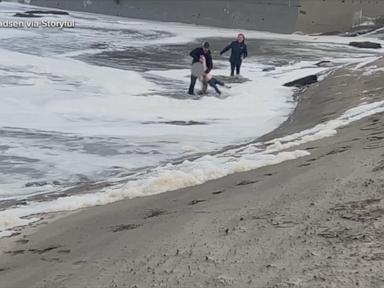
Coastal rescue incidents involving sneaker waves follow a predictable sequence of hydrodynamic energy transfer, human perception failure, and rapid thermal incapacitation. When a low-frequency ocean swell converges with steep bathymetry along the Pacific coastline, wave run-up can exceed the mean high-water line by tens of meters without prior visual warning. Understanding these events requires stripping away sensational media framing and analyzing the physical mechanisms of coastal wave superposition, the cognitive biases that anchor beachgoers to the surf zone, and the physiological clock that governs cold-water survival.
The Physics of Wave Superposition and Coastal Run-Up
Standard surf forecasting relies on significant wave height, defined as the average height of the highest one-third of waves in a given sampling period. This metric masks extreme outliers. Sneaker waves—technically classified as coastal infragravity surges or constructive wave-train interference—do not originate from local wind chop. They are generated by distant pelagic storms that propagate long-period swells across ocean basins.
Wave energy scales proportionally to the square of the wave height and linearly with the wave period. A swell with an 18-to-22-second period carries substantially more kinetic energy beneath the surface than a short-period 8-second wind wave of identical visible height. Because wave phase velocity in deep water is a direct function of wavelength, longer-period waves travel faster and organize into coherent sets.
When multiple wave trains arrive at the continental shelf simultaneously, constructive interference occurs. The troughs and crests align, momentarily amplifying water column displacement. As this combined energy enters shallow water, shoaling forces the wave height upward while the wavelength compresses.
Bathymetric Focusing and Swash Dynamics
The severity of a sneaker wave depends heavily on nearshore seabed topography, known as bathymetry. Steeply sloping beaches—common along the Northern California, Oregon, and Washington coasts—prevent waves from breaking gradually offshore. Instead of dissipating energy across a wide surf zone, the wave surges directly onto the beach face as a high-velocity sheet of water, termed swash.
Submarine canyons and offshore sandbars act as acoustic lenses for wave energy. Refraction bends wave crests toward shallower water, concentrating kinetic energy onto specific segments of shoreline while leaving adjacent stretches calm. This spatial variance creates a false baseline of safety. An observer watching the surf for five minutes may see uniform, low-amplitude waves breaking fifty meters offshore, unaware that a long-period set is currently shoaling over an outer bar.
Once the surge breaches the beach berm, the water mass carries immense momentum. Because seawater has a density of approximately 1,025 kilograms per cubic meter, a surge just thirty centimeters deep moving at three meters per second exerts substantial lateral drag force against human ankles and lower legs. This force easily exceeds the static friction threshold of wet sand, resulting in immediate loss of footing.
The Hydrodynamics of Backwash and Entrainment
Surviving the initial onshore surge is only the first phase of the hazard. The primary mechanism of coastal drowning during sneaker wave events is the subsequent backwash.
Gravity pulls the displaced water mass down the beach slope. Unlike the incoming surge, which spreads upward and loses velocity against gravity and bed friction, the backwash accelerates down-gradient. Water drains into natural depressions, forming localized, high-velocity return channels.
- Bed Scouring: As water retreats over saturated sand, fluid shear stress lifts sediment into suspension. A person knocked down by the initial surge experiences rapid scouring beneath their body, eliminating any physical purchase on the seafloor.
- Buoyancy Loss: Aerated whitewater—a mixture of seawater and entrained air bubbles—has a lower bulk density than solid water. A swimmer caught in the turbulent backwash loses natural positive buoyancy, making it physically difficult to keep the airway above the surface even while actively treading water.
- Lateral Transport: The backwash rarely flows perpendicular to the shoreline. Longshore currents, driven by angled wave approach, deflect the retreating water laterally, sweeping victims away from their point of entry and into deeper rip channels.
For a small child, the mass-to-drag ratio is severely unfavorable. Lower body mass means minimal inertial resistance against the initial impact, while smaller stature places the center of gravity low enough that even a moderate surge submerges the airway immediately.
Cognitive Biases in Shoreline Risk Assessment
Human perception is poorly calibrated for non-linear environmental hazards. Coastal visitors rely on visual heuristics that fail entirely when confronted with long-period wave intervals.
The primary cognitive failure is recency bias coupled with an insufficient observation window. Most beachgoers assess water safety within thirty to sixty seconds of arriving at the shoreline. If no large waves break during that brief interval, the brain classifies the environment as static and benign. However, long-period wave sets frequently arrive in intervals of twelve to twenty minutes. A thirty-second visual check misses the macro-pattern entirely.
A second failure mode is the dry-sand illusion. Visitors assume that standing on dry, uncompacted sand places them beyond the reach of the ocean. Geomorphologically, dry sand above the active swash zone simply marks the maximum run-up of the recent tidal cycle—not the absolute boundary of extreme wave events. Logs, kelp lines, and damp sand striations higher up the beach profile provide objective physical evidence of recent surge limits, yet untrained observers rarely read these environmental indicators.
Finally, attention tunneling degrades parental and bystander vigilance. Engaging with mobile devices, framing photographs, or focusing on coastal wildlife narrows visual peripheral awareness. Because sneaker waves often advance silently—lacking the loud, crashing acoustic signature of plunging breakers—an approaching surge generates almost no auditory warning until it is already within the immediate perimeter.
The Physiological Timeline of Cold-Water Immersion
Along the temperate and subarctic Pacific coast, nearshore sea surface temperatures typically range between 8°C and 14°C year-round. When a sneaker wave pulls a victim into open water, the body enters a strict physiological countdown dictated by thermal conductivity. Water conducts heat away from the human body roughly twenty-five times faster than air at the same temperature.
- Cold Shock Response (0 to 3 Minutes): Sudden immersion triggers an involuntary gasp reflex driven by cutaneous cold receptors. If the victim's head is submerged during this gasp, immediate water aspiration occurs. Hyperventilation follows, accompanied by peripheral vasoconstriction and a spike in heart rate and blood pressure. Breath-holding capacity drops to less than ten seconds, making it nearly impossible to swim through breaking waves.
- Cold Incapacitation (3 to 30 Minutes): As peripheral tissues cool, neuromuscular transmission slows. Fine motor control in the hands and fingers deteriorates first, preventing a victim from grasping a thrown rope, life ring, or rescuer's hand. Gross motor function in the arms and legs degrades shortly after. Swim failure sets in long before core body temperature drops to clinical hypothermia levels.
- Hypothermia (30+ Minutes): True core cooling—defined as a core temperature dropping below 35°C—requires prolonged immersion. In dynamic surf conditions, victims rarely survive long enough to die of hypothermia; they succumb to drowning secondary to cold incapacitation within the first fifteen minutes.
Children experience accelerated heat loss compared to adults due to a higher surface-area-to-mass ratio and thinner subcutaneous fat layers. Every second of immersion compounds motor degradation, compressing the viable window for an unassisted or bystander rescue.
Operational Mechanics of Bystander and Professional Rescue
When a victim is swept into the surf zone, the rescue operation shifts immediately into high-risk water recovery. Bystander interventions account for a high percentage of successful child rescues in sneaker wave incidents, yet they carry extreme secondary fatality risks.
An untrained rescuer entering the surf without flotation faces the exact same hydrodynamic and thermal forces that overwhelmed the victim. Panic-induced muscular tension increases oxygen consumption, accelerating fatigue. If the rescuer reaches the victim without a buoyant aid, the victim's instinctive drowning response—pressing downward on the rescuer's shoulders to elevate their own airway—frequently submerges both individuals.
Successful rapid rescues rely on specific operational protocols:
- Continuous Visual Tracking: The turbulent surf zone creates severe visual clutter. Once a rescuer enters the water, their eye level drops to the water surface, eliminating depth perception and line-of-sight over incoming swells. A dedicated spotter must remain on high ground, pointing continuously at the victim's last known position without breaking visual contact.
- Flotation Interposition: Introducing any buoyant object—a surfboard, cooler, driftwood log, or rescue tube—between the rescuer and the victim neutralizes the downward climbing reflex and offsets the loss of buoyancy in aerated water.
- Diagonal Egress: Fighting directly against a retreating backwash or rip current exhausts human glycogen stores within minutes. Rescuers must angle their trajectory parallel to the shoreline to exit the narrow return channel before attempting to ride incoming whitewater back toward the beach.
Systemic Mitigation and Coastal Risk Architecture
Relying on individual vigilance to prevent sneaker wave incidents is a failed strategy. Human behavioral patterns at the coast remain static across generations: visitors will continue to turn their backs to the ocean, underestimate wave intervals, and allow children near the water's edge. Effective risk reduction requires structural changes to coastal infrastructure, forecasting communication, and municipal response systems.
- Dynamic Telemetry Integration: Coastal municipalities must move beyond static warning signs, which suffer from rapid visual habituation. Automated beach access points should integrate real-time National Data Buoy Center (NDBC) spectral wave data. When offshore buoys detect long-period swell arrivals exceeding 16 seconds combined with rising tide windows, automated flashing beacons at trailheads should trigger automatically, signaling elevated run-up probability.
- Public Access Flotation Staging: High-incident beaches require weather-hardened, unlocked rescue tube stations positioned at primary access trails, modeled after automated external defibrillator (AED) deployments. Providing immediate access to high-buoyancy foam rescue tubes transforms an untrained bystander from a potential secondary drowning victim into a viable surface-rescue asset.
- Geomorphological Zoning: Parks departments and coastal engineers should map historical maximum swash limits using LiDAR elevation models and mark high-risk pocket beaches with physical visual boundaries—such as painted rock markers or recessed boardwalks—that establish an objective, non-negotiable safety perimeter during winter swell seasons.
Coastal agencies that continue to treat sneaker wave rescues as isolated acts of luck or individual negligence miss the underlying physics. These events are deterministic outcomes of swell period, bathymetry, and predictable human cognitive blind spots. Re-engineering beach access around real-time spectral wave thresholds and staged flotation hardware is the only viable path to reducing nearshore fatalities.