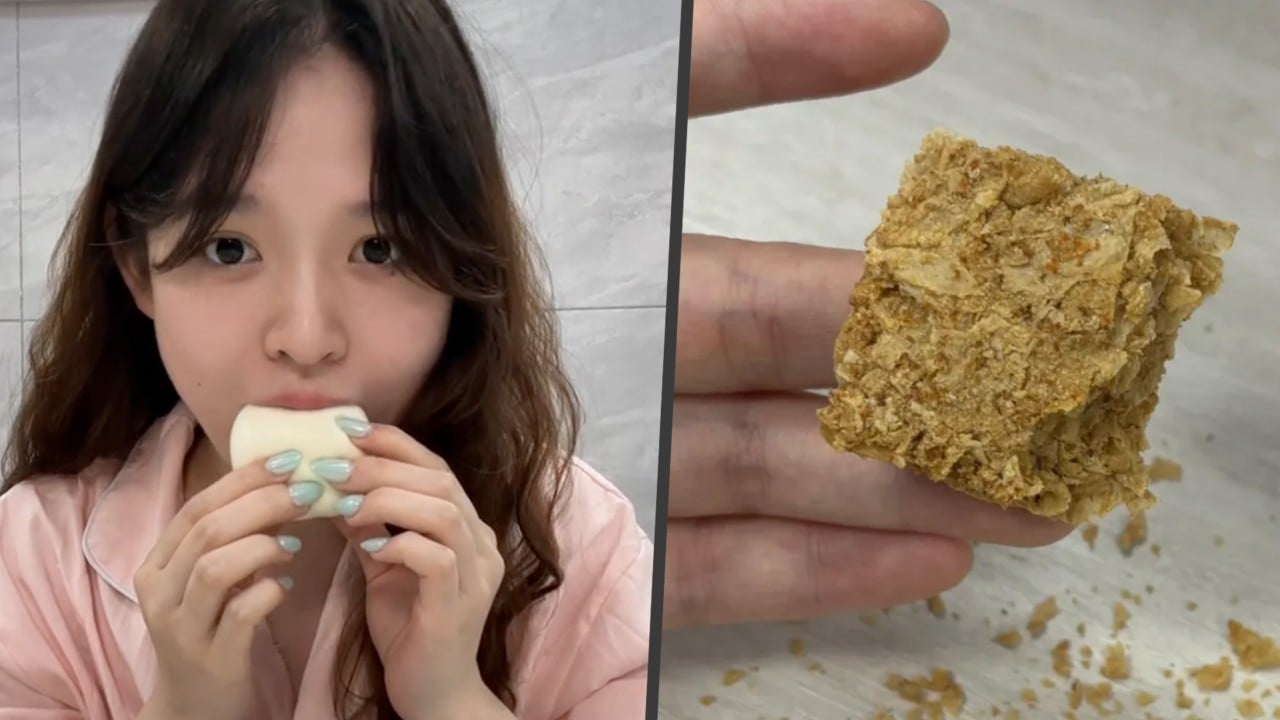
The desk lamp buzzes with a low, parasitic frequency. Outside the high-rise window, Beijing is a smear of gray smog and neon halos, a city that never quite stops humming even past midnight. Inside, glowing in the blue light of a laptop screen, sits twenty-four-year-old Xiao Mei.
She is chewing. Meanwhile, you can explore related events here: Why Declaring Victory on Ebola is the Deadliest Public Health Illusion.
She has been chewing the exact same piece of bland, rubbery konjac strip for twenty minutes. It tastes of almost nothing—perhaps a faint, ghostly whisper of artificial sesame and salt, engineered in a laboratory to mimic satisfaction without ever delivering a calorie. Her jaw aches. Her masseter muscles are tight from hours of mechanical grinding. But she does not swallow. She keeps rhythm with the blinking cursor on her spreadsheet, locking her teeth down on a synthetic cud because in this moment, chewing is a quiet act of rebellion against a world that demands perfection and an economy that leaves young people with very little they can actually control.
We have entered a peculiar chapter of modern hunger. In the bustling corporate hives of Shanghai, Shenzhen, and Beijing, a generation raised on milk tea and midnight delivery apps has made a sharp, jarring pivot. They are abandoning the sweet, the spicy, and the rich. They are trading flavor for friction. To explore the complete picture, we recommend the detailed article by Medical News Today.
To understand why thousands of Chinese youth are willingly trading savory indulgence for tasteless, jaw-exhausting snacks, we have to look past the superficial headlines. This is not merely a quirky diet fad. It is a psychological symptom of a society caught in a severe economic slowdown, staggering job competition, and an oppressive beauty standard that leaves zero margin for error.
Consider the baseline facts stripped of all poetry. In recent months, sales of zero-calorie, high-fiber, aggressively chewy products have surged across e-commerce platforms like Taobao and JD.com. We are talking about dehydrated konjac blocks, dried vegetable stems that require the mechanical persistence of a woodchipper to break down, and tasteless gluten knots molded into dense, rubbery strips. They cost pennies. They offer zero nutritional fulfillment beyond filling the physical void in an empty stomach. They are designed to do one thing: keep the mouth busy and the brain distracted.
When a young graduate faces the terrifying reality of the "involution"—the fierce, soul-crushing competition known locally as neijuan, where millions fight for a handful of stable white-collar jobs—the desire for control metastasizes into physical discipline. If you cannot control the housing market, and you cannot control your starting salary, you can at least control what crosses your lips. Or better yet, you can trick your biology into thinking it is eating a feast while consuming practically nothing at all.
I remember watching my own grandmother pack dumplings into our kitchen, her hands moving with flour-dusted grace, teaching me that food was love, security, and the ultimate measure of survival. To her generation, who had lived through the razor-thin margins of historical scarcity, a full plate was a moral triumph.
How strange it is, then, to witness the exact inverse among her grandchildren. For modern youth, an empty plate—or worse, a plate of flavorless, punishingly tough diet snacks—has become the new badge of honor. It is a silent declaration: Look how little I need. Look how much pressure I can absorb.
The science behind this phenomenon is as fascinating as it is melancholy. Behavioral psychologists have long known about the concept of oral fixation and sensory-specific satiety. When you eat something intensely flavored, your brain’s dopamine receptors fire rapidly, but they also fatigue quickly. After a few bites, the pleasure diminishes, triggering the urge to keep eating more.
Tasteless, ultra-chewy foods short-circuit this loop entirely. Because there is no rich flavor profile to trigger a dopamine spike, the brain remains neutral. You do not want more; you simply endure what is in front of you. The sheer physical labor of chewing sends signals to the vagus nerve and the hypothalamus, tricking the brain into registering the act of consumption without the metabolic consequences. It is a masterclass in biological self-deception.
Yet, this biological hack carries a heavy emotional tax.
Imagine walking through a convenience store in downtown Chengdu. The shelves are neatly partitioned. On the left, vibrant, glossy packages scream with neon colors—images of molten cheese, dripping chili oil, and caramelized sugar meant to seduce the senses. On the right, sitting in clinical, matte-gray wrappers, are the ascetic products. No pictures of smiling models. Just stark, utilitarian fonts listing dietary fiber content and zero sugar counts.
The youth gravitate toward the gray side.
Why? Because the left side feels like a trap. Every sweet or oily snack is wrapped in cultural anxiety. Social media algorithms constantly broadcast impossibly slender idols, reminding young women and men that their professional worth is tied to their physical silhouette. In a culture where body-shaming is casual and ubiquitous—where job applications in certain sectors still request height, weight, and photographs—every calorie consumed is evaluated as a potential career hazard.
So, the snacks become armor. If you chew on a strip of flavorless konjac long enough, the hunger pangs vanish. The anxiety temporarily recedes beneath the rhythmic ache of your jaw. You have successfully cheated your body out of its natural needs for another three hours, buying yourself a temporary shield against the mirror.
But the human spirit is remarkably resilient, and even within this ascetic trend, human creativity finds a way to poke holes in the gloom. On Xiaohongshu—China’s answer to Instagram—users don't just review these snacks; they critique them with theatrical severity. They rank them on a scale of "cardboard density" to "jaw-locking durability." They treat the consumption of these joyless items as an extreme sport. There is a dark, self-aware humor to it all. They know it is absurd. They know that gnawing on a piece of reconstituted plant fiber while staring at a glowing Excel sheet at two in the morning is not how human beings were meant to live.
And yet, they laugh about it in the comment sections. They share memes of themselves wearing jaw-exercising devices afterward to fix the asymmetry caused by chewing too hard on one side. They turn their collective exhaustion into a shared, digital camaraderie.
This is where the true narrative lies. It is not a story about bizarre dietary trends or eccentric youth culture. It is a mirror reflecting a generation caught at the intersection of hyper-modernity and ancient pressures.
Consider what happens next when the economic winds shift, or when the weight of these invisible expectations finally cracks the armor. The human body can only process so much denial before it demands its due. Eventually, the jaw stops aching, the spreadsheet closes, and the silence of the empty room rushes back in.
Xiao Mei finally sets the half-chewed strip down on its wrapper. She closes her laptop. The room is dead quiet except for the hum of the refrigerator in the corner. She looks at her reflection in the dark windowpane—thin, disciplined, exhausted, and entirely alone with her ambitions.
She reaches out, turns off the desk lamp, and lets the dark take over the room.