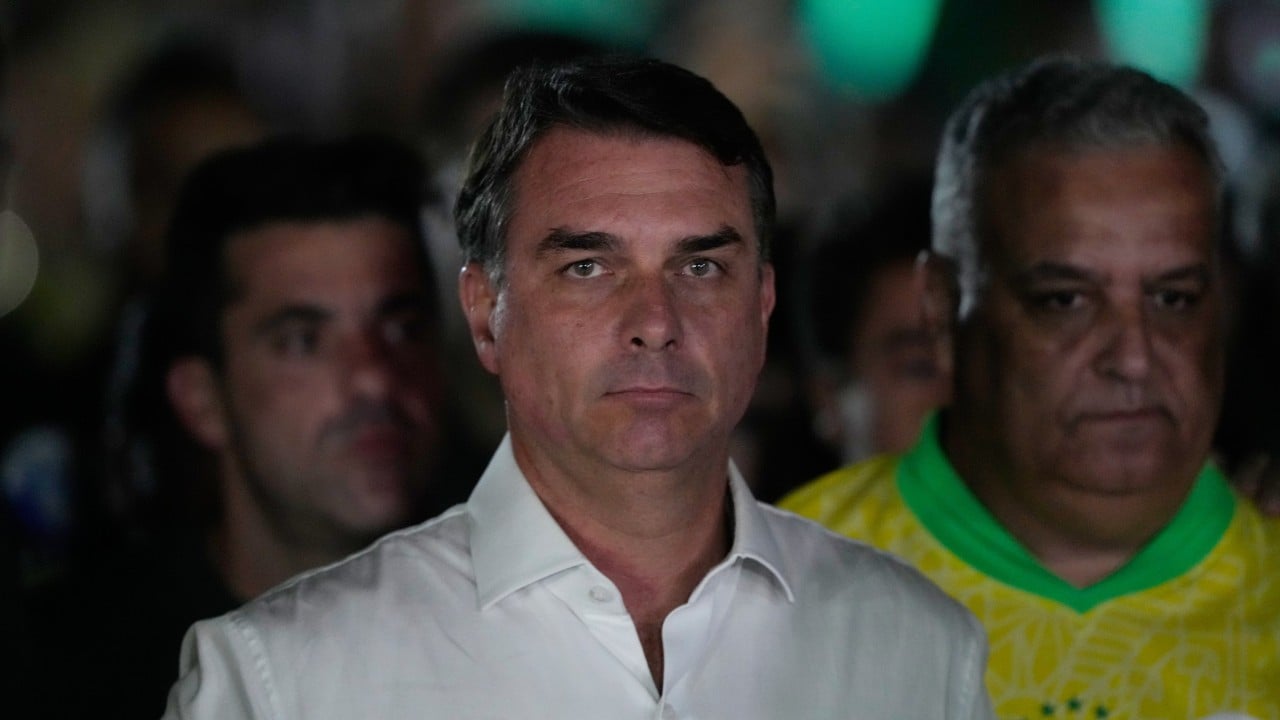
Mainstream political commentary treats Flavio Bolsonaro’s declaration that he will lead the opposition against President Luiz Inácio Lula da Silva as a serious consolidation of right-wing power in Brazil. According to standard press reports, Senator Flavio Bolsonaro has positioned himself as the primary voice challenging the Lula administration's legislative and economic agenda.
That framing misses the structural reality of Brazilian politics. Meanwhile, you can explore other developments here: Replacing Parcoursup Won't Stop a Single Riot.
The lazy consensus assumes that because Flavio carries the Bolsonaro surname and sits in the Federal Senate, he naturally inherits the mass mobilization capacity of his father, former President Jair Bolsonaro. In practice, placing Flavio at the helm of the opposition does not strengthen the Brazilian right. It traps the movement inside a defensive, transactional dynamic that benefits Lula’s coalition in Brasília.
To understand why, you have to look past campaign slogans and examine how power actually moves through the Centrão—the shifting bloc of pragmatic, non-ideological parties that controls the legislative floor in Brazil. To explore the complete picture, check out the detailed article by NPR.
The Dynastic Illusion
Political analysts frequently confuse name recognition with political capital. Jair Bolsonaro built a movement on anti-establishment disruption, bypassing traditional party structures to speak directly to millions of voters. Flavio Bolsonaro operates in the exact opposite manner.
Throughout his tenure in the Rio de Janeiro Legislative Assembly and later in the Federal Senate, Flavio’s political style has been defined by institutional accommodation and backroom negotiation. According to legislative records and political observers in Brasília, he has consistently favored pragmatic deals with established power brokers over ideological confrontation.
When an opposition leader relies on institutional bargaining rather than street-level mobilization, the opposition loses its primary leverage. Lula’s Workers' Party (PT) and its allies are masters of institutional bargaining. By shifting the battleground from mass ideological mobilization to committee-room negotiations, Flavio steps onto terrain where the current administration holds all the structural advantages, including ministerial appointments and discretionary budget amendments.
The Vulnerability Factor
A credible opposition leader needs moral and political insulation to attack an incumbent government effectively. Flavio Bolsonaro enters this role carrying heavy legal and political baggage that limits his offensive reach.
For years, Flavio has faced scrutiny and investigations regarding the alleged rachadinha scheme—a practice involving the diversion of staff salaries during his time as a state lawmaker in Rio de Janeiro. While Brazilian courts annulled key evidence in the case on procedural grounds, the political damage remains documented in public polling and media coverage.
In Brazilian politics, an opposition figure with unresolved ethical controversies cannot sustainably prosecute a corruption or governance narrative against the executive branch. Every time Flavio attacks the Lula administration on fiscal responsibility or ethical standards, government surrogates simply pivot back to Rio de Janeiro. The attack neutralizes itself before it ever reaches undecided voters.
What the Press Gets Wrong About the Brazilian Right
Coverage of Flavio’s leadership bid routinely asks whether he can unite the conservative movement. That is the wrong question entirely. The Brazilian right is no longer a monolithic bloc waiting for a single member of the Bolsonaro family to issue marching orders.
Following Jair Bolsonaro’s ineligibility ruling by the Superior Electoral Court (TSE), power on the right decentralized rapidly. Regional executives—most notably São Paulo Governor Tarcísio de Freitas, Minas Gerais Governor Romeu Zema, and Paraná Governor Ratinho Júnior—have built independent bases of administrative credibility.
Consider the contrast between these two models of opposition:
- The Dynastic Model: Centers on defending the Bolsonaro family’s legacy, managing legal defenses, and maintaining loyalty among core base voters. It prioritizes family survival over coalition expansion.
- The Administrative Model: Focuses on fiscal discipline, infrastructure privatization, and public security results at the state level. It appeals to the center-right business class and moderate voters who rejected Lula in 2022 without necessarily embracing hardline populism.
By asserting himself as the leader of the opposition, Flavio is not uniting these factions. He is attempting to re-centralize authority around the family brand at the exact moment the broader conservative movement is trying to graduate beyond it.
How This Plays Out in Congress
Imagine a scenario where a major fiscal reform or tax bill hits the Senate floor. Under a disciplined, policy-focused opposition, conservative senators would force the government into costly concessions by threatening unified blockades and rallying business associations.
Under Flavio’s leadership, the incentives shift. His primary political objective is protecting his family's institutional standing and preserving alliances with key judicial and legislative figures. Reports from Brasília have repeatedly noted instances where Flavio broke with hardline Bolsonarista rhetoric to avoid antagonizing Supreme Federal Court (STF) justices or Senate leadership, such as Senate President Rodrigo Pacheco.
This creates a split-screen effect that paralyzes the opposition:
- Base Confusion: Hardline voters see an opposition leader shaking hands with the very institutions they view as adversaries.
- Centrão Opportunism: Centrist lawmakers realize the opposition is divided between ideological purists and family loyalists, allowing them to extract higher prices from Lula without ever genuinely threatening his legislative survival.
- Executive Relief: The Lula government gets a predictable, manageable adversary rather than a unified, disciplined counter-coalition.
The Real Stakes for the Opposition
There is a counterargument to this assessment, and it deserves fair hearing. Supporters of Flavio’s leadership contend that without the Bolsonaro name at the center of the opposition, the right risks fracturing into competing regional fiefdoms, none of which possess the national polling floor that Jair Bolsonaro still commands. From this perspective, Flavio acts as an essential bridge—keeping the populist base tethered to institutional politics while his father remains barred from running.
That argument holds weight only if the goal is maintaining a permanent minority faction. Maintaining a 30 percent electoral floor is enough to win Senate seats and secure committee chairs, which serves the immediate interests of the Bolsonaro family. It is not enough to build a governing majority capable of winning a national presidential election or dismantling the administrative state built by the PT.
The Structural Reality
Political movements die when they confuse their origin story with their future. Jair Bolsonaro was a specific disruption tailored to a specific crisis in Brazilian democracy between 2016 and 2018. Treating his eldest son as the natural heir to lead the opposition assumes that Brazilian politics has stood still for eight years.
It has not. The electorate has moved on to concrete questions of economic growth, interest rates, and urban security. Meanwhile, the Lula administration faces genuine vulnerabilities regarding public spending and international alignment that a sharp, unencumbered opposition could exploit ruthlessly.
Instead, the opposition is tying its flagship strategy to a senator whose primary political instinct is self-preservation and whose surname guarantees maximum polarization with minimum center-ground appeal. Lula’s strategists could not have designed a more convenient rival.


