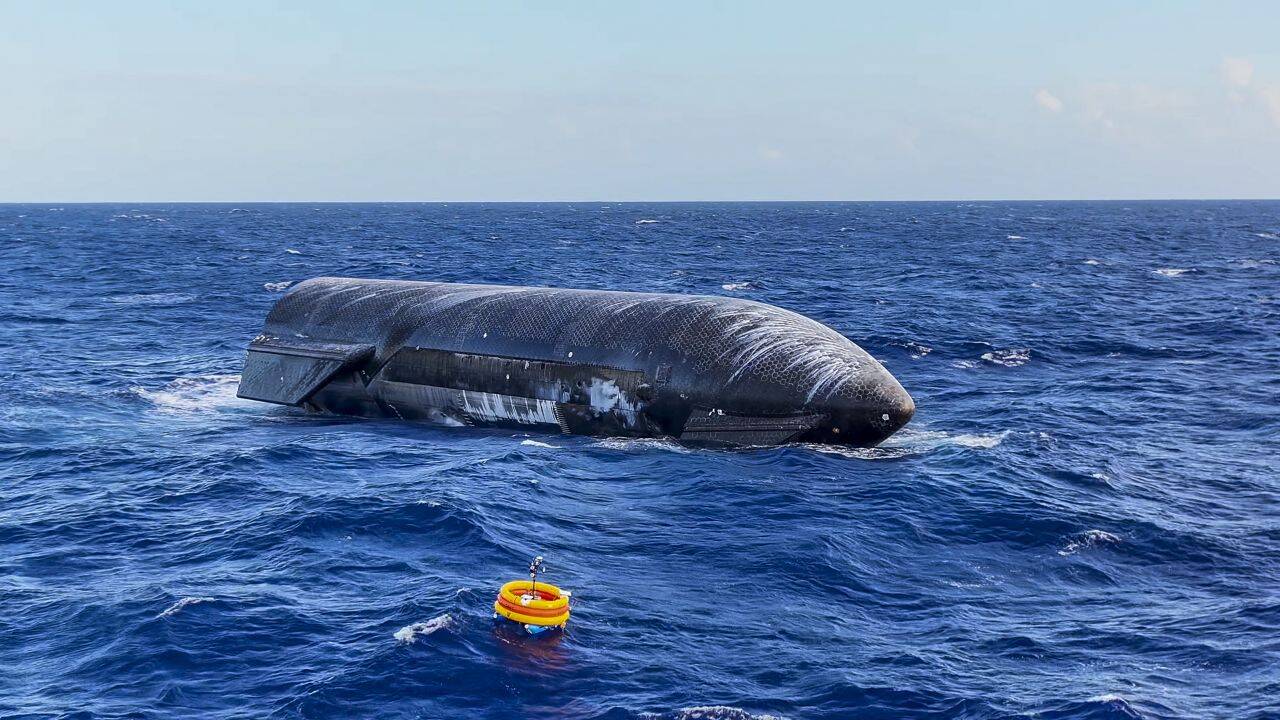
The aerospace press is popping champagne over a glorified shipwreck.
When Flight 13 touched down softly in the Indian Ocean and managed to stay buoyant for one hundred and twenty hours, the headlines practically wrote themselves. SpaceX fans cheered. Analysts nodded sagely. The lazy consensus solidified immediately: surviving a water landing for five days proves the vehicle is essentially ready for orbital operations, proving that the hardware can endure the brutal thermal shock of re-entry and still find its way home.
It is a comforting illusion. And it is completely wrong.
I have spent two decades watching rocket programs bleed capital, and I have learned one unchanging rule. Engineers love surviving failures because survival feels like progress. It is not. Remaining afloat in a remote stretch of salt water after a controlled descent does not mean you have built a reusable spacecraft. It means you built a very expensive buoy.
Let us look past the viral splashdown footage and stare at the cold, mechanical reality of what structural survival actually requires.
The Myth of the Buoyancy Metric
The core misconception plaguing modern aerospace commentary is the worship of structural integrity post-splashdown. A ship that stays afloat for five days is an impressive feat of sheet metal assembly and compartmentalized sealing, sure. But space transportation is not a maritime salvage contest.
The entire premise of the Starship architecture relies on rapid reusability. That word gets thrown around so often it has lost its teeth, so let us define it strictly. Rapid reusability means landing a vehicle, inspecting it with minimal tooling, slapping it back on a pad, and pushing it through another orbital insertion within days, if not hours.
If your vehicle requires five days to be hauled out of the ocean—assuming anyone even bothers to retrieve it from a desolate oceanic trench—your turnaround loop is already broken.
Imagine a scenario where a commercial airline lands a Boeing 777, but instead of pulling up to a jet bridge, it gently drops into the Pacific, bobs around for a week while a flotilla of tugboats hunts for it, and then gets towed back to a dry dock for a six-month overhaul. You would call that airline bankrupt within a quarter. Yet when SpaceX leaves a skyscraper-sized stainless steel cylinder bobbing in international waters, we call it a triumph.
The water is the enemy. Salt water is a corrosive nightmare. It sneaks into micro-fissures in thermal protection tiles, it cakes avionics bays in conductive residue, and it wrecks seals that took months to machine. Celebrating five days of flotation is like celebrating a car that survives a high-speed crash by resting peacefully in a lake. Sure, the doors still open, but the engine block is filled with trout.
What the Press Misses About Thermal Shock
To understand why this milestone is being misread, you have to look at the telemetry that does not make it into the highlight reels.
During re-entry, Starship sheds kinetic energy by creating a massive plasma shockwave. The vehicle’s belly takes the brunt of temperatures exceeding one thousand four hundred degrees Celsius. The stainless steel structure relies on active cooling and thousands of fragile ceramic tiles to keep the primary hull from turning into molten slag.
When that hot metal hits the ocean surface, the thermal shock is catastrophic. Even if the outer shell holds together, the internal micro-stresses ripple through the weld joints. A vehicle that floats for five days has proven it can keep water out of its propellant tanks long enough to avoid sinking immediately. It has not proven that its load-bearing bulkheads can handle the cyclic fatigue of doing it ten more times next week.
I have watched companies blow millions chasing structural survivability metrics while ignoring fatigue thresholds. They build a tank that can take a beating once, and they mistake that resilience for longevity. Steel is forgiving, but it is not magic. Every time Starship goes through a brutal atmospheric deceleration and a violent aquatic impact, its crystal lattice undergoes stress it never fully forgets.
The Regulatory and Logistical Blind Spot
Let us talk about the elephant in the room that no fanboy wants to address. The Indian Ocean.
Why did Flight 13 end up there instead of landing back at the orbital launch mount in Texas? Because dropping a multi-story, hundred-ton steel vehicle out of the sky near populated landmasses is a regulatory nightmare waiting to turn into a tragedy.
The public assumes ocean landings are a design choice. They are a constraint. They are a safety buffer built because we do not yet trust the guidance systems enough to bring these massive hulls back to a precision concrete pad without risking a catastrophic cratering event inland.
Catching a booster with mechanical arms on land is a bold engineering stroke. Catching an orbital ship the same way is the ultimate bottleneck. Until Starship can return directly to the launch site, stand itself back up, and prep for fueling without a naval retrieval operation, it is not a transport system. It is an expensive science experiment running out of runway.
Stop Asking About Survival
People love to ask: "Did it survive?"
It is the wrong question entirely. It invites a binary, comforting answer: yes or no. Yes, it survived. Yes, it stayed afloat. Yes, telemetry was gathered.
The question you should be asking is: "How much of that hardware can we fly again tomorrow without replacing half the internal architecture?"
The answer, if we are being brutally honest with ourselves, is very little. Every ocean landing is a teardown. Every day spent bobbing in the brine is a day of aggressive corrosion eating away at the margins of economic viability.
SpaceX is playing a long, brilliant game of iterative design, and their velocity is unmatched in human history. But worshiping a floating wreck blinds us to the monumental engineering chasms still left to cross. Reusability is not about keeping the hull dry for a week. It is about rendering the ocean irrelevant.
Until Starship lands on a dry pad under its own power, folds away its landing legs, and prepares for a second flight before the local coffee shop closes for the evening, the five-day float is just a very nice photo op for people who don't understand the balance sheet.