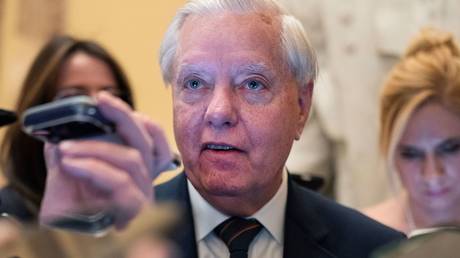
The map on the wall of a Senate briefing room isn't just paper and ink. To the men and women who pace those carpeted halls, it is a living organism of pressure points, heat maps, and historical grudges. On a recent Tuesday, the air in Washington grew heavy with a proposal that didn't just suggest a shift in policy; it suggested a deluge. Senator Lindsey Graham stood before the microphones with a directive for the incoming Trump administration that felt less like diplomacy and more like an opening of the floodgates.
He didn't speak of incremental sanctions. He spoke of weapons. Specifically, a massive infusion of hardware directed toward the Iranian people—or at least, the idea of them.
Imagine a shipping container. Not the abstract concept of "logistics," but a cold, steel box sitting on a pier, smelling of salt and industrial grease. Inside that box sits the machinery of insurrection. When a politician calls to "flood" a nation with weapons, they are betting on a specific kind of human alchemy. They are betting that the weight of a rifle in a hand can transform a whispered grievance into a tectonic shift. It is a gamble on the physics of chaos.
The logic Graham presents is rooted in a brutal kind of pragmatism. For decades, the shadow war between Washington and Tehran has been fought in the margins: bank accounts frozen in mid-air, digital worms eating through centrifuges, and proxy battles fought in the dust of third-party nations. Graham’s pitch to Donald Trump is an abandonment of the margins. He is calling for the center to break.
The argument is simple. Lethal.
If the Iranian government is the dam holding back the will of its people, then the United States should provide the dynamite. But dynamite doesn't choose what it destroys.
Consider a hypothetical young man in Isfahan. We will call him Arash. Arash has watched the value of his currency evaporate like water on a hot stone. He has seen his sister’s hair pulled in the street by those who claim to protect public morality. He is angry. In the dry, factual reporting of a Senate press release, Arash is a "freedom fighter" waiting for the tools of his trade.
But Arash is also a person who lives in a neighborhood. If that container on the pier opens and the rifles start to flow, Arash isn't just a symbol of democracy anymore. He is a combatant in a civil war that has no front lines. He is a variable in a calculation that usually ends in smoke.
The Senator’s call to action hinges on the belief that the Iranian regime is more brittle than it looks. It is a house of cards held together by the glue of fear. If you give the "cards" the means to fight back, the house collapses. This isn't just a theory; it’s a strategy that has been tried in the mountains of Afghanistan, the jungles of Central America, and the streets of Libya. Sometimes the house falls. Sometimes the house burns down with everyone still inside.
There is a specific kind of silence that follows a proposal like this in the corridors of the Pentagon. It’s the silence of people who know that "flooding" an area with weapons is easy, but controlling the tide is impossible. Once the hardware is on the ground, it belongs to the wind. It ends up in the hands of the very groups the United States spent billions trying to suppress. It becomes the black-market currency of the next decade.
Graham is tapping into a very specific Trumpian instinct: the desire for the big play. The "Art of the Deal" often requires a massive amount of leverage. In this vision, the threat of an armed uprising isn't just a human rights move; it’s a poker chip. It says to the Ayatollahs: Negotiate now, or watch your streets turn into a shooting gallery.
It is a high-stakes game played with other people's lives.
The invisible stakes are found in the kitchens of Tehran, where families weigh the cost of bread against the cost of dissent. For them, a "flood of weapons" isn't a headline. It’s a terrifying new reality where the knock at the door could be a liberator or a predator, and often, it’s hard to tell the difference until the door is already off its hinges.
History is a relentless teacher, yet we are often distracted students. We remember the triumphs of the French Resistance, fueled by dropped canisters from Allied planes. We tend to forget the long, agonizing decades of "blowback" that occur when those same canisters fall into the hands of those who simply want to be the new oppressors.
The Senator’s plan assumes that the Iranian people are a monolith of pro-Western sentiment just waiting for a trigger. It ignores the messy, grey reality of nationalism. Even those who hate their government often find a renewed, fierce loyalty to it when they feel their country is being treated as a laboratory for foreign weaponry.
War is not a faucet. You cannot simply turn it on to wash away the grime and then turn it off when the surface is clean.
If the Trump administration takes this advice, they are not just changing a policy. They are lighting a fuse in a room filled with gas. They are betting that the explosion will blow the doors open rather than bringing the ceiling down on the world’s head.
The sun sets over the Potomac, casting long, distorted shadows of the monuments that define our capital. In those shadows, the talk of "flooding" sounds like a solution. But on the ground, in the places where the metal actually meets the skin, a flood is never a solution. It is a disaster.
The containers are waiting. The maps are marked. The only thing missing is the order to let the water rise.
Steel is heavy. It doesn't float. It sinks into the soil of a nation and stays there for generations, a cold reminder of the day someone decided that the best way to save a house was to fill it with fire.