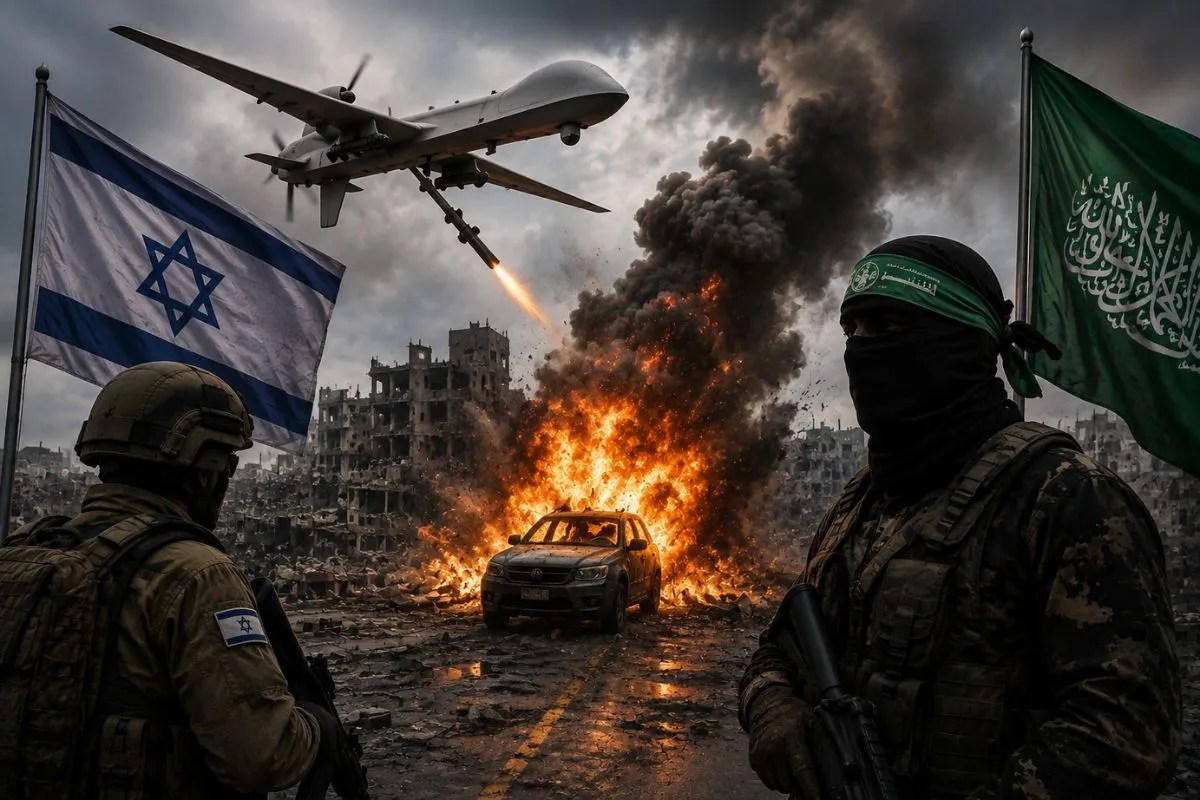
Silence in Gaza rarely arrives as a peaceful absence of sound. It is heavy. It smells of crushed concrete, pulverized brick, and the bitter copper tang of old dust settled over streets that used to echo with the shouts of children playing football. When the strike came, it did not announce itself with a long, slow whistle. It cracked like the sky splitting in half, a sharp, violent punctuation mark written in fire across the gray afternoon.
Moments later, the air filled with the frantic chatter of two-way radios and the urgent stomping of boots on rubble.
Another name had just moved from the living registers of the present into the cold ledgers of history.
News reports across the region would soon flash the dry, clinical bulletins. An Israeli airstrike had targeted and killed the district police chief of Hamas within the Gaza Strip. To the wire services, it was a data point. A coordinate on a map. A tactical update delivered in clipped, bureaucratic prose meant to be consumed over morning coffee and forgotten by noon. But statistics do not bleed. They do not capture the weight of a heavy leather belt left unbuckled on a chair, or the frantic scramble of men trying to salvage order from an atomized command post.
To understand what happened in that precise second, you have to look past the military press releases. You have to look at the anatomy of power in a strip of land barely thirty miles long, where authority is worn like a target on the back.
For years, the uniform of a Gaza district police chief was a paradox. It represented local order, traffic management, and the mundane enforcement of civil laws in a place defined by extraordinary chaos. Yet, in the tangled architecture of governance within the enclave, that same uniform was inextricably woven into the apparatus of a militant wing. The man who sat behind that desk signed off on patrol routes while simultaneously navigating the subterranean labyrinths where rockets and supply lines were counted like currency.
He was an administrator of a siege.
Consider what happens when a command structure is built entirely within the civilian fabric of a densely packed city. Every desk is a potential target. Every residential block hides an underground artery. When intelligence agencies track a phone, a vehicle, or a courier, they are not looking at a distant battlefield in an empty desert. They are looking down a microscope at a crowded neighborhood where civilian apartments lean against security checkpoints like old friends.
The strike was precise. Modern aerial warfare has evolved past the indiscriminate carpet bombings of the last century into something terrifyingly surgical. Guided by algorithms, thermal imaging, and human operatives feeding data into digital feeds in real time, a missile does not care about the history of the building it enters. It follows a laser dot. It obliterates a room, a floor, and a life in the span of a heartbeat.
And then, the dust rises.
I remember standing near the edge of a conflict zone years ago, watching the aftermath of a precision hit. The strangest thing is the quiet that follows the initial screams. It is an industrial quiet. The sound of burning plastic, the high-pitched whine of a car alarm that refuses to turn off, and the dull thud of heavy equipment beginning to clear the road. People emerge from doorways slowly, blinking against the harsh sun, their faces coated in the ghostly white powder of pulverized gypsum. They do not run anymore. They have run too many times. They simply look at the smoking crater with a flat, exhausted gaze that tells you everything you need to know about the human capacity to endure horror until it becomes routine.
The death of a district police chief does not stop the war. It does not redraw borders or bring a permanent peace. In the brutal mathematics of asymmetric conflict, leadership is a renewable resource. For every commander who vanishes in a flash of thermal light, another steps into the shadow of the vacant chair, pulls the desk a little closer to the wall, and turns on the radio.
Yet, something shifts.
The invisible threads of coordination snap. A district loses its anchor, however feared or contested that anchor might have been. The precinct house down the street becomes an empty shell, its windows blown out, its files scattered to the wind like autumn leaves in a hurricane.
As the sun began to dip below the Mediterranean horizon, casting long, bruised shadows across the shattered concrete, the rescue workers finally packed up their gear. The sirens faded into the distance. The street returned to its broken silence, waiting for the next coordinate to drop.