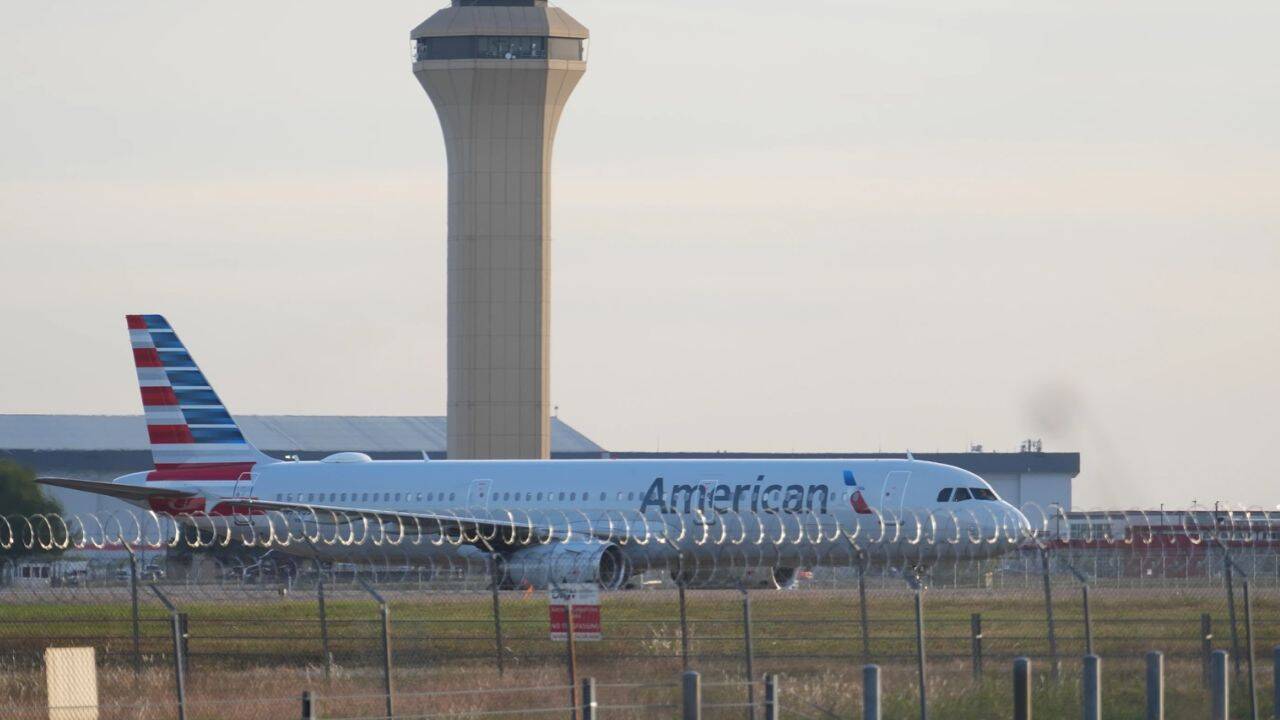
The terminal at Newark Liberty International Airport smells like burnt espresso, damp wool, and quiet panic.
You know this smell if you have ever watched a departure board flip from green to amber, and then to that suffocating, motionless red. Around Gate C112, three hundred strangers are slumped over charging ports, refreshing airline apps that refuse to tell the truth. A toddler cries in a rhythmic, exhausted wail. A businessman in a rumpled suit negotiates a missed merger over a dying phone battery. Nobody is angry at the sky. They are angry at the gate agent, the airline, the weather app showing clear blue skies over New Jersey while their plane sits grounded on a tarmac in Chicago. You might also find this connected story interesting: Why the Trump, Xi, and Putin Summit Signals a Brutal New Era of Great Power Politics.
They are looking at the wrong target.
High above the gate, behind tinted glass and thick concrete walls, sits the real reason nobody is going home tonight. It is not the airline. It is not a thunderstorm. It is a piece of technology so ancient that if you found it in your grandfather’s attic, you would throw it in a dumpster. As extensively documented in latest reports by TIME, the effects are notable.
Floppy disks. Paper strips. Copper wires installed when Dwight D. Eisenhower was in the White House.
Recently, Transportation Secretary Sean Duffy stepped up to a podium in Washington and dropped a number that made fiscal hawks choke on their coffee. Fifty billion dollars. That is the price tag the Trump administration is floating to tear down and rebuild America’s rotting air traffic control system from the bedrock up. To the casual observer scrolling past headlines, fifty billion sounds like another bloated government wishlist, a bureaucratic fever dream cooked up in a windowless conference room.
It is not a wishlist. It is a ransom payment to reality.
The Invisible Tightrope
To understand why a fifty-billion-dollar overhaul is suddenly on the table, you have to stop thinking about aviation as sleek aluminum tubes slicing through the clouds, and start thinking of it as a high-wire act performed blindfolded.
Consider a hypothetical character—let us call her Elena. Elena is a senior air traffic controller working the night shift at the New York Terminal Radar Approach Control, known in the industry as N90. For eight hours, Elena sits in a darkened room illuminated only by the phosphor glow of radar scopes. Her job is to herd forty commercial airliners—each carrying two hundred human souls—through a slice of airspace tighter than a Manhattan subway tunnel during rush hour.
She does this at five hundred miles an hour. She does it with zero margin for error.
When Elena hands a flight off to the next sector, she does not click a sleek digital icon on a unified cloud network. Often, she prints a physical piece of paper—a flight progress strip—marks it with a pencil, and physically slides it across a console to the person sitting next to her. If a thunderstorm rolls across Pennsylvania, Elena cannot simply ask an automated network to reroute fifty planes simultaneously. She has to talk to every single pilot, one by one, over a crackling VHF radio frequency that dates back to the Second World War.
Think about that. You can track a twelve-dollar burrito from a restaurant kitchen to your front porch in real time on your phone, complete with the driver’s name and GPS coordinates. Meanwhile, the Federal Aviation Administration still relies on ground-based radar sweeps that update every few seconds, leaving massive blind spots over oceans, mountains, and rural stretches of the Midwest.
I have spent enough hours stranded on frozen tarmacs in Denver and sweating through delayed connections in Atlanta to know the specific helplessness of modern air travel. We treat flight delays like acts of God, unavoidable taxes on our time. We blame the carriers for overbooking, or we curse the winter wind. What we rarely see is the sheer exhaustion of the people keeping two Boeing 737s from occupying the same cubic foot of air at the exact same second.
The Anatomy of a Meltdown
Why is US flight chaos getting worse right now? The answer is a collision of record demand and fossilized hardware.
In the past two years, commercial air travel has surged past pre-pandemic highs, with the FAA regularly managing over forty-five thousand flights every single day. More than two point nine million passengers step onto a plane in the United States every twenty-four hours. Yet the nervous system guiding those millions of people was designed for a fraction of that volume.
The numbers inside the FAA’s own audit reports read like the medical chart of a patient in critical condition. Out of 138 air traffic control systems currently operating across the country, more than a third are classified as unsustainable. Another forty percent are labeled potentially unsustainable. That means three-quarters of the machinery keeping American aviation airborne is actively failing or teetering on the edge of obsolescence.
Parts are so scarce that FAA technicians routinely scour eBay to buy replacement components for radar displays and radio transmitters. Let that sink in. The safety of the world’s busiest airspace depends, in part, on online auctions for vintage electronics.
When a single fiber-optic cable gets severed by a construction crew in Florida, or a decades-old cooling unit fails in a radar facility in Virginia, the entire eastern seaboard seizes up like an engine without oil. A ground stop in Newark cascades to Miami within forty minutes. Within two hours, flights in Los Angeles are delayed because the aircraft scheduled to fly them are trapped behind a digital traffic jam two thousand miles away.
And the hardware is only half the crisis. The human toll is worse.
The United States is currently short roughly three thousand certified air traffic controllers. Because the technology is so archaic and fragmented, training a new controller takes years of grueling memorization and high-stress simulation. Nearly forty percent of trainees wash out before ever earning their certification. Those who survive are rewarded with mandatory six-day workweeks, ten-hour shifts, and chronic sleep deprivation.
Imagine driving a school bus full of children down an icy mountain highway for sixty hours a week, knowing that if you blink at the wrong second, everyone dies. Now imagine doing it with a steering wheel that occasionally disconnects from the tires. That is Tuesday in an American control tower.
The History We Refused to Learn
We have been here before. Every decade, a near-miss or a catastrophic gridlock forces Washington to promise a revolution.
In the 1980s, after President Ronald Reagan fired over eleven thousand striking controllers, the government promised a sweeping technological modernization called the Advanced Automation System. It burned through billions of dollars and collapsed under its own bureaucratic weight. In the mid-2000s, Congress launched NextGen—the Next Generation Air Transportation System—designed to transition America from ground radar to satellite-based GPS navigation.
NextGen was supposed to be finished by 2025. It was supposed to save billions in jet fuel, slash delays, and allow planes to fly closer together safely.
Instead, NextGen became a cautionary tale of half-measures and shifting political winds. While the FAA spent over fourteen billion dollars installing new software in some facilities, other towers remained trapped in the 1970s. Cockpits became supercomputers capable of landing themselves in zero visibility, while the control towers talking to them were still running on Windows 95 and copper telephone lines.
Airlines upgraded their fleets. Passengers got high-speed satellite Wi-Fi at thirty-five thousand feet. The government, paralyzed by annual budget fights and continuing resolutions that prevent long-term capital planning, simply patched the leaks with duct tape.
You cannot run a twenty-first-century economy on twentieth-century wiring. Eventually, the bill comes due.
Why Fifty Billion Dollars?
When Secretary Duffy and the Trump administration floated the fifty-billion-dollar figure, the sticker shock was immediate. Where does that kind of money actually go? Is it just another slush fund destined to vanish into defense-contractor spreadsheets?
To answer that, think of air traffic control not as a single software update, but as an entire interstate highway system suspended in the sky.
If you want to replace a crumbling suspension bridge while fifty thousand cars drive across it every hour, you cannot simply close the road for three years. You have to build a brand-new bridge right next to the old one, seamlessly transfer the traffic over in the middle of the night, and then demolish the rusting steel behind you.
That is what fifty billion dollars buys. It is the cost of building a parallel, fully digitized, satellite-driven nervous system while keeping the current one alive.
First, it pays to rip out the copper wiring and replace it with high-speed, redundant fiber-optic and satellite communications networks. No more single points of failure where one stray backhoe in a field shuts down air travel across three states.
Second, it consolidates and rebuilds the physical facilities. Many of the FAA’s regional radar centers and airport towers are literally crumbling—suffering from leaking roofs, asbestos, mold, and failing HVAC systems that threaten to overheat the servers inside. Rebuilding these nerve centers from scratch, equipped with modern ergonomic workstations and unified display screens, is the only way to bring American controllers into the modern era.
Third, it funds the software architecture needed to integrate artificial intelligence, predictive weather modeling, and automated trajectory management. Instead of a controller manually calculating wind shear and fuel burn for forty separate aircraft on paper strips, algorithms can propose optimal, conflict-free flight paths in milliseconds, leaving the human controller free to act as a strategic supervisor rather than a frantic air-traffic cop.
Finally, it unlocks the bottleneck on human talent. Modern, intuitive interfaces dramatically cut down the grueling training curve for new controllers. If a twenty-four-year-old recruit does not have to spend two years learning how to translate cryptic, 1980s-era keyboard commands, the FAA can actually fill those three thousand empty chairs before the current generation retires.
The Skeptic’s Dilemma
It is completely rational to be skeptical. Taxpayers have watched Washington throw monumental sums at infrastructure projects before, only to get delays, cost overruns, and excuses. You might reasonably ask: why would this fifty-billion-dollar plan succeed where NextGen stumbled?
The honest answer is that there is no guarantee it will. Giving a massive, risk-averse federal agency fifty billion dollars does not automatically cure institutional inertia. Without radical procurement reform—stripping away the red tape that forces the FAA to spend five years approving a new monitor—that money could easily get bogged down in litigation and contractor bloat.
Even the structure of the FAA itself is part of the problem. Unlike Canada, the United Kingdom, or Germany—all of which spun off their air traffic control systems into independent, user-funded nonprofits decades ago—the United States ties its aviation infrastructure directly to the whims of congressional appropriations. When Congress threatens a government shutdown every six months, controller hiring freezes, training academies close, and long-term tech upgrades grind to a halt.
For a fifty-billion-dollar investment to work, it cannot be dribbled out in annual pennies. It requires dedicated, multi-year capital authority, insulation from political shutdowns, and a willingness to buy proven, off-the-shelf commercial technology rather than inventing bespoke government software from scratch.
Yet doing nothing is infinitely more expensive.
Flight delays already cost the United States economy over thirty billion dollars every single year in lost productivity, wasted fuel, missed business deals, and ruined vacations. Every summer thunderstorm that paralyzes the East Coast drains hundreds of millions of dollars from the national ledger. And beyond the money lies the quiet, terrifying erosion of our safety margin.
The Sound of Safety
For more than fifteen years, the United States commercial aviation industry achieved something miraculous: zero fatal crashes on a major domestic carrier. That safety record became so consistent that we took it for granted, like gravity or clean tap water.
Then came the warning shots. Near-misses on foggy runways in Austin, Burbank, and New York. Planes cleared to land on runways where another jet was already rolling for takeoff. And finally, the tragic mid-air collision over the Potomac River near Reagan National Airport—a devastating reminder that when systems are stretched too thin and human beings are pushed past their cognitive limits, tragedy is not a statistical anomaly. It is an inevitability.
Safety in the sky is not an accident. It is engineered. It is paid for in quiet rooms full of glowing screens, by men and women who drink too much coffee and carry the weight of thousands of lives in their headsets.
Think back to Elena, sitting in that darkened radar room in New York at three in the morning. Outside, a line of spring thunderstorms is marching across the Hudson Valley. Forty blips of light are converging on her screen, each representing mothers, fathers, college kids, surgeons, and soldiers trying to get home.
Right now, we are asking Elena to protect them with a pencil, a paper strip, and a prayer that a forty-year-old circuit board does not fry before dawn.
Fifty billion dollars is a staggering sum of money. Until you are sitting in row 24B, watching the lightning flash outside your window, realizing that the only thing keeping you safe in the dark is a system built before you were born.