Eight sailors tried to end their lives. Let that number sink in.
When the truth finally leaked from an internal Navy letter, it exposed a grim reality that leadership tried to sweep under the rug. Acting Navy Secretary Hung Cao confirmed what independent journalists and worried families already suspected. Across the USS Abraham Lincoln carrier strike group, eight service members attempted suicide during a brutal, record-shattering deployment.
We aren't talking about a routine training mission. We are talking about a floating city of thousands operating under relentless combat strain during operations connected to the war with Iran. No port calls for months. Constant threat alerts. Zero breathing room. When politicians sit in air-conditioned offices and dismiss these conditions as normal wear and tear, they show a profound disconnect from the human cost of modern naval power.
You cannot push human beings past their breaking point and expect a piece of military hardware to absorb the shock. The numbers are out. The excuses are wearing thin. It is time to look at what actually went wrong on the Lincoln and why the military keeps repeating the same lethal mistakes.
The Brutal Reality of 286 Days at Sea
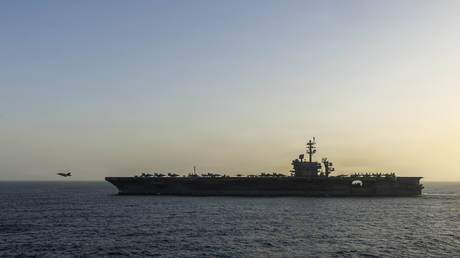
The USS Abraham Lincoln carrier strike group did not just complete a standard deployment. They smashed records for uninterrupted time in open water, logging an exhausting 286 days at sea before finally dropping anchor in Thailand. For nearly ten months, roughly 6,000 to 7,000 sailors, aviators, and support staff lived in cramped metal compartments with no shore leave, no reset button, and no escape from the job.
Think about what that does to the human brain. You are crammed into tight berthing spaces with hundreds of other people. You are breathing recycled air. You are eating whatever rations or pantry supplies are left when supply chains stretch thin. The noise never stops. The hum of the engines, the roar of flight operations, the blare of general quarters alarms—it drills into your psyche 24 hours a day.
Two of the eight suicide attempts occurred during active combat engagements. Think about that context. Sailors were fighting for survival against incoming threats while simultaneously fighting internal despair. When external danger spikes, internal safety should increase. On the Lincoln, isolation magnified every single stressor.
Military leaders often talk about resilience like it is an infinite resource. It is not. Resilience is like a battery. If you never plug it into a charger—in this case, basic human comforts, solid sleep, and a few days of solid ground—it dies. That is what happened on the Lincoln.
How the Crisis Came to Light
For months, the Pentagon tried to project an image of total control. Public relations teams rolled out statements highlighting how low mental health incidents were compared to historical baselines. CENTCOM commanders insisted that the ship handled its operational load brilliantly.
Then the letters leaked.
When CNN and other outlets published Hung Cao’s internal correspondence, the polished facade cracked. The letter confirmed eight separate suicide attempts within the strike group, shattering the narrative that everything was fine. While the Navy was quick to note that no completed suicides occurred onboard during this specific run, an attempt is a blaring siren. It means the system failed to catch someone before they reached the edge.
The response from the top was tone-deaf. President Donald Trump publicly remarked that the nearly nine-month stretch at sea was a "good period of time," noting that past eras had seen even longer deployments. Defense Secretary Pete Hegseth doubled down, claiming that reports about the horrific conditions aboard the Lincoln were entirely misrepresented.
Senators like Kirsten Gillibrand pushed back hard, pointing out that dismissing these harrowing experiences with political spin shows a dangerous lack of empathy for enlisted personnel. When leadership treats mental health cries as PR problems instead of operational emergencies, sailors notice. And they lose trust.
Inside the Floating Mental Health Bottleneck
The Navy will argue that they did not ignore the problem. Official reports note that the Lincoln deployed equipped with mental health professionals: a psychologist, a clinical social worker, a counselor, three behavioral health technicians, and even a therapy dog.
On paper, that sounds proactive. On a massive nuclear-powered aircraft carrier with thousands of stressed-out crew members, it is like bringing a garden hose to a forest fire.
Sailors report massive bottlenecks when trying to access care. Waiting weeks to see a single overworked clinician while you are stuck on a gray ship in the middle of a war zone is useless. Privacy is practically nonexistent. When you walk into a designated medical or mental health compartment on a warship, everyone knows why you are there. The stigma remains ferocious.
If you ask for help, your peers might have to pick up your slack. Your chain of command might view you as a liability. In a hyper-masculine, performance-driven culture like the United States Navy, admitting you want to end your life feels like painting a target on your back. Many sailors choose to suffer in silence rather than risk their careers, which explains why so many slip through the cracks until they make a desperate attempt to escape the pain.
The Domino Effect on Retention and Readiness
This crisis extends far beyond human tragedy, though that should always be enough to force change. It is actively destroying military readiness.
Young sailors watch how the institution treats their peers during and after severe mental health crises. They see the burnout. They see the exhausted leadership pushing for more metrics, more flight hours, and more time on station without regard for biological limits. Then they make a rational calculation about their future.
Why reenlist? Why sign up for another decade of broken promises, missed family milestones, and institutional neglect when private sectors and civilian trades offer stability and respect? The retention crisis in the armed forces is not a mystery. It is a direct consequence of grinding personnel down to dust.
When a carrier strike group returns to port, the ships need massive overhauls, maintenance, and deep-clean repairs. But the human element needs rebuilding too. Right now, the Navy treats sailors like replaceable components of a machine. Swap out a broken part, keep the ship moving. That mindset works until the human parts start breaking down en masse.
Fixing a Broken Culture
We don't need more hollow awareness campaigns or mandatory PowerPoint slides on suicide prevention. Sailors rolling their eyes through another online training module while running on four hours of sleep accomplishes nothing.
Real change requires structural disruption. First, hard caps on deployment lengths must be enforced. Pushing carrier strike groups toward ten months at sea without a break is an operational failure, no matter how tense geopolitical flashpoints get. If ships are overworked, the fleet is too small, and the answer is building more capacity, not bleeding existing crews dry.
Second, mental health care must be decentralized and entirely decoupled from immediate chain-of-command reporting where possible. Sailors need anonymous, frictionless access to professional help without fear that a counseling session will permanently ground them or derail their promotions.
Third, accountability has to start at the top. When leaders minimize a mental health crisis with defensive soundbites, they signal to every junior officer and enlisted sailor that nobody is listening.
The eight sailors who tried to survive the Lincoln's deployment are symptoms of a deeper rot. Until the Department of Defense stops treating human endurance as an infinite asset, the next carrier strike group to face a prolonged war will face the exact same invisible casualties. Stop the spin. Fix the ships. Protect the people inside them.