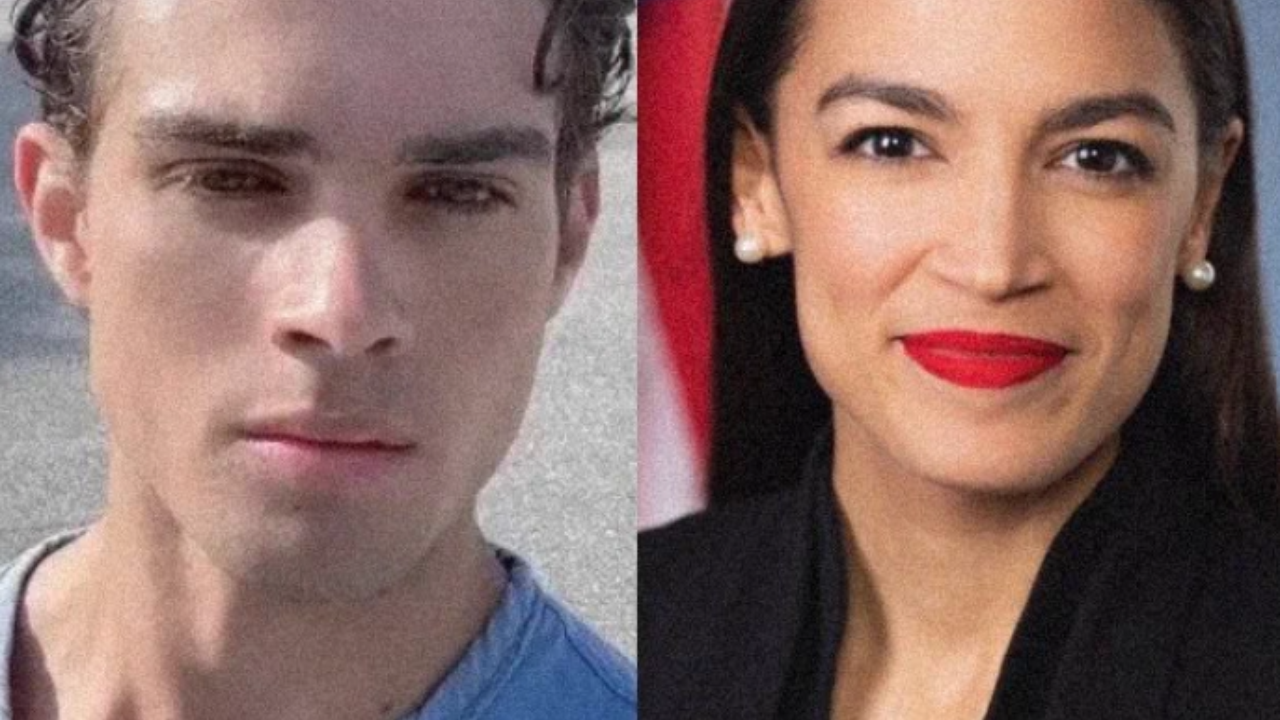
We have officially reached peak political theater.
When a sitting member of the United States Congress stands in front of a camera to debate the foreign policy obligations of a twenty-year-old Kick streamer who became famous for rating jawlines and telling young men how to "mog" their peers, the system is not just broken. It is a circus.
Recently, Representative Alexandria Ocasio-Cortez was cornered by a TMZ reporter in Washington, D.C.. The topic? Braden Eric Peters, known to millions of disaffected young men online as "Clavicular". Peters had recently touched down in Tel Aviv, livestreaming his vacation, rating the local nightlife, and declaring that "the girls are hot."
Instead of dismissing the question as the irrelevant digital noise it is, Ocasio-Cortez took the bait. She expressed deep concern over the "looksmaxxing" trend Clavicular champions and then urged the streamer to use his platform to "shed some light" on the plight of the Palestinians.
The immediate media reaction followed the predictable, lazy script. Outlets praised the Congresswoman for stepping into the cultural arena to hold online creators accountable. They lamented the toxic influence of the "manosphere" and demanded that internet stars show more geopolitical awareness.
This consensus is flat wrong. It relies on a profound, almost embarrassing misunderstanding of how the modern internet works, why young men turn to these bizarre subcultures in the first place, and what happens when we demand that every micro-influencer become a makeshift foreign policy correspondent.
We need to stop asking looksmaxxing influencers to solve geopolitics. Here is why the entire premise of this demand is a performative disaster.
The Performative Trap of Digital Conscription
Let us be entirely honest about what is happening here. The demand for every public figure, no matter how specialized or absurd their niche, to weigh in on global tragedy is a disease of the modern attention economy. It is a form of digital conscription.
When AOC suggests that Clavicular should utilize his platform to educate his audience on the displacement in Gaza, she is operating under a flawed assumption: that "raising awareness" from an unqualified source has any intrinsic value.
Imagine the actual execution of this request. A streamer who built his entire empire on "hardmaxxing"—a subculture involving extreme physical alterations, anabolic steroids, and pseudoscientific practices like "bonesmashing"—suddenly pauses his stream to deliver a lecture on the historical complexities of the Middle East.
What does that accomplish?
- It trivializes real human suffering. It turns a devastating, multi-generational geopolitical conflict into a checkbox item on a social media checklist.
- It spreads misinformation. Expecting a creator who dropped out of college and built a brand on sheer aesthetic vanity to provide nuanced, historically accurate commentary on international law is a recipe for disaster.
- It alienates the audience further. The young men watching Clavicular are not tuning in for statecraft. They are tuning in because they feel invisible. Forcing geopolitical content down their throats does not educate them; it makes them log off or double down on their cynicism.
During my years analyzing media structures and digital trend cycles, I have watched brands, politicians, and creators blow millions of dollars trying to force-feed serious political messaging through highly specialized, degenerate entertainment channels. It never works. It only breeds resentment and dilutes the gravity of the actual issues being discussed.
What the Political Class Gets Wrong About Looksmaxxing
To understand why this intersection of politics and internet subculture is so dysfunctional, we have to define what "looksmaxxing" actually is, stripped of the sensationalized headlines.
The mainstream media loves to paint looksmaxxing as a simple extension of vanity, a toxic boy's club fueled by pure misogyny. But that is a surface-level diagnosis.
Looksmaxxing, which originated in the darker corners of incel forums in the early 2010s, is a highly systematized, almost clinical approach to physical self-improvement. It divides actions into "softmaxxing" (hygiene, skincare, basic fitness) and "hardmaxxing" (surgical jawline adjustments, intense steroid regimens, and extreme fat-dissolving injections). Clavicular named himself after the clavicle bone, reflecting the community’s hyper-fixation on skeletal width.
To the uninitiated, it looks like madness. To a generation of isolated young men, it looks like a life raft.
Consider these realities:
- The Autistic Appeal of Systematization: Peters himself has openly discussed his self-identification with autism. The looksmaxxing community appeals heavily to neurodivergent young men because it translates the highly subjective, terrifyingly complex world of human attraction and social hierarchy into a set of rigid, quantifiable metrics. It promises that if you change variable X (your jaw angle), you will unlock outcome Y (social dominance).
- The Loneliness Epidemic: With statistics showing that roughly one in four young men report feeling intense, persistent loneliness, these online communities fill an existential void. They offer a strange, dark form of camaraderie.
- The Dating Market Despair: Clavicular’s recent viral push for "geomaxxing"—moving to countries with weaker economies to find dating success because the domestic market is deemed "too brutal"—is a direct symptom of this deep-seated despair.
When politicians look at this and simply say, "I want people to learn to love themselves," they are offering a therapeutic platitude to a structural crisis. Young men do not want platitudes. They want actionable rules. Because the mainstream culture has failed to offer them a constructive framework for masculinity, they have built their own extreme, distorted version of it.
To expect a community forged in the fires of deep social alienation to suddenly pivot to high-minded international advocacy is not just unrealistic; it is completely out of touch with the psychological reality of these spaces.
The Illusion of the Ethical Influencer
There is a deep hypocrisy in the way we treat online creators. We treat them as public utilities when it suits our political goals, but brand them as toxic outcasts when they step out of line.
Clavicular is a polarizing figure, to put it mildly. He has faced intense backlash for allegedly singing along to antisemitic lyrics, injecting unverified substances into people on stream, and promoting highly dangerous physical practices. Yet, the moment he lands in Tel Aviv, he is suddenly expected to carry the mantle of human rights advocacy on his shoulders.
This is the "ethical influencer" illusion. We demand that creators who have built their entire platforms on being unfiltered, controversial, and self-absorbed suddenly exhibit the moral clarity and diplomatic tact of a seasoned statesman.
When pro-Israel influencers in Tel Aviv debated whether to welcome Peters, they fell into the same trap. Some saw him as a boost to public relations, a way to show that Tel Aviv is still a vibrant, normal party destination. Others recoiled at his controversial past.
Both sides are guilty of the same error: treating a livestreamer as an ideological asset or liability.
Let us look at the mechanics of the Kick platform where Clavicular streams. Kick was built specifically to bypass the strict moderation policies of Twitch and YouTube. It thrives on chaos. It monetizes raw, unedited, often offensive human behavior. The algorithm does not reward nuance. It rewards the shock value of injecting a fat-dissolving peptide into a teenager's jaw on live television.
To expect this environment to yield a constructive dialogue about the Middle East is pure delusion. If Clavicular actually attempted to do what AOC suggested, the result would not be a thoughtful exploration of Palestinian displacement. It would be a trainwreck of bad takes, clipped out of context, designed to generate hate-clicks and boost his subscription numbers.
The Danger of Top-Down Moralizing
When political figures try to intervene in hyper-specific online subcultures, they almost always trigger the Cobra Effect: their attempts to solve the problem only make it worse.
By calling out Clavicular by name, AOC did not diminish his influence. She supercharged it. She validated his status as a rebel counter-cultural figure fighting against the "establishment." In the eyes of his followers, a high-profile progressive politician criticizing their leader is the ultimate badge of honor. It proves their thesis: that the mainstream world hates them and wants to keep them down.
This top-down moralizing ignores the actual mechanisms of online radicalization. Young men do not get pulled into extreme looksmaxxing or the manosphere because they lack information. They get pulled in because they are starving for agency.
If we actually want to address the toxic elements of these communities, the solution is not to demand that their influencers start reading United Nations reports on stream. The solution is to offer alternative, healthier paths to self-actualization that do not require hitting your face with a hammer or injecting black-market peptides.
We must admit the uncomfortable truth: looksmaxxing, in its gentler forms, actually works for some of these men. Improving their fitness, learning how to dress, and taking pride in their appearance gives them a sense of control they cannot find anywhere else in a chaotic world. When we dismiss the entire trend as a pathology, we close the door to any constructive intervention.
Stop Looking for Prophets in the Chat
It is time to establish some clear boundaries between the serious business of global politics and the circus of internet celebrity.
The next time a politician is asked to comment on a viral streamer's vacation, the answer should be a swift, uncompromising pass. We must stop validating the idea that every digital platform must be turned into a ideological battleground.
We do not need looksmaxxers to explain geopolitics. We do not need foreign policy experts to explain bone structure.
The tragedy in the Middle East deserves serious, dedicated diplomatic effort and rigorous journalism. It does not need to be processed through the lens of a Kick stream. And the young men struggling with identity and isolation in their bedrooms do not need performative lectures from politicians who only notice them when they trend on Twitter.
Let the streamers stream, let the politicians legislate, and stop pretending that a twenty-year-old with a camera and a bottle of testosterone is the key to global peace.
You can watch the original exchange and decide for yourself whether this is the kind of political discourse we should be cultivating: AOC on Clavicular's Looksmaxxing Trend. This video shows the exact moment a serious political figure was asked to validate a viral looksmaxxer, highlighting the bizarre intersection of internet culture and national politics.