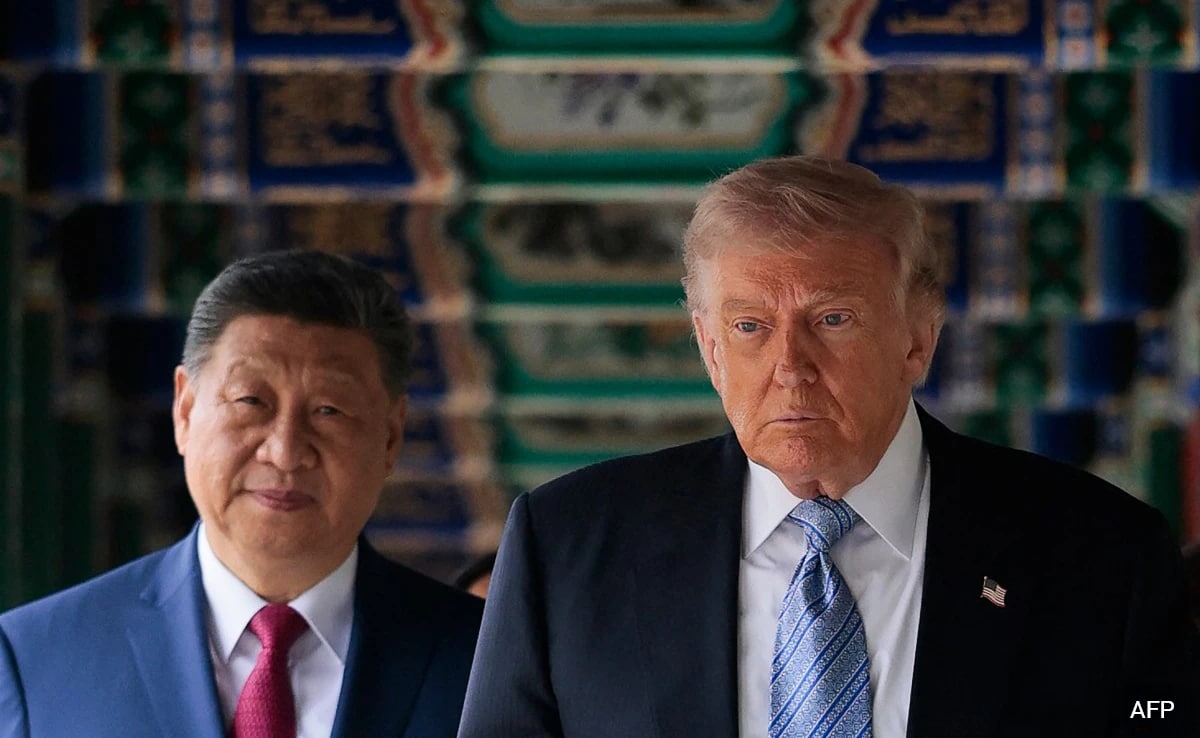
Geopolitical analysts love a good fairy tale about imperial ghosts. When Xi Jinping led Donald Trump through the manicured pathways of Zhongnanhai—the red-walled fortress right next to the Forbidden City—mainstream media instantly fell back on their tired, predictable script. They called it a masterclass in psychological manipulation. They spun a narrative about a calculation designed to exploit an American president's well-documented obsession with luxury, royalty, and historical grandiosity.
They got it completely backward. Don't forget to check out our earlier article on this related article.
The lazy consensus insists that China opens the gates of its most guarded political compound to project absolute, unbroken historical continuity. The talking heads look at the centuries-old roses, the ancient trees, and the pavilions of Yingtai Island, and they see a subtle, civilizational flex. They tell you that Xi is playing a deep, multi-generational game of chess, using imperial aesthetics to make a Western leader feel transient and insignificant.
This reading is not just flawed; it is dangerously naive. It mistakes theater for strategy. The reality is far more transactional, deeply cynical, and rooted in current structural vulnerabilities rather than ancient dynasty building. Xi did not take Trump inside Zhongnanhai to show off China's eternal strength. He did it because Beijing is negotiating from a position of acute, structural desperation, and they needed a controlled environment to execute a high-stakes corporate pivot. To read more about the background here, Associated Press provides an in-depth breakdown.
The Mar-a-Lago Myth and the Illusion of Reciprocity
The official diplomatic line, parroted by state media and Western journalists alike, is that this stroll through the gardens was a simple act of reciprocity. Xi was supposedly returning the favor after Trump hosted him at the Mar-a-Lago resort in Florida.
Let's dismantle that premise immediately.
Mar-a-Lago is a commercial country club where members pay initiation fees to eat steak over gold-plated chargers. Zhongnanhai is the nerve center of a nuclear-armed party-state. It is where Mao Zedong slept, where the Politburo Standing Committee seals the fate of 1.4 billion people, and where the elite Central Security Bureau controls every single blade of grass. To suggest that a walk through China’s inner sanctum is a polite "thank you" for a weekend in Palm Beach is a fundamental misunderstanding of Chinese diplomatic protocol.
In China's rigidly hierarchical world of foreign relations, nothing is done for sentiment. I have spent years analyzing capital flows and supply chain shifts through East Asia, and if there is one undeniable truth, it is this: when Beijing breaks its own rules of secrecy, it is because the status quo has become unsustainable.
The invitation was not a sign of respect. It was an extraction mechanism. By isolating Trump within the physical architecture of Chinese power, away from his broader cabinet and the prying eyes of the traveling press corps, Xi created a hyper-controlled echo chamber. The goal was to bypass institutional U.S. policy and secure a highly personalized, erratic executive truce.
The Real Crisis Behind the Red Walls
To understand why Beijing opened the gates, look at what is happening outside of them. The conventional narrative treats China as an unstoppable monolith. The data says otherwise.
China is facing a compounding structural crisis that no amount of state-directed lending can fix.
- The Real Estate Implosion: The domestic property sector, which historically drove up to 30% of Chinese GDP, is effectively dead.
- The Demographics Trap: Population decline is accelerating, eroding the cheap labor supply that built the modern Chinese economic miracle.
- Capital Flight: Despite aggressive capital controls, wealthy elites are moving money out of the yuan at record speeds.
Worse for Beijing, the center of gravity in global trade has shifted away from simple tariffs—which can be negotiated or absorbed—and toward absolute dominance over critical minerals, rare earths, and magnet supply chains. China currently controls the vast majority of these resources, but that monopoly is triggering a massive, irreversible Western decoupling.
When Trump walked those grounds, he was not being treated as a visiting emperor. He was being courted as a critical client. China desperately needs to buy time to consolidate its technological and industrial positions before Western supply chain independence becomes a reality. The garden tour was a tactical stall tactic designed to delay aggressive supply chain sanctions by dangling the illusion of a grand, personalized bilateral deal.
The Weaponization of Yingtai Island
Consider the specific geography of the tour. Media reports focused heavily on whether the leaders would spend time on Yingtai Island, the artificial landmass within Zhongnanhai's lakes. The historical romanticists immediately pointed out that this was where the Qing Emperor Guangxu was imprisoned after his failed, Western-leaning modernization attempts in the late 19th century. The standard analysis suggests this was a warning to Trump about the dangers of overplaying his hand.
Let’s apply some logic. Do we honestly believe an administration focused on immediate trade balances and domestic manufacturing numbers is spending its time decoding subtle allegories from the 1898 Hundred Days' Reform? Of course not.
The selection of Yingtai has zero to do with historical warnings and everything to do with modern maritime geography. Yingtai is the exact site where Emperor Kangxi made the strategic decision to conquer Taiwan in the 1680s. By hosting discussions in a space explicitly tied to the historical absorption of Taiwan, Xi was not dropping a subtle hint; he was setting a hard geopolitical boundary. It was a physical manifestation of a red line, wrapped in the disarming aesthetic of a garden walk. It allowed Xi to project absolute domestic resolve to his own internal hardliners while presenting a soft, accommodating face to the American delegation.
The Corporate Delegation Blindspot
The most egregious oversight in the mainstream coverage of this summit is the total failure to look at who else was on the trip. While journalists were busy writing prose about 500-year-old rose bushes and symbolic tea ceremonies, the real action was happening in the wings. The American delegation included the absolute apex of Western technology and hardware manufacturing—including leaders from major semiconductor giants and automotive pioneers like Elon Musk.
This is where the contrarian truth becomes undeniable.
China does not care about changing Trump's mind on abstract geopolitics. They care about securing the compliance of the people who actually build the Western tech stack. By hosting Trump in a venue of ultimate exclusivity, Xi provided the American corporate elite with the ultimate political cover. It allowed Western tech CEOs to argue to their boards and shareholders that engagement with China was not a betrayal of national security, but a patriotic alignment with the President’s personal diplomacy.
Imagine a scenario where a Western tech company is facing immense pressure from the Department of Commerce to pull its manufacturing facilities out of Shenzhen. Suddenly, the CEO is invited to a high-level luncheon inside the most exclusive compound in Asia, sanctioned by a walking tour between the two heads of state. The political risk of maintaining Chinese operations evaporates overnight. The garden tour was an enterprise-level retention strategy aimed directly at American capital.
The Fragility of the Visual Flex
Every strategy has a failure point, and Beijing’s reliance on high-protocol theater is incredibly risky. The major downside to this approach is that it relies entirely on the stability of a single relationship. By bypassing institutional diplomatic channels and betting the farm on personal chemistry within the walls of Zhongnanhai, China exposes itself to massive volatility.
The moment the American political winds shift, or a sudden export control is signed in Washington, the entire value of the "Zhongnanhai consensus" drops to zero. We saw this clearly with the $83 billion West Virginia energy memorandum produced during a previous state visit—a massive, highly publicized deal that evaporated into thin air the moment the cameras turned off.
History shows that personal diplomatic arrangements made in secret enclaves are inherently brittle. They fail because they ignore the underlying structural friction between an incumbent superpower and a rising challenger. No amount of shared tea, historical anecdotes, or gifts of rose seeds can alter the fundamental reality that the U.S. and China are locked in a zero-sum competition for the commanding heights of computing power, artificial intelligence, and global logistics.
Stop analyzing the scenery. Stop looking at the ancient trees. The walk through Zhongnanhai was not a demonstration of imperial timelessness; it was a highly managed liquidation sale of political access, executed by a regime that knows its window of economic leverage is rapidly closing.