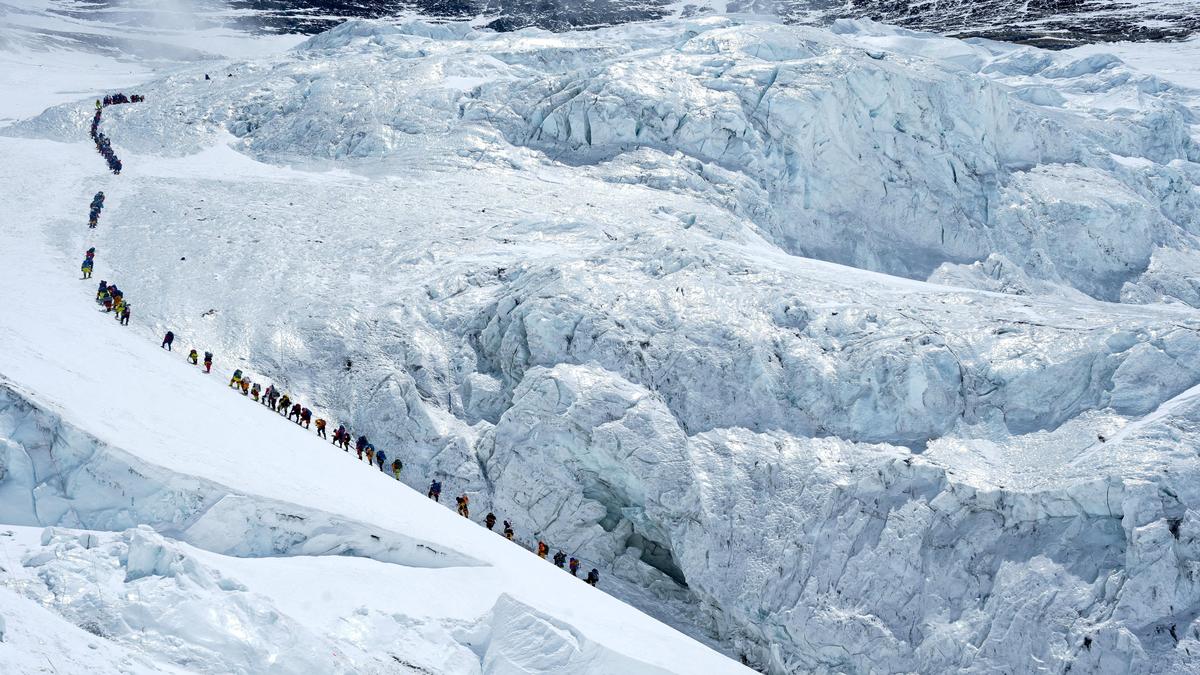
Mount Everest just saw its busiest day in history. A staggering 274 climbers stood on the summit from the Nepalese side in a single 24-hour window. Headlines are calling it a triumph of human endurance. It isn't.
When you see 274 people standing on top of the world on the exact same day, you aren't looking at an athletic breakthrough. You're looking at a terrifying logistical traffic jam. The government officials at the Nepal Department of Tourism are quick to celebrate the revenue and the records. But anyone who understands high-altitude mountaineering looks at these numbers with a knot in their stomach.
This massive single-day surge happened because the weather window in the Death Zone narrowed down to almost nothing. Teams had to sit tight for days at Camp 4, breathing through expensive bottled oxygen, waiting for the ferocious jet stream winds to drop below 20 mph. When the window cracked open, everyone moved at once.
The Logistics of a 274 Person Traffic Jam
Climbing Everest isn't a solitary walk up a hill. It's a highly orchestrated, industrial-scale operation. To get 274 human beings to $8,848\text{ meters}$ and back down alive in one day requires an army of high-altitude Sherpa guides, miles of fixed nylon ropes, and hundreds of heavy oxygen canisters.
Think about the geography of the upper mountain. Above Camp 4 at $7,900\text{ meters}$, climbers enter the Death Zone. The human body cannot acclimatize to this altitude; it is literally dying by the minute. The route goes up the Southeast Ridge, passes the Balcony, moves over the South Summit, and then squeezes through the Hillary Step.
The Hillary Step is a narrow, vertical rock face. It creates a bottleneck. Only one person can go up or down at a time.
Imagine waiting in line at a grocery store, but the temperature is minus 30, your fingers are freezing, your oxygen mask is icing up, and if you stay there too long, you die. That's what happened during this single-day summit record. Faster, elite climbers get stuck behind slower, commercial clients who struggle to clip their safety carabiners onto the fixed lines.
Veteran mountain guides have warned about this for years. When people stand still in the Death Zone, their bodies stop producing heat. Frostbite sets in. Hypoxia creeps in as oxygen tanks run dry. The record sounds glorious on paper, but on the mountain, it's a game of Russian roulette with the weather.
What the Tourism Bureau Won't Tell You
Nepal issued a massive number of permits for this climbing season. Each foreign climber pays $11,000 just for the permit, before spending tens of thousands more on guiding companies, food, gear, and flights. It's a massive cash cow for a developing economy.
But the mountain has structural limits.
The crowd of 274 climbers wasn't just a random event. It's the direct result of a shift in the guiding industry. Historically, Western boutique companies dominated the mountain, taking small, highly vetted groups. Today, local Nepalese operators lead the charge. They offer cheaper expeditions and take much larger groups.
This democratization of Everest means more people get to try. It also means the average skill level of the climber has plummeted.
Some clients don't even know how to put on their crampons when they arrive at Base Camp. They rely entirely on their Sherpa guides to pull them up the mountain. When a difficult situation arises, these inexperienced climbers can't react. They freeze. They block the path.
This record day proves that Everest has become an assembly line. When the assembly line works, people get their summit photos for social media. When it breaks—when a sudden storm hits while 200 people are trapped above the Hillary Step—it results in mass tragedy, much like the infamous 1996 disaster or the deadly 2019 season.
The True Cost of Everest Records
We need to talk about the environmental and human toll behind these big numbers. 274 people on the summit means hundreds more support staff moving up and down the mountain.
- Human waste: Tons of solid waste are left at Camp 2 and Camp 4 every year. The freezing temperatures mean it doesn't decompose. It stays frozen, polluting the glacial meltwater that millions of people downstream rely on.
- Gear abandonment: Empty oxygen bottles, torn tents, and broken ladders litter the high camps. Cleaning up the Death Zone is incredibly dangerous, and while campaigns exist to bring trash down, they can't keep up with the volume.
- Sherpa exploitation: The unsung heroes of this record day are the Sherpas. They carry the heavy loads, fix the lines, and risk their lives repeatedly to ensure their clients survive. A single summit day of this scale puts immense physical strain on the local workforce.
If you're planning to climb a major peak, or if you're just a fan of mountaineering history, don't look at this single-day summit record as a milestone to celebrate. Look at it as a warning sign. The mountain didn't change. Human ambition just outpaced safety margins.
If you want to experience true mountaineering, look toward the hundreds of unclimbed, technical $6,000\text{ and }7,000\text{ meter}$ peaks across the Himalaya. Leave the crowded, commercialized slopes of Everest to the trophy hunters, or prepare yourself rigorously so you aren't part of the bottleneck when the next narrow weather window opens.