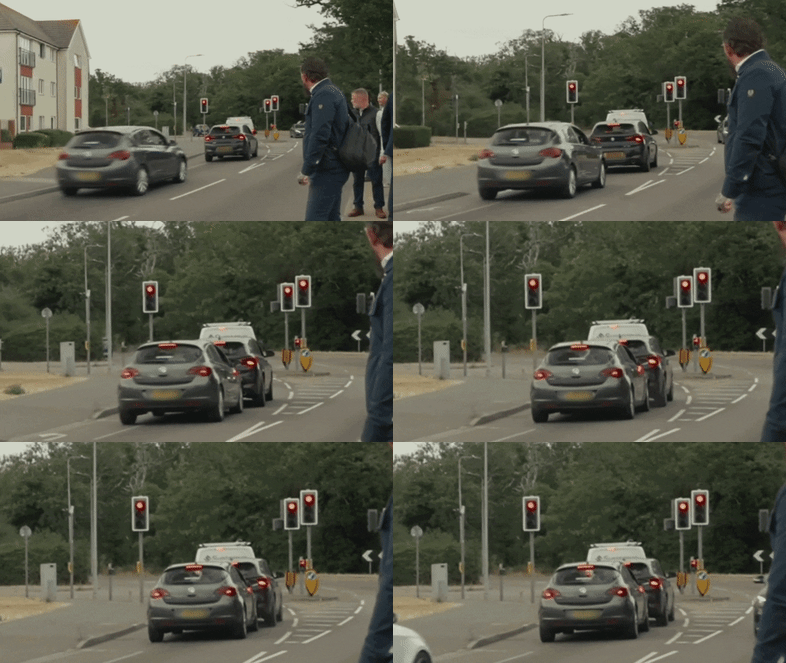
Mainstream political commentators love nothing more than declaring a "car crash" moment the absolute end of Nigel Farage.
Whenever a chaotic interview clip or a sensationalized blunder goes viral across social platforms, the political establishment pops champagne. They compile hot takes, dissect every nervous twitch, and assure their audience that the populist bubble has finally burst.
They are completely misreading the room.
What legacy media pundits misinterpret as a devastating optics disaster is actually the exact engine driving modern populist endurance. While the establishment sees a derailment, Farage’s core demographic sees a bare-knuckle brawl against a hostile media machine.
The Flawed Premise Of Polished Politics
Modern political consulting is built on a dead model.
For three decades, media strategists taught politicians to sound like corporate press secretaries: controlled, sanitized, and deeply risk-averse. The moment a candidate steps out of line or stumbles in an interview, media handlers panic.
They assume the public demands flawless performance.
They do not.
In a media environment defined by curated PR spin, polish signals insincerity. When Farage finds himself in a high-stakes, aggressive interview that devolves into chaos, it breaks the sterile monotony of traditional political broadcast.
The friction itself is the product.
Imagine a scenario where an establishment candidate is confronted with tough questions about off-the-record funding or questionable connections. They revert to rehearsed soundbites, dodging and weaving with practiced neutrality. The viewer tunes out. Now contrast that with a fiery exchange where emotions flare, tempers fray, and the confrontation feels unscripted.
Even when the politician looks bruised, they win the war for attention.
Algorithmic Friction Beats Pristine Messaging
Every viral "car crash" clip operates on a mechanical level that traditional political scientists fail to understand:
- High-arousal emotion: Anger and indignation drive algorithmically amplified sharing far faster than polite policy debates.
- In-group reinforcement: Opponents share the clip to mock it; supporters share the clip to prove the interviewer was biased. Both sides drive the engagement metrics skyward.
- Authenticity framing: The messy, uncontrolled nature of a chaotic interview cuts through the noise of pre-packaged campaign ads.
By treating a messy media moment as a terminal failure, analysts ignore basic human psychology. People rarely change their political alignment because a politician had a rough twenty minutes on live television. Instead, voters filter the wreckage through their existing bias.
To critics, it looks like incompetent collapse. To supporters, it looks like a lone warrior taking fire in enemy territory.
The Trap Of The Gotcha Interview
Brocasters believe they are exposing fatal flaws when they back a populist into a corner. They gather facts, line up tricky timeline inconsistencies, and go for the knockout punch.
Yet this strategy backfires consistently.
When political journalism centers entirely on procedural "gotchas" and personal optics, it misses the structural grievances driving voters to populist movements in the first place. A voter concerned about local infrastructure or wage stagnation does not care if a politician misremembered a detail on live radio.
When the press focuses on the spectacle of the crash, they surrender the opportunity to debate actual substance.
The political establishment keeps waiting for the single viral mistake that permanently dismantles anti-establishment politics. It does not exist. Every time the media gathers to celebrate a supposed downfall, they simply prove how out of touch they are with the voters driving the movement.
Stop analyzing the wreckage and start paying attention to why millions of people are cheering for the collision.


