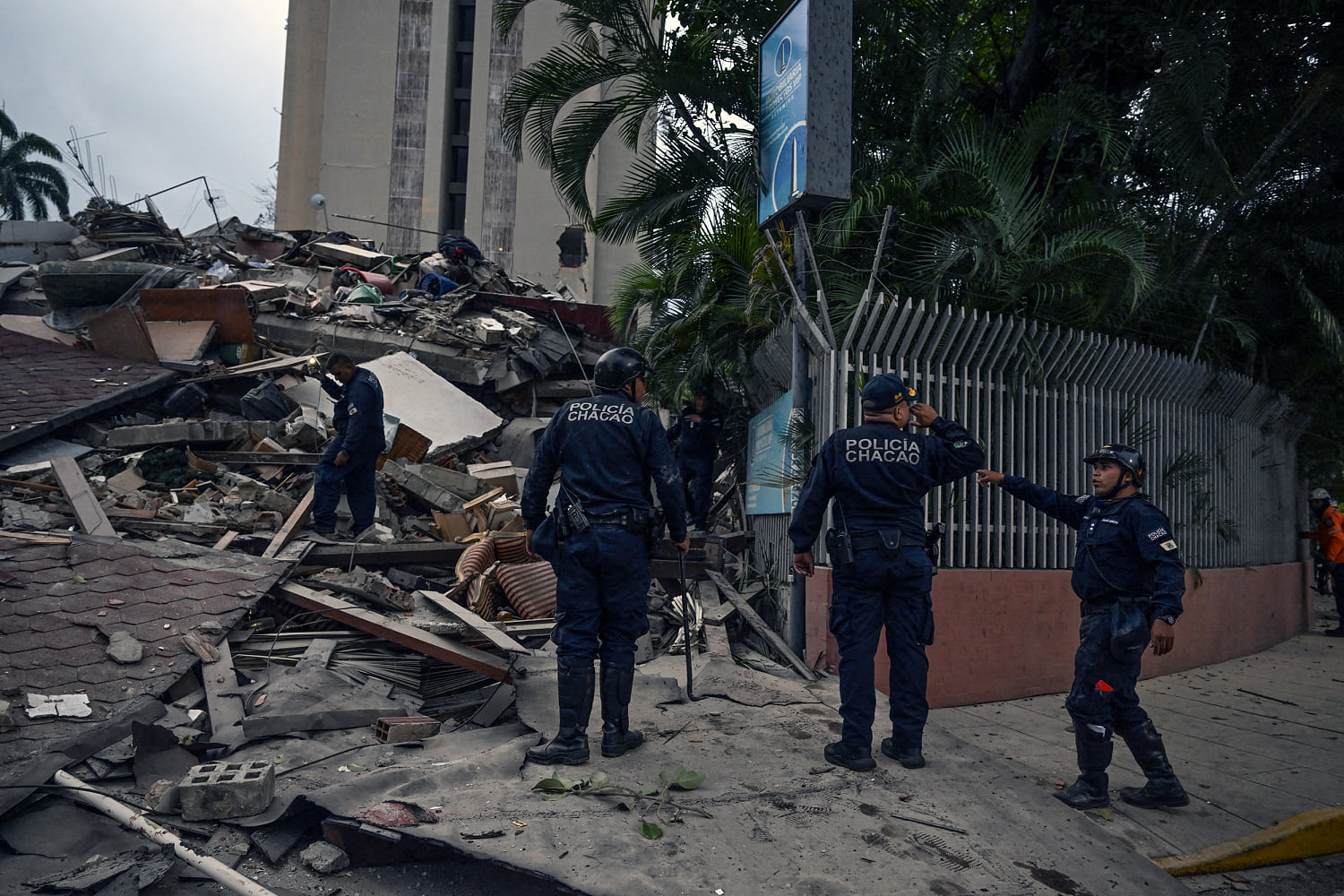
The headlines are reading exactly how the Venezuelan government wants them to read.
"32 dead, over 700 injured as powerful twin earthquakes hammer Venezuela."
Mainstream media outlets dropped the news alert, tallied the body count, quoted President Nicolás Maduro’s televised address, and moved on to the next crisis. They treat tectonic plates like unpredictable villains and the resulting chaos as an unavoidable act of God. It is a predictable formula. It is also entirely wrong.
Earthquakes do not kill people. Bad engineering and corrupt governance kill people.
When twin tremors strike a nation, the international community jumps to send emergency blankets and bottled water. They ask how much aid is required to rebuild. That is the wrong question. The real question is why a moderate seismic event—one that a city like Tokyo or Santiago would shrug off before lunch—can completely paralyze a South American oil giant.
The narrative surrounding this tragedy is a masterclass in political misdirection. By focusing entirely on the raw magnitude of the disaster, the global media is helping the regime cover up decades of systemic infrastructure theft.
The Myth of the Unavoidable Catastrophe
Let’s dismantle the lazy consensus right now. The official reports emphasize the "power" of the twin earthquakes to imply that no infrastructure could have withstood the shock.
This is a lie.
Seismologists have known for decades that northern Venezuela sits squarely on the boundary between the Caribbean and South American plates. The Boconó fault system isn't a surprise. It is a documented reality.
When you look at the actual data from regional monitoring stations, the peak ground acceleration of these tremors was well within the limits of what modern engineering can handle. Yet, apartment complexes folded like accordions. Hospitals lost power instantly because backup generators failed. Water mains burst, not because the earth split open, but because the pipes were already corroded to the point of structural irrelevance.
I have spent years analyzing regional supply chains and infrastructure vulnerability across Latin America. I have seen how municipal budgets are allocated in Caracas. The money meant for seismic retrofitting, structural concrete verification, and grid redundancy did not vanish because of an earthquake. It vanished into offshore bank accounts years ago.
The tragedy in Venezuela is not a natural disaster. It is an engineering crime scene.
The Danger of Trusting Autocratic Data
Why are we blindly repeating numbers provided by a regime notorious for data manipulation?
The official count says 32 dead and 700 injured. Anyone who has spent significant time studying Venezuelan institutional transparency knows these figures are curated for political survival.
- Underreporting to Protect Image: A massive casualty count signals state failure. By keeping the official death toll artificially low, the administration minimizes the perception of chaos.
- Overreporting for Aid Extraction: Conversely, the regime will exaggerate the economic damage to demand sanctions relief or unconditional international cash injections.
- Information Blackouts: Local journalists face immediate detention for broadcasting unauthorized footage of collapsed structures in regional capitals outside Caracas.
When independent civil society groups attempt to audit hospital admissions, they run into a wall of military bureaucracy. If you are analyzing this event based strictly on official press releases, you are not doing journalism. You are doing public relations for a dictatorship.
Structural Fraud: How Corrupt Concrete Kills
To understand why the buildings fell, you have to understand the economics of Venezuelan construction over the last twenty years.
During the oil boom, the state initiated massive public housing projects under the banner of Gran Misión Vivienda. On paper, millions of homes were built to shield the poor. In reality, these projects were goldmines for corrupt contractors aligned with the ruling party.
They bypassed standard civil engineering protocols. They substituted high-grade rebar with cheap, brittle alternatives. They watered down the concrete mix to stretch their margins, creating a highly porous material that crumbles under shear stress.
A Lesson from San Francisco and Tokyo
Structural engineering isn't magic; it's physics. When an earthquake hits, a building must either be rigid enough to withstand the force or flexible enough to dissipate the energy. Corrupt concrete does neither. It snaps.
When the twin shocks hit, these housing blocks became vertical tombs. The mainstream media points at the fault line. The real culprit is the fraudulent supply chain that poured substandard cement into vulnerable neighborhoods while regulators took kickbacks to sign off on compliance certificates.
The Sanctions Scapegoat is Running Out of Gas
Predictably, the political rhetoric from Caracas has already shifted blame toward international economic sanctions. The narrative is simple: We could have fixed the infrastructure, but Western sanctions blocked our ability to buy parts.
It is a convenient excuse that completely ignores chronology.
The decay of Venezuela’s electrical grid, water distribution networks, and emergency response services began long before the first major sectoral sanctions were implemented in 2017. The severe lack of maintenance at the Guri Dam and the systematic firing of qualified engineers from the state electricity company, CORPOELEC, occurred in the early 2010s during the height of the oil windfall.
Money was never the issue. Competence and honesty were.
By pretending that the current devastation is a direct result of external economic pressure, the government deflects from the fact that they defunded the country’s central seismological research agency, FUNVISIS, leaving it without the working equipment needed to map micro-tremors effectively.
Stop Sending Cash: The Right Way to Help
The international community is already preparing its standard response: pledging millions of dollars in emergency assistance. This is a profound mistake that will only prolong the suffering.
Direct financial aid sent to centralized state agencies will be weaponized. It will be used to reward political loyalty, while opposition-leaning neighborhoods are left to dig through the rubble with their bare hands.
If international donors want to make an actual impact, they must bypass the central state entirely:
- Fund Local, Decentralized Responders: Funnel resources directly to independent fire departments, university engineering faculties, and non-governmental medical networks like Médicos por la Salud.
- Deploy Satellite Mapping: Use private aerospace tech to audit structural damage independently, bypassing state-run media blackouts to show where help is actually needed.
- Condition Long-Term Aid on Structural Audits: Do not provide a single dollar for reconstruction unless independent, international engineers are permitted to oversee the bidding processes and material testing.
This approach is highly inconvenient. It creates diplomatic friction. It angers the sovereign government. But it is the only way to ensure that the concrete poured tomorrow doesn't crush another family ten years from now.
The ground in Venezuela has stopped shaking, but the structural collapse of the state continues unabated. Stop looking at the Richter scale. Start looking at the ledger books.