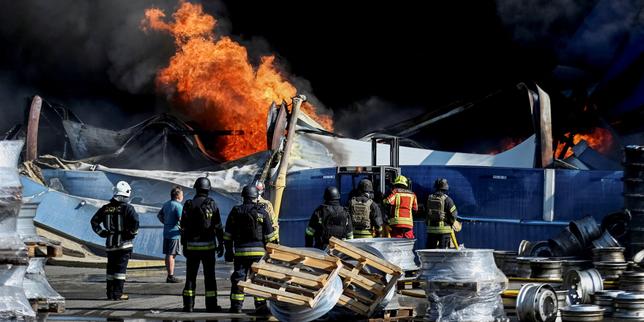
Thirty-seven dead in Bucha. A munitions depot reduced to ash. The figures flash across cable news screens with the predictable rhythm of a metronome, engineered to provoke outrage, secure funding, and flatten a complex geopolitical catastrophe into a morality play. The mainstream narrative wants you to believe that modern war is a series of isolated atrocities committed by cartoon villains against a backdrop of pure, innocent victimhood. That frame is not just lazy. It is structurally dishonest.
I have spent years analyzing operational logistics and industrial mobilization in zones of prolonged conflict. I have watched analysts mistake theater for strategy, treating localized tragedies as turning points while missing the grinding structural mechanics that actually dictate survival. When a warehouse explodes, the knee-jerk media response is to count the bodies, assign immediate blame, and construct a narrative around intentional terror. That approach completely ignores the brutal mathematics of logistics nodes, dispersion failures, and the deliberate blurring of civilian and military infrastructure that defines twenty-first-century combat.
The lazy consensus treats every strike as a war crime manifesto rather than an inevitable consequence of tactical geography.
The Logistics Myth That Keeps People Dying
Every time a major depot goes up in smoke, commentators shriek about indiscriminate slaughter. They assume that storing high-explosives near population centers is an aberration, a sign of malice or desperation. The reality is far more mundane and far more damning: modern armies fighting total wars cannot afford the luxury of pristine, isolated supply chains.
Look at how military supply actually functions when satellite reconnaissance and long-range precision guidance dominate the theater. If you build a warehouse in the middle of an empty field, it becomes a sitting duck for loitering munitions and artillery spotting within minutes. Urban concealment is not a moral shield; it is a mathematical necessity for survival. When military assets are integrated into towns and cities, combatants are not just hiding behind civilians—they are attempting to exploit the friction of urban environments to mask movements that would otherwise be spotted from orbit.
The media refuses to talk about this because it complicates the narrative. It forces the public to confront an uncomfortable truth: when a state fights for its survival, civilian spaces routinely become militarized by necessity, turning every logistical hub into a dual-use hazard zone. Pretending this is an accident or a unique anomaly of one side's cruelty is a disservice to anyone trying to understand why this war refuses to end.
The Danger of Emotional Data
We are drowning in casualty statistics that are weaponized faster than artillery shells. Every figure released by government press offices or local emergency services is treated as gospel truth by journalists who have never stepped foot inside a command post or analyzed a satellite imagery feed.
Imagine a scenario where a military command decides to store high-explosive ordnance inside a disused industrial park on the edge of a residential suburb. They calculate that the risk of detection is lower because the thermal signature blends with urban heat sources. They gamble with the safety of the neighborhood surrounding the site. When the inevitable strike hits, the resulting secondary detonations level city blocks. Who holds the primary responsibility? The force that pulled the trigger, or the command that converted an urban district into an active military target by filling its warehouses with gunpowder?
The standard media framing completely erases the second part of that equation. It reduces citizens to passive bystanders while treating military planners as blameless protectors, ignoring the grim reality of operational trade-offs. If you place military supplies in populated areas, you are inviting destruction upon those areas. That is not a defense of the strike; it is an indictment of the structural choices made by commanders who view civilian safety as a secondary variable.
Precision Strikes and the Illusion of Clean War
We were promised that precision-guided munitions would eliminate collateral damage. That was the great lie of the post-Cold War military-industrial complex. Politicians and defense contractors sold the public on the fantasy of surgical warfare, where smart bombs could take out a target while leaving the morning coffee undisturbed three feet away.
The strike in Bucha proves, yet again, that physics cares nothing for public relations. When you hit a munitions depot, you do not just destroy the building. You ignite hundreds of tons of propellant, artillery shells, and rocket motors. The secondary blast wave is indiscriminate by nature. It shatters windows, collapses roofs, and kills anyone within the blast radius, regardless of their uniform or political affiliation.
The armchair strategists on television act shocked every time secondary detonations cause widespread devastation. They act as if a smart bomb dropped on a warehouse full of high explosives should somehow behave like a gentle whisper. This willful ignorance is dangerous. It sustains the myth that war can be managed, sanitized, and fought without catastrophic civilian fallout.
What Nobody Wants to Admit About the Endgame
The conversation around these strikes always loops back to the same tired demand: more weapons, tighter sanctions, absolute victory. Nobody wants to look at the structural exhaustion grinding both sides into dust.
When supply hubs are routinely vaporized, it signals a deeper systemic vulnerability. It means the logistical tail is failing to keep pace with the sheer volume of consumption. Ukraine is fighting an industrial powerhouse with a bottomless appetite for attrition, relying on a patchwork of Western donors whose manufacturing bases are waking up from a thirty-year slumber. Every time a major depot goes up, the replacement timeline stretches out by weeks or months.
Yet, the pundits keep chanting the same slogans, pretending that moral righteousness is a substitute for steel, propellant, and secure transport lines. They focus on the tragedy of the thirty-seven dead while cheering on the policies that guarantee thirty-seven thousand more will follow them into the ground.
Stop looking at war through the lens of a courtroom drama. Stop searching for pure heroes and unmitigated monsters in a theater where every actor is stained by compromise and necessity. Until we look at the brutal mechanics of logistics, geography, and operational exposure without flinching, we are simply cheering for the next explosion.