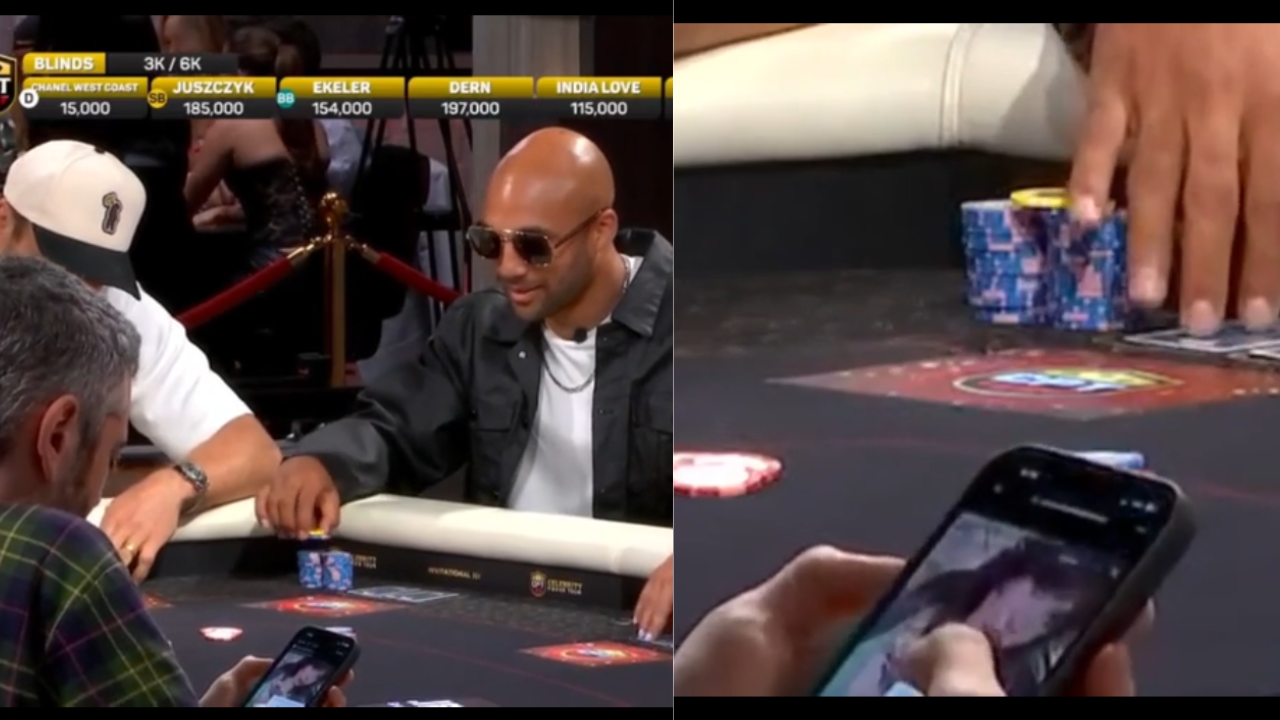
Ethan Klein found himself at the center of a digital firestorm during the Creator Dodgeball World Championship’s companion poker event. A stray camera angle caught the H3 Podcast host scrolling through Instagram and specifically capturing a screenshot of a story posted by Anisa Jomha, the wife of fellow creator iDubbbz. While the act itself lasted only seconds, the immediate explosion of commentary across X and Reddit highlighted a deeper tension in the creator economy. This was not just a breach of social etiquette. It was a collision between the private habits of a professional provocateur and the relentless, 360-degree surveillance of modern live-streaming.
The clip traveled fast because it felt like a "gotcha" moment in a long-standing web of interpersonal YouTube drama. In the high-intensity world of personality-driven content, every notification and swipe is potential fuel for a new narrative. Klein, known for his aggressive commentary on the behavior of others, was suddenly the one under the microscope for something as mundane—yet inherently suspicious in this context—as a screenshot.
The Technical Reality of the Live Stream Breach
Most viewers see a polished broadcast. They do not see the dozens of roving cameras, "rail" cameras, and overhead shots designed to catch every nuance of a player’s hand or their physical tells. When a creator sits at a televised poker table, they are consenting to a level of scrutiny that goes far beyond a standard vlog. The "screenshot heard 'round the world" happened because the production team prioritized a tight shot on Klein during a lull in the action.
The mechanics of the moment were simple. Klein opened his phone, navigated to Jomha’s profile, and performed the two-button press familiar to every smartphone user. In a vacuum, this is a non-event. In the context of the H3 Podcast’s history of critiquing Jomha and her husband, Ian "iDubbbz" Washburn, it looked like a tactical move for future content.
Why the Privacy Argument Fails in the Creator Circle
There is a frequent defense raised when these incidents occur. Fans often argue that even public figures deserve a "private" moment while sitting at a table for four hours. This ignores the contractual reality of these events. Creators are invited precisely because their every move can be monetized. The poker was secondary to the personalities.
When Klein screenshotted the post, he was engaging in a form of digital archiving. In the world of commentary, a deleted story is a lost piece of evidence. By capturing the image, Klein was essentially preparing a script for his next broadcast. The irony, of course, is that the very tools he uses to document others were turned against him in real-time.
The Long Tail of the H3 and iDubbbz Friction
To understand why this specific screenshot caused such a stir, one has to look at the shifting alliances of the "old guard" YouTubers. Klein and Washburn were once close allies, representing a specific era of edgy, confrontational comedy. As the industry matured, their paths diverged sharply. Washburn moved toward more serious documentary work and eventually issued a public apology for his past content, a move that Klein and his audience have dissected with varying degrees of skepticism.
Jomha has often been the lightning rod in this transition. By screenshotting her social media, Klein signaled that despite the "professional" setting of a charity or celebrity event, the "war" for content remains active. It suggests that even in a social setting, the mind of a professional commentator never truly shuts off. He was hunting for a "take" while sitting on a pair of jacks.
The Problem with Constant Connectivity
This incident sheds light on a growing problem for live-produced events featuring influencers. Unlike professional poker players who use their phones to check charts or listen to music, influencers use them to interact with their "real" world—their digital audience.
- The Distraction Factor: High-stakes poker requires focus. Klein’s focus was elsewhere.
- The Narrative Risk: Every action on a phone can be misinterpreted or, as in this case, interpreted exactly for what it is.
- The Production Blindspot: Producers often forget that capturing a phone screen is the ultimate "fourth wall" break.
The Fallout and the New Ethics of the Live Clip
We are entering an era where "background noise" no longer exists. Ten years ago, a creator could whisper a comment or look at a photo in a crowded room without fear of it becoming a headline. Today, the resolution of broadcast cameras is so high that the text on a phone screen held three feet away can be read by a teenager in his bedroom halfway across the world.
Klein’s mistake was a failure to adapt to the equipment. He treated a televised set like a private living room. For the broader industry, this serves as a warning. There is no such thing as "off the record" when you are wearing a lapel mic and sitting under a 4K rig.
The Currency of the Screenshot
In the modern creator economy, a screenshot is a weapon. It is the receipt. It is the proof of a deleted thought or a momentary lapse in judgment. By capturing Jomha’s story, Klein was essentially "reloading." The backlash he faced wasn't necessarily about the content of the story he saved, but the perceived creepiness of the act in a social environment.
This highlights the thin line between being an investigative commentator and being a digital stalker. When does "gathering research" become "invasive behavior"? The internet's answer depends entirely on whether they already like you or not. For Klein’s critics, this was a smoking gun of his obsession with his peers. For his fans, it was just "Ethan being Ethan."
The End of the Unwatched Moment
The real takeaway here isn't about poker or even about the specific drama between these creators. It is about the total erosion of the unobserved space. If a veteran like Ethan Klein, who has spent over a decade navigating the pitfalls of the internet, can be caught so easily, it suggests that the "live" format has outpaced the human ability to remain guarded.
Creators are now required to be "on" for eight, ten, or twelve hours at a time during these marathon events. The brain eventually tires. The guard drops. You check your feed. You screenshot a rival. And the camera, which never tires and never blinks, captures the exact moment your private curiosity becomes a public scandal.
The industry will likely see a push for "phone-free" zones at these events, not for the integrity of the game, but to protect the talent from themselves. Until then, the broadcast will continue to offer a window into the digital habits we usually keep hidden in our pockets. The screenshot wasn't just an image of a story; it was a snapshot of the constant, wearying cycle of creator conflict that defines the current media era.
Keep your phone facedown. The zoom lens is stronger than you think.