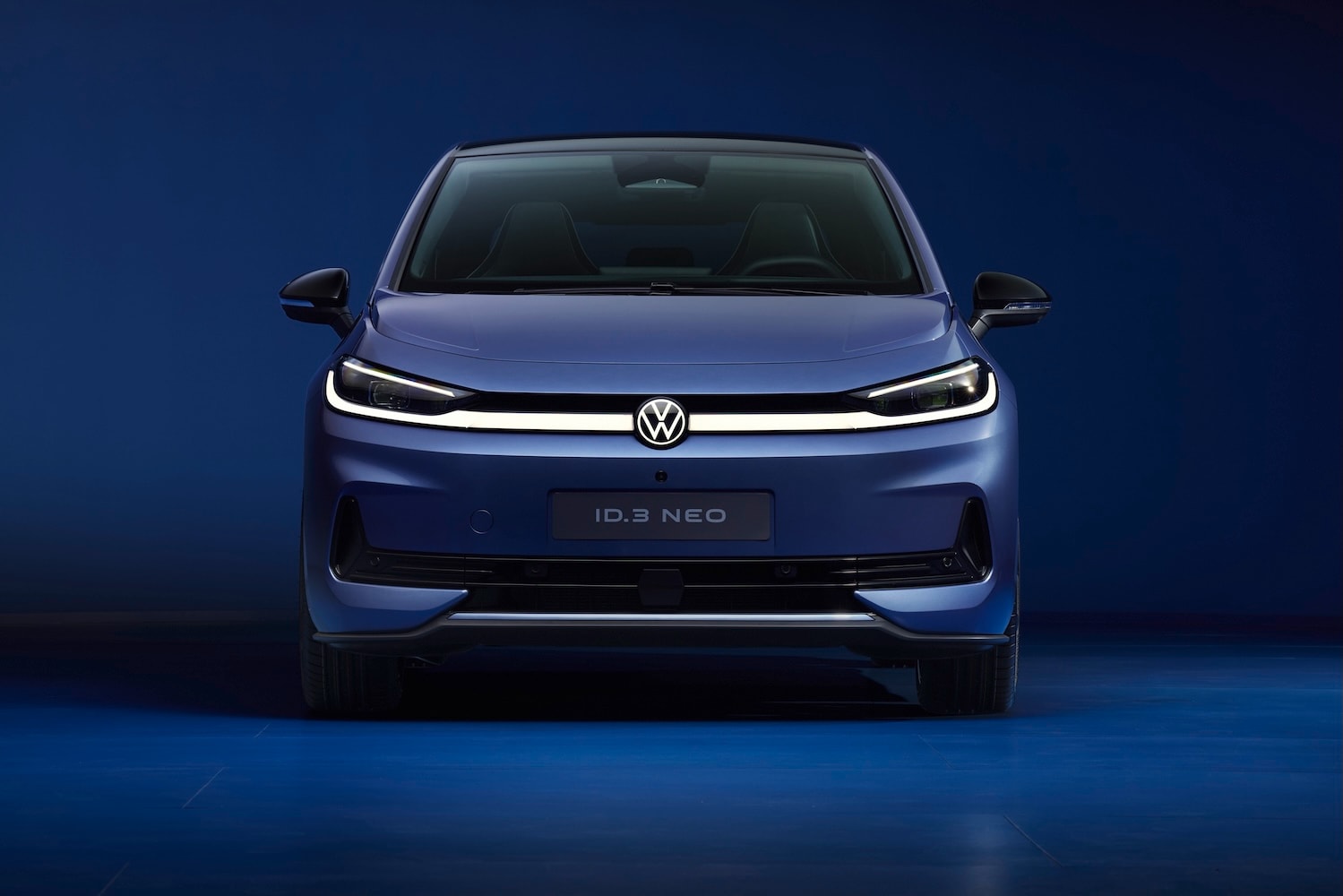
Volkswagen’s transition to the MEB (Modularer E-Antriebs-Baukasten) platform was originally heralded as a total convergence of hardware and software, yet the initial market execution of the ID.3 revealed a fundamental misalignment between digital ambition and ergonomic reality. The ID.3 Neo represents more than a mid-cycle refresh; it is a structural admission that the "touch-first" minimalist interior philosophy failed to account for the cognitive load requirements of high-speed driving. By reintroducing physical haptics and optimizing the energy density of the battery pack to achieve a 630 km range, Volkswagen is attempting to bridge the gap between legacy tactile reliability and the efficiency demands of the modern EV market.
The Triad of Operational Recovery
The ID.3 Neo focuses on three distinct vectors of improvement: thermal management efficiency, user interface (UI) ergonomics, and aesthetic refinement. To understand why these changes are significant, one must first identify the friction points in the previous iteration. The original ID.3 suffered from a capacitive-only interface that lacked backlighting and tactile feedback, leading to a measurable increase in driver distraction.
- Haptic Restoration: The return of physical buttons on the steering wheel and backlit sliders for climate control addresses the "no-look" operation requirement. In automotive safety engineering, the time a driver spends with eyes off the road is a critical risk variable. Capacitive surfaces without physical borders force the driver to use visual confirmation for every adjustment; physical controls utilize muscle memory to reduce this cognitive tax.
- Energy Density and Range Scaling: The jump to a 630 km range (WLTP cycle) indicates an optimization of the cell chemistry or a more aggressive battery management system (BMS) profile. Achieving this figure on the MEB platform suggests that Volkswagen has refined the discharge curve of the lithium-ion cells, potentially through improved thermal regulation that allows for a larger usable window of the total kWh capacity.
- Software Stack 4.0 Integration: The ID.3 Neo moves toward a more centralized computing architecture. The previous distributed ECU (Electronic Control Unit) model created latency in the infotainment system. The Neo utilizes a revamped software layer designed to handle the increased data throughput required for the new 12.9-inch display and augmented reality (AR) head-up display without the stuttering that plagued early MEB adopters.
The Cost Function of Ergonomic Failures
Volkswagen’s initial push toward a buttonless cockpit was driven by a cost-reduction strategy disguised as modernism. Removing physical switches reduces the Bill of Materials (BOM) and simplifies the wiring harness. However, the brand equity cost—measured in negative customer satisfaction scores and critical reviews—outweighed the assembly savings.
The ID.3 Neo’s interior pivot signifies a shift in the internal cost-benefit analysis. The reintroduction of physical components adds complexity to the manufacturing line but acts as a defensive maneuver against the perceived "cheapening" of the brand. This is a crucial distinction in the European market, where tactile quality is often equated with engineering integrity. The use of soft-touch recycled materials replaces the hard plastics of the original, targeting a higher perceived value without increasing the carbon footprint of the vehicle's lifecycle.
Battery Management and the 630 km Benchmark
The 630 km range figure is the primary psychological weapon in the Neo’s arsenal. In the EV sector, range is the most visible metric of competitiveness, even if daily utility rarely requires such a high ceiling. The engineering challenge for the ID.3 Neo was achieving this without fundamentally altering the wheelbase or the footprint of the battery tray.
The increase in range is likely the result of two technical shifts:
- Aerodynamic Drag Reduction: Small modifications to the front fascia and wheel designs reduce the drag coefficient ($C_d$). Even a 0.01 reduction in $C_d$ can yield significant gains in high-speed efficiency, which is where the previous ID.3 struggled most.
- Chemistry Optimization: By moving toward high-nickel cathodes or refining the anode structure, Volkswagen can pack more energy into the same physical volume. This allows the 77 kWh (net) battery to stretch further per charge.
The 630 km range serves as a hedge against the rising competition from Chinese manufacturers who prioritize high-capacity batteries. By matching or exceeding the range of the Tesla Model 3 Long Range, the ID.3 Neo repositioned itself as a viable primary vehicle for long-distance travel, moving beyond its "city car" origins.
The Logic of Physical Controls in a Digital Cabin
The debate between physical and digital controls is often framed as a matter of taste, but from a systems engineering perspective, it is a matter of feedback loops. A digital slider provides no passive feedback; the user must look at the screen to know if their finger is in the correct position. A physical dial or button provides tactile resistance and a "click" that confirms the action has been registered by the hardware.
In the ID.3 Neo, the integration of these controls into a high-resolution digital environment creates a hybrid interface. The 12.9-inch screen handles high-complexity tasks (navigation, media selection), while the physical buttons handle high-frequency tasks (volume, temperature, defrost). This separation of concerns optimizes the user experience by aligning the control method with the task's urgency and frequency.
Strategic Realignment of the MEB Platform
The MEB platform was designed to be universal, but universality often leads to mediocrity in specific use cases. The ID.3 Neo represents a specialization phase. Volkswagen is no longer trying to make the MEB platform do everything for everyone; they are refining it to compete in the premium-compact segment.
This refinement includes:
- Plug & Charge Capability: Reducing the friction of the charging process by automating authentication between the vehicle and the charger.
- Bidirectional Charging: Enabling the vehicle to act as a storage unit for home energy systems (V2H). This turns the car from a depreciating asset into a functional component of a household's energy infrastructure.
- Predictive Thermal Preconditioning: The navigation system now communicates directly with the BMS. If a DC fast charger is set as a destination, the car will heat or cool the battery to the optimal temperature (approx. 30°C to 40°C) before arrival, ensuring the highest possible charging speeds immediately upon arrival.
Structural Challenges to Market Dominance
Despite these improvements, the ID.3 Neo faces structural headwinds. The primary bottleneck is the price-to-performance ratio relative to internal combustion engine (ICE) counterparts and lean-manufacturing competitors. While the Neo improves the "product," it does not fully solve the "price" equation for the mass market.
The reliance on a legacy manufacturing footprint means Volkswagen’s labor costs per unit remain higher than those of vertically integrated competitors like Tesla or BYD. The ID.3 Neo must therefore rely on "brand premium" and superior service networks to justify its position. The return to physical controls is a direct attempt to bolster this brand premium by providing a "German-engineered" feel that cheaper competitors often lack.
The second limitation is the underlying 400V architecture. While the Neo optimizes charging speeds, it remains at a disadvantage compared to 800V systems (found in the Hyundai Ioniq 5 or Kia EV6) which can maintain higher peak charging rates for longer durations. Volkswagen is betting that for the compact ID.3 segment, 630 km of range and a more refined interior are more important to consumers than ultra-fast 10-to-80 percent charging times.
Tactical Recommendation for Market Positioning
Volkswagen must pivot its marketing away from "the future of mobility" and toward "the car, perfected." The ID.3 Neo is a correction of over-innovation. The strategic play here is to capture the "skeptical adopter"—the consumer who wants an EV but is repelled by the lack of buttons and the perceived flimsiness of early electric models.
To succeed, the distribution strategy must emphasize the tactile improvements. Showroom experiences should focus on the haptic feedback of the new steering wheel and the responsiveness of the software 4.0 stack. The 630 km range should be positioned not just as a distance metric, but as "anxiety-free" travel, emphasizing the predictive thermal management that makes that range accessible in cold weather conditions.
The ID.3 Neo is the definitive signal that the era of "innovation for the sake of minimalism" is ending. The industry is moving back toward a balanced architecture where digital screens are supported by physical reliability. For Volkswagen, the Neo is a necessary retreat to higher ground before they attempt the next leap in their EV evolution.