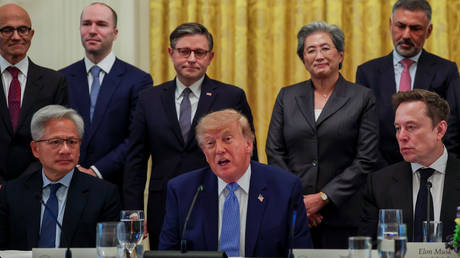
Elon Musk dropped a single post on X, and suddenly the tech press thinks a Silicon Valley executive got railroaded by woke corporate governance.
They missed the plot entirely.
The viral campaign to reinstate an ousted Nvidia leader—amplified by Musk’s massive megaphone—is being framed by mainstream tech outlets as a classic hero-versus-bureaucracy cage match. The lazy consensus goes like this: brilliant builder gets pushed out by timid HR managers, tech titan steps in to defend meritocracy, and the board of directors looks weak. It reads like a clean screenplay. It is also a massive distraction from how high-stakes semiconductor governance actually works.
When a multi-trillion-dollar hardware monopoly removes a senior leader, it is rarely about hurt feelings or ideological purity tests. It is about risk containment, supply-chain leverage, and protecting an asymmetric moat.
The Myth of the Indispensable Tech Martyr
Silicon Valley loves a martyr. Every few months, an executive exits under a cloud, a petition circulates on social media, and billionaire founders chime in to decry the death of founder mode.
I have sat in enough boardrooms and war rooms to know how this movie ends. I have watched companies burn millions of dollars and six months of engineering velocity trying to placate a charismatic leader who stopped respecting operational guardrails. On paper, that leader looks like a genius driving 80 percent of the innovation. Behind closed doors, they are often creating single points of failure, alienating tier-one suppliers, or exposing the company to catastrophic regulatory liability.
Tech journalists love the "ousted visionary" narrative because it requires zero technical literacy. You do not need to understand wafer allocation, CUDA lock-in, or export compliance to write a 600-word blog post about Elon Musk tweeting support for an underdog. You just summarize the outrage, embed three tweets, and hit publish.
Here is the reality nobody in the comment section wants to confront: Nvidia is not a struggling startup needing a maverick to break rules.
Under Jensen Huang, Nvidia operates with one of the flattest, most ruthless, and most execution-obsessed management structures in modern corporate history. Huang famously manages dozens of direct reports without traditional middle-management buffers. If someone gets ousted from that orbit, it is not because the company went soft. It is because that executive became an unacceptable drag on velocity or an acute legal hazard.
Why Elon Musk’s Endorsement Means Less Than You Think
Let us look at the mechanics of Musk’s intervention. Musk operates as a geopolitical actor with a personal hardware dependency. His companies—specifically xAI and Tesla—are among the largest buyers of high-end GPU clusters on the planet. Every tweet Musk fires off regarding Nvidia is simultaneously a public opinion play and a subtle negotiation tactic with his most critical supplier.
When Musk backs a campaign to reinstate a former Nvidia boss, he is not auditing internal HR files or reviewing confidential compliance logs. He is signaling alignment with an anti-establishment narrative that plays well to his base while subtly reminding Nvidia’s leadership that the industry is watching their internal politics.
Treating a billionaire’s social media endorsement as a forensic exoneration is amateur hour.
Think about the information asymmetry here:
- What the public sees: A passionate advocate, a viral petition, and a billionaire co-sign.
- What the board sees: Audited communications, IP boundary logs, customer escalation reports, and export-control exposure.
- What the competitors see: A rare crack in an otherwise airtight organizational fortress.
If you are betting on the public narrative over the board’s risk calculus at a company trading at historic multiples, you are ignoring basic fiduciary reality. Boards of companies worth trillions do not blow up a leadership seat on a whim. They do it when the cost of keeping the person exceeds the guaranteed PR nightmare of firing them.
What Everyone Is Really Asking (And Why the Premise Is Broken)
Whenever a high-profile tech ouster hits the front page, the search engines light up with the same predictable questions. Let us dismantle them with actual operational logic instead of fanboy speculation.
Can a viral petition actually force a public company to rehire an executive?
No. Almost never.
The only time a public pressure campaign reinstates an ousted tech leader is when institutional shareholders and key revenue drivers threaten immediate mutiny—like the OpenAI board meltdown in late 2023. Even then, OpenAI was a bizarre nonprofit-capped-profit hybrid where employees held all the leverage because there were no traditional public shareholders to answer to.
Nvidia is a publicly traded juggernaut governed by Delaware corporate law and institutional giants like Vanguard and BlackRock. Institutional investors care about predictable gross margins, datacenter roadmap execution, and zero regulatory interruptions. A petition signed by fifty thousand internet commenters carries zero voting shares at an annual general meeting.
Why would Nvidia risk bad press by firing a popular leader?
Because bad press lasts seventy-two hours, while a compliance failure or broken supplier relationship lasts five years.
In the semiconductor sector, reputation with regulators in Washington, Taipei, and Brussels matters infinitely more than popularity on X. Nvidia walks a razor-thin tightrope between US export restrictions, antitrust scrutiny from the Department of Justice, and total reliance on TSMC’s advanced packaging capacity. One rogue executive cutting corners, making unauthorized commitments to restricted entities, or creating a hostile environment that triggers a whistleblower lawsuit can invite federal monitors into the building.
Is "founder mode" dying at big tech companies?
The exact opposite is happening. True founder mode means the founder—not the internet—decides who stays on the bus.
People confuse "founder mode" with "zero accountability for executives." Real founder mode, as practiced by figures like Jensen Huang or even Musk himself at SpaceX, is an authoritarian commitment to the mission. If a lieutenant deviates from the mission or becomes bigger than the product, the founder cuts them loose without hesitation. Demanding that a founder keep an executive they already decided to remove is the antithesis of founder autonomy.
The Hidden Governance Trap in Hyper-Growth Hardware Companies
To understand why these blowups happen with increasing frequency, you have to look at what hyper-growth does to internal power dynamics.
When a company’s valuation explodes in less than twenty-four months, every vice president and regional head suddenly commands budgets larger than entire Fortune 500 companies. Ego inflation follows market cap inflation. Executives who were scrappy builders when the stock was at twenty dollars start acting like untouchable warlords when the stock hits a hundred and forty.
I have seen this exact pattern destroy entire divisions at enterprise tech firms. An executive delivers massive numbers during a boom cycle. Because the revenue charts point straight up, leadership ignores small procedural violations, dismisses complaints from peer teams, and overlooks sloppy documentation. Then the regulatory environment tightens or a supply bottleneck hits. Suddenly, those "minor" corners that got cut become existential liabilities.
Let us run a quick thought experiment to see how this plays out behind closed doors.
Imagine a scenario where a top hardware executive promises custom allocation timelines to a favored partner without clearing it through central supply-chain allocation, or brushes off internal legal reviews to close a marquee deal faster. During a quiet quarter, nobody notices. During a global GPU shortage where every major cloud provider and sovereign AI fund is auditing fairness and antitrust compliance, that single unilateral move becomes a smoking gun for regulators.
When leadership steps in to remove that person, they cannot go on CNBC and read the legal brief aloud. Confidentiality agreements, pending litigation, and regulatory sensitivities force the company to issue a sterile, three-sentence press release.
Nature abhors a vacuum. So the internet fills that silence with conspiracy theories.
The Downside of My Own Argument
I will be the first to admit where this hard-nosed defense of corporate governance breaks down.
Boards and HR departments do get captured by risk-averse bureaucrats. When a company grows past ten thousand employees, the immune system often attacks the exact antibodies that made the company great in the first place. Middle managers weaponize compliance policies to kneecap rivals who move faster than they do. Brilliant, abrasive engineers get pushed out by smooth-talking political operators who never ship a line of code or tape out a single chip.
If Nvidia’s internal immune system genuinely rejected a high-output builder over minor stylistic friction, that is a legitimate warning sign for long-term innovation. Great hardware companies die slowly when process worship replaces product obsession.
The catch is that outsiders cannot tell the difference between a bureaucratic hit job and a justified containment maneuver from a tweet. Both look identical from the outside: a sudden exit, corporate silence, and angry allies rallying online.
How Smart Operators Actually Read Executive Ousters
If you are an investor, a founder, or an executive watching this drama unfold, stop reading the hot takes and start watching the structural signals. Viral outrage is noise. Operational metrics are signal.
- Watch the direct reports, not the Twitter replies. When a truly indispensable leader gets unfairly purged, their top lieutenants quietly update their LinkedIn profiles and exit within ninety days. If the engineering and sales bench stays locked in place, the ousted boss was not the glue holding the team together.
- Track customer escalation patterns. In enterprise hardware, major buyers vote with purchase orders. If key accounts do not pause deployments or demand executive briefings after a leadership change, the transition was already priced into customer relationships months ago.
- Check the legal and compliance calendar. Sudden executive departures right before major earnings calls, antitrust filings, or international trade reviews are almost always preemptive cleanups. Leadership is clearing the deck before external auditors arrive.
- Ignore billionaire amplification unless capital follows it. Talk on social media is free. Until Musk or another major buyer actually shifts billions in capital expenditure away from Nvidia over a personnel dispute, their commentary is pure theater.
The tech media wants you to believe this story is about free speech, corporate wokeness, or one billionaire rescuing a fallen comrade. It is none of those things. It is a textbook collision between viral internet populism and the cold, unforgiving reality of running a critical global monopoly.
Elon Musk can win every poll on X, and the petition can hit a million signatures by Tuesday. Jensen Huang is still going to run Nvidia the exact same way he has for thirty years: ruthlessly, quietly, and without asking the internet for permission.


