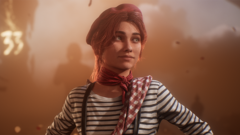
The room is too quiet for a celebration. In a small studio in Montpellier, France, a group of developers sits huddled around screens, the blue light reflecting off tired eyes that haven't seen a full night's sleep in months. They aren't looking at code anymore. They are looking at a list. It is the shortlist for the Bafta Games Awards, and their creation—a surreal, turn-based odyssey called Clair Obscur: Expedition 33—is sitting at the very top of it.
Nine nominations.
To the outside world, this is a statistic. To the people in that room, it is the sound of a heartbeat returning to a body they weren't sure would survive the winter. They are the underdogs who decided to build a high-fidelity role-playing game in an era where massive corporations are shuttering studios and playing it safe. They chose to tell a story about the end of the world, only to find themselves accidentally narrating the survival of their own dreams.
The Paintbrush and the Guillotine
To understand why Expedition 33 has captured the British Academy’s imagination, you have to understand the Paintress.
In the world of the game, every year, a spectral woman wakes up and paints a number on a monolith. Every person of that age turns to smoke. They simply cease to be. It is a literal countdown to extinction. This year, the number is 33. The protagonists, a group of "Expeditioners," set out on a suicide mission to kill the Paintress before she can pick up her brush again.
This isn't just a clever hook for a fantasy plot. It is a visceral metaphor for the ticking clock we all feel. We live in an age of "optimization," where every minute of our day is tracked, monetized, and judged. We are all Expeditioners, trying to reach some goal before our own internal clock hits a number that renders us obsolete. The Bafta judges didn't just see a polished game; they saw a mirror.
The game leads the pack with nods for Best Game, Narrative, and Artistic Achievement. It is standing shoulder-to-shoulder with titans, yet it feels different. It feels human. While other nominees might boast larger budgets or decade-long franchises, Sandfall Interactive’s debut feels like a defiant scream in a library.
The Sound of Falling Ash
Consider the category of Technical Achievement. Usually, this goes to the game with the most realistic water physics or the fewest frame-rate drops. But for Expedition 33, the achievement is emotional.
The developers took the "turn-based" genre—something often dismissed as slow or nostalgic—and injected it with shot of adrenaline. You don't just click a menu and wait for an animation to play. You parry. You dodge. You time your strikes in real-time. It’s a rhythmic dance between life and death.
Imagine a young animator, let's call him Marc. Marc spent three weeks perfecting the way a character's cape flutters when they realize they are about to be erased from existence. He didn't do it because a spreadsheet told him it would increase player retention by 0.5%. He did it because he knows what it feels like to be overlooked. He knows that in a world of digital noise, the only thing that cuts through is soul.
When the Bafta nominations for Music and Performer in a Leading Role were announced, they weren't just honoring voices and melodies. They were honoring the labor of people who stayed late to make sure a violin swell hit exactly when a player realized their favorite character wasn't going to make it to age 34.
The industry is currently obsessed with "live services" and "recurring revenue." Expedition 33 is an antithesis. It is a finite story. It has a beginning, a middle, and a brutal end. There is something profoundly brave about making a game that knows how to say goodbye.
The Shadow of the Giants
It is easy to look at the list of nominees and see a hierarchy. You have the established masterpieces, the indie darlings, and the surprise hits. But the Baftas have a history of looking past the marketing budget.
By securing nine nominations, Expedition 33 has effectively jumped the queue. It has bypassed the "wait and see" period and moved straight into the "must study" phase of game design. It’s not just competing for a trophy; it’s competing for the future of what a mid-sized studio can achieve.
Think about the risk. If this game had failed to land, it wouldn't have just been a bad fiscal quarter. It would have been the end of a vision. The "Clair Obscur" (Chiaroscuro) of the title refers to the contrast between light and dark. In the development office, that contrast was daily reality. One day, a breakthrough in the combat system (light); the next, news of industry-wide layoffs (dark).
The nominations serve as a validation of the "risk-heavy" model. It suggests that players—and critics—are starving for something that doesn't feel like it was designed by a committee of accountants. They want the rough edges. They want the strange, French-inspired surrealism. They want to feel like they are playing something that a human being actually cared about.
The Ghosts in the Machine
We often talk about video games as products. We "consume" them. We "review" them. But for the people nominated this year, these games are more like horcruxes. They have poured bits of their identity into the code.
When you play Expedition 33, you aren't just moving a 3D model through a landscape. You are interacting with the cumulative hours of a thousand lunch breaks, missed birthdays, and frantic late-night bug fixes. The Bafta nominations for Best Game are, in many ways, a recognition of that sacrifice.
The competition is fierce. There are games on that list that have sold tens of millions of copies. There are games that have changed the way we think about open worlds. But Expedition 33 has something they don't: the raw energy of a first attempt. It has the desperation of a story that needs to be told before the Paintress wakes up.
The invisible stakes are the most important ones. If a game like this wins, it tells every other small studio in the world that they don't have to follow the template. It tells them that they can be weird. They can be difficult. They can be poetic.
The Silence Before the Paint
On the night of the ceremony, the lights will dim, and the tuxedoed presenters will open the envelopes. For most of the audience, it’s a show. For the team from Montpellier, it’s a reckoning.
They will remember the days when the monolith seemed too tall to climb. They will remember the skeptics who said that turn-based RPGs were a dead language. And they will look at their peers—the creators of the other nominated masterpieces—and realize they aren't just competitors. They are fellow travelers in a darkening world.
The Paintress is always waking up. The clock is always ticking. The numbers on our own monoliths are always climbing toward a finality we can't escape.
But in the glow of those nine nominations, the shadows seem a little less imposing. The light of the Clair Obscur is holding steady. It turns out that even when the world is ending, there is still time to make something beautiful. There is still time to fight back.
The brush is poised. The paint is wet. But for one more night, the number remains unwritten.
The Expedition continues.