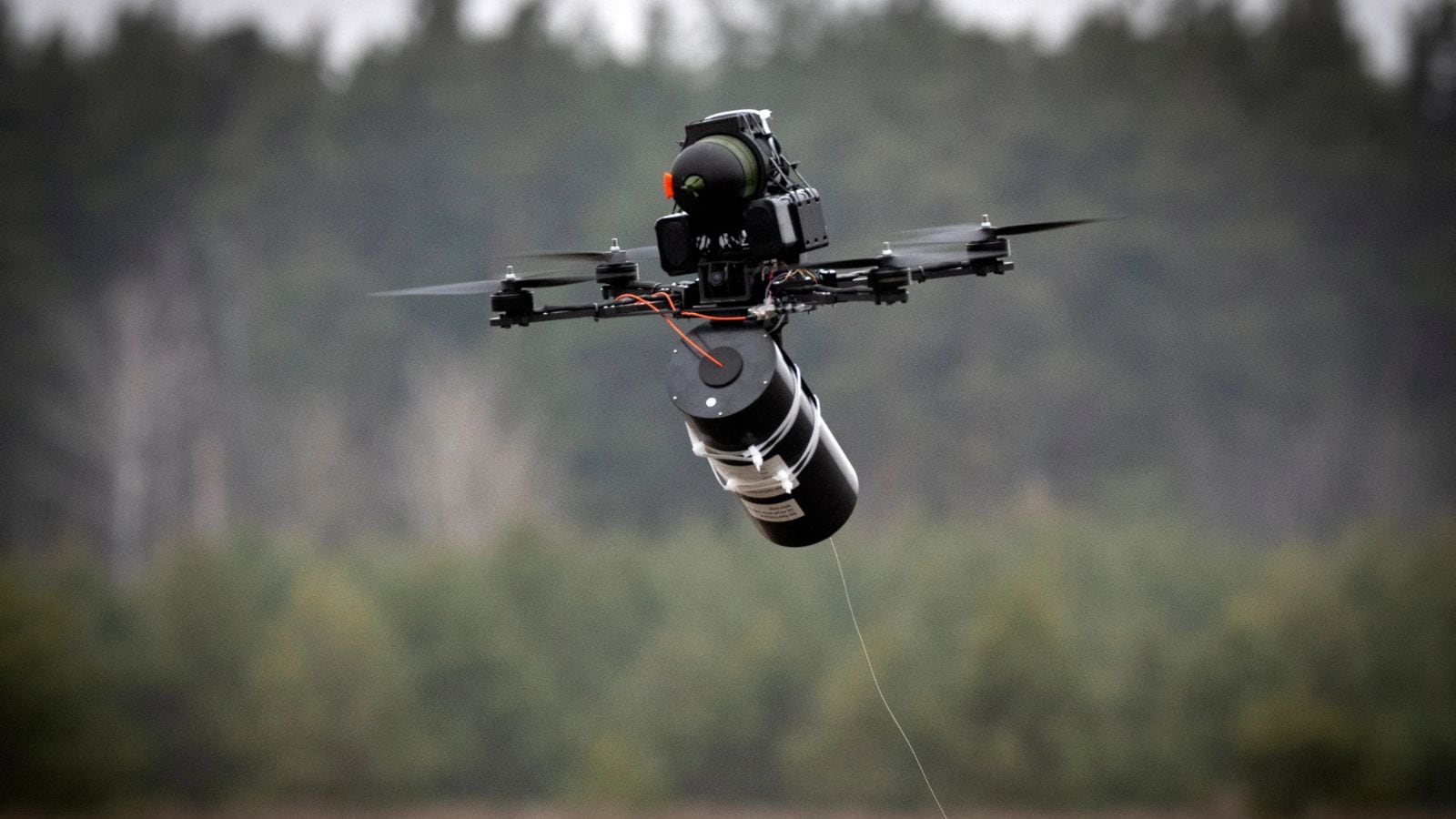
The electronic warfare bubble just popped. For years, the military-industrial complex sold us on the idea that jamming was the ultimate shield against drone swarms. If you could scramble the radio frequency, the drone would drop like a stone or fly aimlessly into a tree. It worked well enough in the early days of the Ukraine conflict. It worked for a while in the Middle East. But Hezbollah is currently proving that a spool of glass thread can render a multi-million dollar jammer completely useless.
We're seeing a fundamental shift in the border skirmishes between Israel and Hezbollah. The militant group has started deploying fiber-optic guided drones. These aren't your typical GPS-reliant quadcopters. They don't use Wi-Fi. They don't use radio links. Instead, they unroll a thin strand of fiber-optic cable behind them as they fly.
It’s a literal physical tether. Because there’s no wireless signal to intercept, there’s nothing for an electronic warfare (EW) suite to "jam." You can blast the sky with as much electromagnetic noise as you want. It won’t matter. The data stays inside the wire.
The Physical Link That Defies Logic
Most people think of drones as high-tech wireless marvels. Going back to a physical wire feels like a step backward, right? Wrong. In a high-intensity combat zone where the spectrum is crowded with interference, a wire is the only thing you can actually trust.
Hezbollah is likely using technology derived from the Iranian "Almas" missile system, which itself is a reverse-engineered version of the Israeli Spike missile. It’s ironic. The very technology designed to provide "man-in-the-loop" accuracy for anti-tank missiles is now being strapped to cheap, mass-produced FPV (First Person View) drones.
When a drone pilot in Lebanon flies one of these toward an IDF position, they get a crystal-clear, 4K-quality video feed all the way to the moment of impact. Standard drones usually get "snowy" or lose connection as they get closer to the ground or move behind hills. This is because of the Earth’s curvature or physical obstacles blocking the line of sight. With fiber optics, that doesn't happen. The cable goes where the drone goes.
The pilot can see through the "noise." They can see through the jamming. They can even see through some types of smoke. It makes these systems incredibly lethal against stationary targets and armored vehicles hidden in valleys.
Why Your Jammer Is Now Just An Expensive Radio
Electronic warfare works by being "louder" than the command signal. If a drone is listening for a 2.4GHz signal from its pilot, a jammer drowns that out with screaming static. The drone gets confused and fails.
Fiber optics move the data via light pulses inside a glass core. To jam that, you'd have to physically cut the wire. Since that wire is a fraction of a millimeter thick and trailing behind a drone moving at 100 kilometers per hour, good luck hitting it.
I've watched how EW units struggle with this. They see the drone on radar. They activate the "dome" of protection. The drone keeps coming. It doesn't flinch. It doesn't enter "Return to Home" mode. It just keeps tracking the target with terrifying precision. This isn't just a "hack." It's a hard counter to the way modern Western militaries have prepared for drone threats.
The Tradeoffs Nobody Mentions
Nothing is perfect. If fiber optics were the flawless solution to everything, we wouldn't have wireless tech at all. There are serious physical limitations to flying with a tail.
First, there's the weight. Carrying 5 or 10 kilometers of fiber-optic cable adds significant mass to a small drone. This kills the battery life. You aren't going to see these drones flying 50 miles behind enemy lines. They're short-range snipers. They’re meant for hitting targets just over the ridge or across the immediate border.
Then there's the snag factor. If the drone flies through a dense forest or circles a building too many times, the wire can catch on a branch or a jagged piece of metal. If the wire snaps, the drone is dead. It has no backup radio because, if it did, it would be vulnerable to jamming again.
Hezbollah's tactical shift shows they've weighed these risks. They don't need a drone that can fly for an hour. They need a drone that can survive for six minutes and hit a specific window in a command center. For that specific job, the wire is king.
How the IDF is Forced to React
Israel has some of the most advanced defense systems on the planet. The Iron Dome is great against rockets. The Trophy system is incredible against RPGs. But a tiny, wire-guided drone flying low and fast is a nightmare for automated systems.
We're seeing a return to "hard kill" solutions. If you can't scramble the brains of the drone, you have to hit it with a physical projectile. This means more 30mm cannons, more programmed airburst ammunition, and potentially, directed energy like the "Iron Beam" laser.
The problem is cost and reaction time. A fiber-optic drone might cost a few thousand dollars to assemble. An interceptor missile costs tens of thousands, if not more. Using a million-dollar system to stop a "toy" on a string is a losing game of attrition.
A Lesson in Low Tech Dominance
There's a lesson here about over-engineering. We spent decades and billions of dollars perfecting the "invisible" war of signals. Hezbollah looked at that and decided to use a technology that dates back to the 1970s wire-guided missiles, just updated for the 2020s.
It’s effective because it’s simple. It’s hard to stop because it doesn't play by the rules of the electromagnetic spectrum. It ignores the "digital" battlefield and stays in the physical one.
If you're tracking the security situation in the North, keep your eyes on the optics. The era of "safe" airspace behind a jammer is over. The battlefield is getting physical again.
Start looking into acoustic detection systems. Since radar can be tricky with small plastics and EW is useless against fiber, sound is one of the few reliable ways left to spot these things before they’re on top of you. Focus on "kinetic" interception. If it has a wire, you have to break the machine, not the signal. That’s the new reality of drone warfare. No more easy buttons. Just hard physics.



.png?width=1200&auto=webp&trim=0%2C0%2C0%2C0)