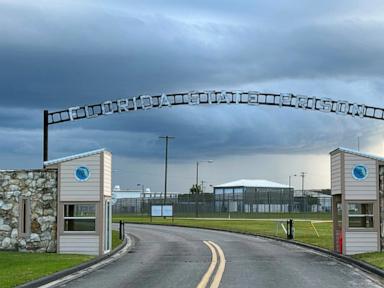
The air inside a witness viewing room at the Florida State Prison in Starke does not circulate like regular air. It feels heavy, thick with the collective breath of people waiting for a man to die. For those who sit in those plastic chairs, the world narrows down to a thick pane of glass and the gurney on the other side.
Outside, the Florida sun beats down on the flat, uncompromising landscape of Bradford County. Inside, time stretches.
By the time the lethal injection lines are cleared for execution in the coming days, Florida will have put eight people to death in 2026 alone. It is a pacing that the state has not seen in decades, a systematic clearing of death row that has turned the execution chamber into a conveyor belt of finality. But behind the statistics, the legal filings, and the dry press releases from the Governor’s office lies a story of absolute devastation that began long before the state ever readied a needle.
This is not a story about abstract justice. It is a story about the crushing weight of what happens when the vulnerable are left unprotected, and what remains when the state finally exacts its highest price.
The Room Where Time Stopped
To understand how a man ends up strapped to a gurney as the eighth execution of a single year, you have to travel backward. Past the appeals. Past the mandatory judicial reviews. Past the prison bars and the decades of waiting. You have to go back to a quiet apartment, to the sound of television static, and to the fragile life of an infant who could not yet speak to defend himself.
The crime itself occupies a dark, permanent space in the public record. A mother leaves her baby in the care of her boyfriend. The trust is misplaced. The violence that follows is swift, brutal, and entirely senseless. When the paramedics arrive, the air is filled with panic.
Medical examiners would later testify about the specifics. They used cold, anatomical terms to describe what happens to a child's body under the force of adult anger. Fractures. Internal hemorrhaging. Trauma so severe that the human brain simply shuts down under the pressure. The baby died because he was small, and because the person responsible for his safety chose violence instead of protection.
In courtrooms, these facts are laid out on glossy poster boards. Prosecutors point with laser pointers. Defense attorneys look down at their legal pads. But for the family left behind, the trial is just a formal dress rehearsal for a grief that never ends.
Consider the mother. She is a figure often lost in the margins of these high-profile execution stories. The public judges her for her choice of partner. The legal system uses her testimony to secure a conviction. But she is trapped in a permanent purgatory of "what ifs." Every milestone her child should have reached—the first day of school, a driver's license, a wedding—is replaced by a silent anniversary marked only by a visit to a manicured plot of grass.
The Machinery of Death
Florida’s death penalty operates with a clinical precision that masks the raw emotion underneath. The process is designed to be sterile.
Once the death warrant is signed, the inmate is moved to a death watch cell, mere feet from the execution chamber. The final weeks are a countdown of mundane details mixed with existential terror. The choosing of a final meal. The restriction of phone calls. The sound of guards testing the equipment in the next room, a rhythmic clicking that serves as a heartbeat for an impending death.
The state justifies this through the concept of retribution. The argument is simple: some crimes are so heinous that the only proportional response is the forfeiture of the offender's life. It is a philosophy that dates back to the earliest codes of human law.
Yet, as the state prepares for its eighth execution of the year, the sheer frequency raises questions that go beyond the guilt of the man on the gurney.
When capital punishment becomes routine, it loses its status as an extraordinary measure. It becomes a bureaucratic function. The executioner becomes a state employee performing a task, checking boxes on a clipboard, ensuring the chemicals flow in the correct sequence—the sedative first, then the paralytic, then the drug that stops the heart.
The state kills to demonstrate that killing is wrong. The paradox is obvious, yet the machinery grinds on, fueled by a collective societal anger that demands closure, even if that closure is an illusion.
The Illusion of Closure
We tell ourselves that executions bring peace to the victims' families. We use the word "closure" as if it were a physical place, a room you can walk into and lock the door behind you.
But talk to those who have stood outside the prison gates after the white van carries the body away. The anger doesn’t vanish when the heart monitor flatlines. The emptiness inside the family home remains just as vast. The man who committed the atrocity is gone, but the child is still missing from the dinner table.
The legal battle creates a false focal point. For years, the family's energy is channeled into hearings, appeals, and state supreme court decisions. They become experts in capital jurisprudence. They know the names of judges and prosecutors. They focus on the execution date as the finish line of their marathon of pain.
Then the day arrives. The curtain opens. The chemicals are administered. The curtain closes.
And then?
The drive home is quiet. The news trucks pack up their satellite dishes. The reporters move on to the next case, the next warrant, the next press conference. The family is left with the silence of a Tuesday morning, realizing that the execution was not a time machine. It could not undo the violence of the past. It merely added another death to the ledger.
The Weight of the System
There is an invisible toll that capital punishment exacts on everyone it touches. The corrections officers who must maintain professional distance while watching a man they have guarded for years prepare for death. The attorneys who carry the weight of a life in their briefcases, knowing that a single missed deadline or a poorly argued motion could mean the end.
The system is designed to be infallible, but it is run by humans. It is prone to the same biases, mistakes, and pressures that plague every other institution. In Florida, the history of the death penalty is littered with exonerations—men who spent decades on death row for crimes they did not commit, saved only by the arrival of new DNA technology or a witness who finally decided to tell the truth.
This particular inmate is not an exoneree. His guilt is not in question. The evidence of his brutality against a defenseless baby is overwhelming.
But the question the state faces with its eighth execution of 2026 is not whether he deserves to die, but whether we, as a society, deserve to kill. Every execution requires a collective agreement to look away from the humanity of the condemned, to reduce a complex, flawed, and broken individual into a single monstrous act.
When the needle enters the vein, it is done in the name of every citizen of the state. The executioner's hand is guided by the law, and the law is written by the people. We are all in that room, standing behind the glass, watching the rhythmic rise and fall of a chest until it stops.
The clock on the wall of the execution chamber doesn't tick louder than any other clock, but in those final moments, the silence between the seconds is deafening. The state will get its justice, defined by the strict parameters of Florida statute. The ledger will be balanced with ink and blood.
But as the witnesses walk out into the humid evening air, past the armed guards and the perimeter fencing, the realization sets in. The darkness that entered that apartment all those years ago did not leave the world when the inmate died. It merely found a permanent home in the memory of everyone who watched the light go out.