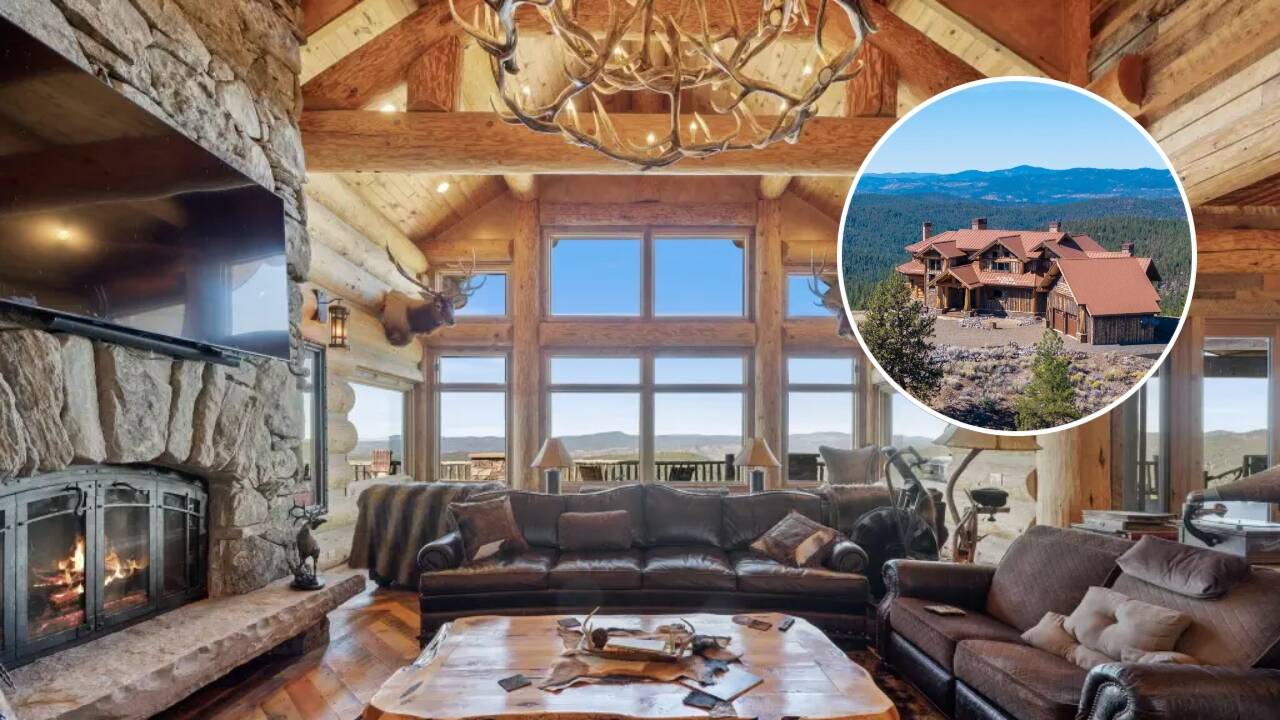
The valuation of luxury real estate at the absolute peak of the market does not follow standard comparable sales metrics. When a property like the Oregon ranch with a self-sustaining lodge lists for fifty-four million dollars, the pricing mechanism shifts from residential square footage calculations to enterprise-level asset valuation, operational cost-benefit analysis, and risk mitigation economics. Assets of this scale operate less like traditional homes and more like private corporate compounds or boutique sovereign entities. Analyzing a transaction of this magnitude requires deconstructing the underlying cost functions, operational dependencies, and liquidity constraints that govern ultra-high-net-worth real estate.
The Capital Expenditure Structure of Self-Sustaining Infrastructure
Achieving true self-sustainability on a multi-thousand-acre property demands massive capital expenditure that dwarfs the initial acquisition cost. Buyers in this tier are not paying merely for aesthetic luxury or scenic isolation; they are purchasing an independent utility and security grid.
The primary cost drivers of self-sustaining remote infrastructure include:
- Power Generation and Redundancy: Off-grid capabilities require utility-grade microgrids, typically combining commercial solar arrays, battery storage banks, and diesel generator backups with automated switching systems. The cost function of this infrastructure scales non-linearly with the acreage and operational footprint of the lodge.
- Water Acquisition and Rights: Owning land with primary water rights is fundamentally an economic moat. Infrastructure must account for deep-well pumping, filtration, storage reservoirs, and distribution piping that withstands extreme seasonal temperature swings.
- Waste and Resource Management: Closed-loop systems for wastewater treatment, commercial-grade composting, and heavy-duty mechanical maintenance shops are mandatory operational overheads that require continuous capital reinvestment.
When a property internalizes these utilities, the operational expenditure shifts from passive municipal service fees to active asset management. The owner assumes the role of a municipal utility operator, which changes the total cost of ownership equation significantly compared to a traditional suburban luxury estate.
The Liquidity Trap and Asset Illiquidity Premium
Ultra-prime rural real estate exists in an extreme liquidity desert. The addressable market for a fifty-four-million-dollar remote ranch is extraordinarily narrow, restricted to a fractional percentage of global ultra-high-net-worth individuals.
This creates a severe pricing asymmetry. The holding cost—comprising property taxes, specialized insurance, security, and infrastructure maintenance—runs in the millions annually. Because the exit timeline for a specialized asset can easily span three to seven years, the holding friction acts as a heavy tax on capital.
Sellers at this level do not price based on cost-plus methodology. Instead, they price based on scarcity value and replacement cost. The fifty-four-million-dollar figure represents an attempt to capture the absolute scarcity rent of assembled contiguous land parcels, water rights, and completed commercial-grade infrastructure that could not be replicated today within a reasonable timeframe due to environmental permitting hurdles and supply chain constraints.
Operational Risk Analysis and Revenue Mitigation
Properties configured as self-sustaining lodges often flirt with dual identities: private sanctuary versus commercial or semi-commercial hospitality operations. This creates operational tension.
Operating a remote lodge requires a dedicated, full-time staff ranging from facility engineers and agricultural managers to hospitality professionals and security personnel. The payroll and retention costs for skilled remote labor represent a fixed overhead that must be balanced against utilization rates. If the asset remains vacant for forty weeks out of the year, the marginal cost of maintenance spikes due to weather exposure and degradation of idle mechanical systems.
Conversely, attempting to monetize the property through high-end corporate retreats or luxury eco-tourism introduces liability, wear and tear, and privacy compromises that directly contradict the core utility of a private sanctuary. The buyer must resolve this optimization problem: accept continuous cash bleed as a pure lifestyle cost, or run a complex hospitality business that dilutes the primary asset's core value proposition as an ultra-private retreat.
The Strategic Play
Evaluate multi-million-dollar remote agricultural and lodge assets through the lens of enterprise replacement cost rather than residential valuation metrics. Discount the asking price by the estimated five-year capital expenditure required to bring aging self-sustaining infrastructure up to commercial redundancy standards, and treat the transaction as an acquisition of an illiquid operating business rather than a passive store of value.