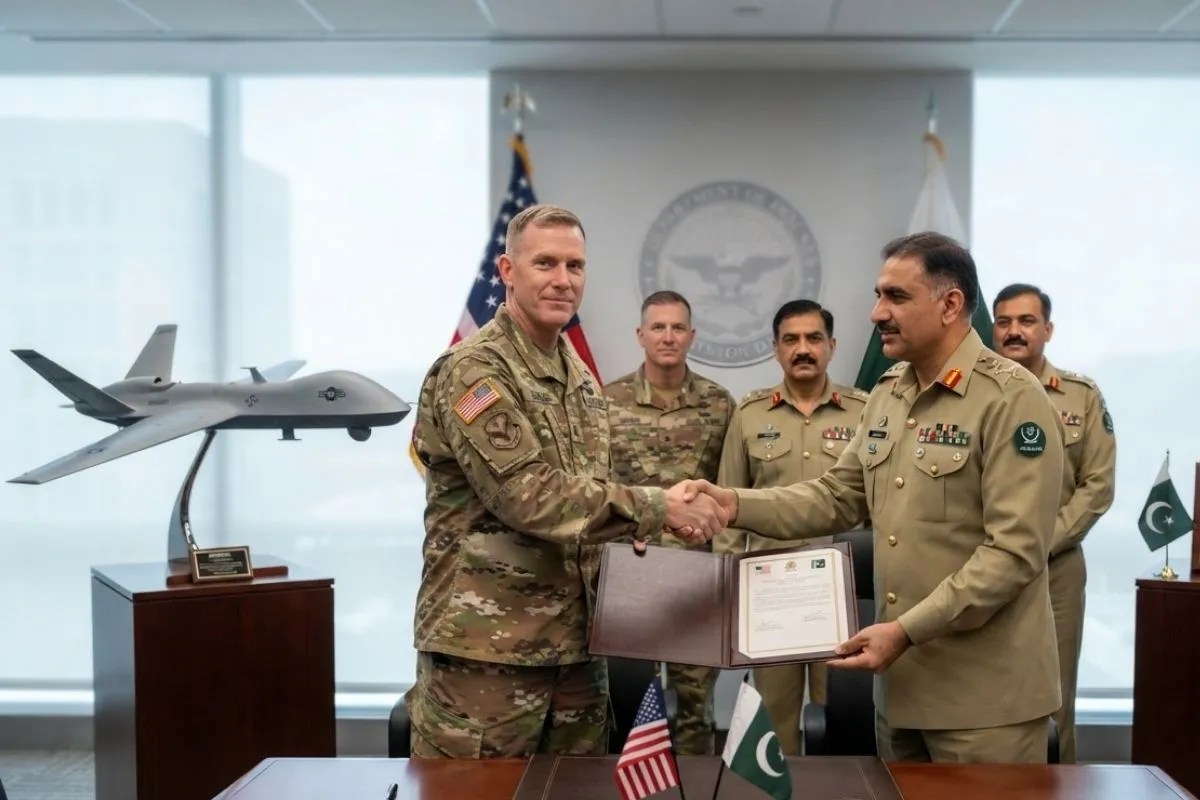
The intersection of commercial defense technology and executive family equity structures creates complex governance challenges that standard international relations frameworks often fail to capture. The recent memorandum of understanding signed between American unmanned aerial systems manufacturer Powerus and the Pakistan Army, led by Field Marshal Syed Asim Munir, offers a clear case study in how private corporate consolidation intersects with state-level procurement. By examining the structural components of this agreement, including the pending merger involving entities linked to Donald Trump Jr. and Eric Trump, observers can isolate the distinct economic incentives and strategic risks driving this technology transfer.
The Corporate Architecture and Ownership Mechanics
The transaction centers on Powerus, a firm specializing in tactical aerial and maritime drones, and its impending merger with Aureus Greenway Holdings. Regulatory filings indicate that an investment vehicle designated as American Ventures holds a beneficial ownership stake that will translate into approximately a 9.9 percent equity position in the combined corporate entity following the merger. Donald Trump Jr. and Eric Trump hold passive financial exposures within this structure through the investment fund.
From a corporate finance perspective, this setup creates a multi-layered separation between operational execution and ultimate beneficial ownership. Company representatives and White House spokespersons have maintained that the executive family members possess no operational control, day-to-day managerial duties, or prior knowledge regarding specific international sales negotiations.
However, the structural proximity introduces analytical friction. In defense markets, brand association and political signaling frequently function as intangible assets. Even without direct executive intervention, the perception of alignment can alter risk calculations for foreign defense ministries seeking to signal diplomatic favor to Washington.
The Operational Scope of the Procurement
The agreement comprises two distinct legal instruments: a broad memorandum of understanding focusing on joint technology frameworks and local manufacturing exploration, alongside a limited procurement order for unmanned aerial systems placed by the Pakistan Ministry of Defence.
- Unmanned Aerial Systems Supply: The initial acquisition focuses on tactical platforms capable of surveillance and targeted deployment. While exact unit volumes and financial valuations remain classified due to proprietary and security sensitivities, the arrangement establishes a baseline supply chain.
- Industrial Localization: Powerus leadership has articulated an intent to explore domestic production pathways within Pakistan, specifically evaluating military industrial sites for localized assembly and technological integration.
The strategic rationale from Islamabad centers on indigenization. Pakistan has historically relied on diversified procurement channels, integrating platforms from China and Turkey. Introducing a U.S.-origin private vendor into this matrix diversifies their technological inputs, though it creates operational overlap with existing defense partnerships.
Dual-Sourced Technology and Regional Friction
A critical analytical dimension of the Powerus-Pakistan agreement involves market overlap. Powerus technology is simultaneously marketed or deployed within other regional markets, including India. When a single private defense contractor supplies competing state actors, distinct supply chain vulnerabilities emerge.
- Strategic Hedging: Pakistan's outreach to a U.S. firm with indirect political connections represents an effort to institutionalize bilateral defense linkages independent of shifting congressional appropriations or traditional foreign military financing channels.
- Adversarial Procurement Risk: Supplying technologically similar aerial platforms to states engaged in strategic rivalry creates intelligence and countermeasure parity challenges. Military analysts note that commonalities in hardware architecture can accelerate electronic warfare adaptation cycles for both nations.
- Alliance Coherence: The arrangement tests the tolerance limits of existing suppliers like Beijing and Ankara, who view Pakistan as a core partner in regional defense manufacturing. Introducing an American private entity into the local manufacturing ecosystem requires careful diplomatic balancing to avoid alienating primary strategic creditors.
Evaluating Long-Term Market Viability
The durability of this procurement channel depends on regulatory oversight and execution capacity. Because the transaction involves defense-related articles, export controls and Department of State compliance mechanisms govern any physical transfer of technology or manufacturing blueprints.
If the proposed local assembly sites move from memorandum status to operational facilities, the agreement will shift from a standard export contract to a complex foreign direct investment in defense infrastructure. Tracking whether the Ministry of Defence issues follow-on orders to Powerus or diversifies further among other private Western vendors will provide the definitive metric for assessing whether this arrangement represents a permanent realignment of Pakistan's defense procurement strategy or a temporary transactional anomaly.