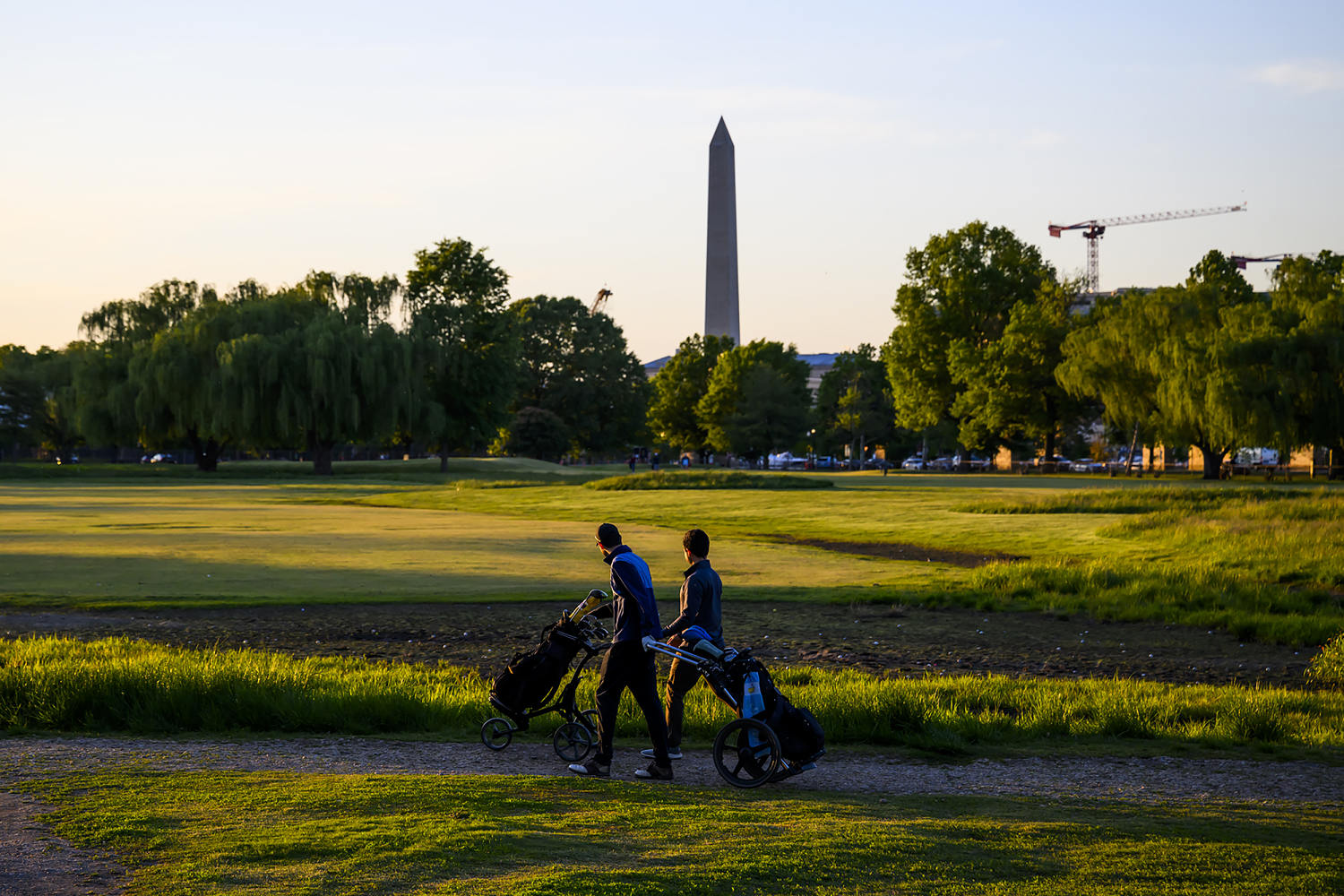
President Donald Trump's plan to overhaul the historic East Potomac Golf Links in Washington, D.C., into a championship-caliber venue is stalled in federal court after U.S. District Judge Ana Reyes issued a temporary restraining order blocking closure and construction work through November 28, 2026. What started as a dispute over municipal golf maintenance and White House demolition rubble has escalated into a bruising clash over executive authority, environmental law, and government candor in court.
Surface-level coverage treats this fight as a straightforward clash between a developer-president who wants to fix a rundown public course and preservationists who hate change. Anyone who has covered land-use fights and federal litigation long enough knows that is rarely the whole story. When a public park sits on a peninsula flanked by the Potomac River and the Washington Channel, every inch of grading, tree removal, and seawall repair triggers interlocking statutes and political incentives that do not vanish just because a president posts a schedule on Truth Social.
How East Wing Rubble Triggered a Municipal Takeover
The dispute did not begin with a polished architectural master plan. It began with dirt.
As demolition progressed on the East Wing of the White House to clear ground for a new ballroom, crews needed somewhere to haul excavated soil and debris. Interior Secretary Doug Burgum suggested sending material to Hains Point on the East Potomac Golf Links to serve as fill for a potential redesign, according to reporting cited in court filings and legal commentary. Golfers suddenly found mounds of rubble near holes on the White Course, raising alarms among advocates over potential contaminants such as asbestos.
Shortly after that reporting emerged in late December 2025, the Department of the Interior moved to revoke the 50-year lease held by the National Links Trust, a nonprofit that had been working to restore D.C.'s municipal golf facilities. By May 2026, a settlement left the trust with other courses while placing East Potomac squarely under Interior's control. Trump then brought in golf course architect Tom Fazio—who had previously designed courses for Trump properties—and floated turning the facility into a "U.S. Open-caliber" destination capable of hosting major championships or a Ryder Cup.
From an operations standpoint, that championship pitch runs straight into physical reality. Modern major tournaments and a Ryder Cup require massive staging footprints for hospitality tents, broadcast compounds, shuttle logistics, and spectator crowds that a narrow riverfront peninsula in downtown Washington struggles to absorb without disrupting surrounding park roads and river edges. Even if Fazio reshapes the routing into a single 18-hole championship layout in place of the existing multi-course setup for varying skill levels, turning a gritty, affordable municipal staple into a marquee tournament venue inevitably raises questions about green fees, tee-time access, and who the course actually serves.
Social Media Promises vs. Courtroom Claims
In federal litigation, credibility is currency. The administration spent much of 2026 spending it recklessly.
For months, Justice Department attorneys told the court in DC Preservation League v. Department of the Interior that no final decision or authorization to overhaul the East Potomac Golf Links existed—characterizing the effort as conceptual or preliminary while assuring the judge that the government would provide advance notice before major construction or large-scale tree removal.
Then came the calendar. On October 10, 2026, crews cut down hundreds of trees on the course without the kind of prior notice plaintiffs and the court expected. Days later, Trump posted on Truth Social announcing plans developed with Interior and Fazio to build a championship course, setting a November 15 start date and a 15-month closure timeline.
"This started as a case about golf. That good walk spoiled," Judge Ana Reyes wrote in her opinion, capturing how a local land fight collided with contradictory statements from the bench and the bully pulpit.
💡 You might also like: The Price of a Blank Page
That gap between public declarations and courtroom representations created severe friction. Reyes ordered a misconduct inquiry into whether government officials and lawyers misled the court, and she rejected a mid-October motion asking her to recuse herself for alleged bias. White House officials and Trump pushed back fiercely, calling her orders political and arguing that lower courts were obstructing a mandate backed by Supreme Court wins.
The Seawall Shield and Statutory Hurdles
When a direct push to close the park ran into judicial skepticism, the administration pivoted toward infrastructure and urgency.
Officials pointed to the aging seawall around the park—a project estimated to cost at least $300 million—and argued that safety risks and deteriorating turf justified an immediate 15-month shutdown. Reyes was not convinced that a sudden closure was necessary to address seawall problems that the National Park Service had documented for years, drawing a line between legitimate repairs and sweeping course redevelopment.
| Issue | Administration Position | Plaintiffs and Court Focus |
|---|---|---|
| Course Redesign | Replace existing layout with a single 18-hole championship course by Tom Fazio. | Claims of lost beginner and affordable public access; statutory park mandate. |
| Environmental Review | Cites poor turf conditions, maintenance needs, and seawall safety. | Alleged violations of NEPA, NHPA, and improper segmentation of review. |
| Park Closure | Sought a 15-month shutdown starting mid-November for work. | Temporary restraining order keeps park open through November 28, 2026. |
| Court Candor | Insisted plans were not final while arguing against a misconduct inquiry. | Judge cited social media posts and tree felling in ordering ethics scrutiny. |
There is a legitimate gray area here that critics on both sides sometimes gloss over. Anyone who has walked a heavily played municipal course with aging drainage, worn greens, and crumbling waterfront bulkheads knows deferred maintenance is real. A course does not stay healthy on nostalgia alone.
Yet federal environmental and historic preservation laws exist precisely to force agencies to study impacts—such as tree canopy loss, runoff, flood risk, and historic park character—before bulldozers reshape public land. Speeding past environmental review in the name of urgency is a classic administrative shortcut, and it is the exact shortcut that gets injunctions granted.
Why East Potomac Means More Than Golf in Washington
East Potomac Golf Links carries weight in Washington that goes far beyond scorecards. Opened to the public in July 1920 for 25 cents a round, it became a cornerstone of municipal recreation. In 1941, Black golfers played an 18-hole round there amid hostility in a pivotal challenge to segregation at capital facilities, a milestone that helped propel broader desegregation of national park spaces.
To local golfers, runners, cyclists, and families picnicking near the river, the peninsula is a democratic commons sitting minutes from federal monuments. To Trump, it is one piece of a wider physical remaking of the capital—alongside a proposed triumphal arch, White House ballroom construction, and changes at the Kennedy Center—designed to project grandeur and personal imprint.
With appellate review underway, ethics inquiries hanging over the litigation, and incoming congressional majorities eyeing federal spending levers, the temporary block on the East Potomac Golf Links renovation is only the latest round in a fight over who gets to reshape public space in the nation's capital. Watch whether the administration slows down to build an airtight administrative record or tries to force the issue through appeals before the next construction season peaks.