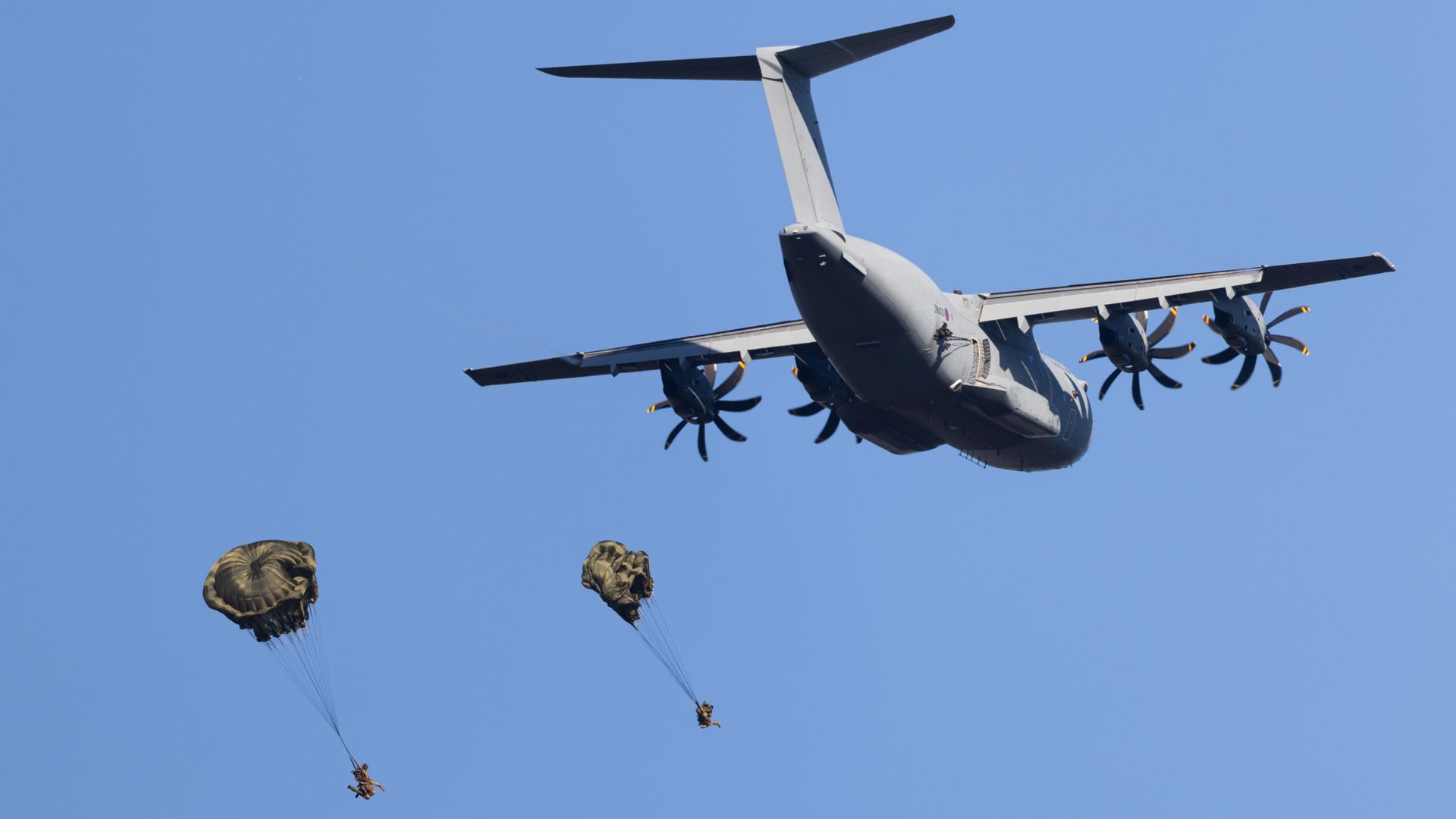
Military public affairs officers love a good parachute drop. It photographs well. Thousands of silk canopies blossoming against a grey European sky, elite British and French paratroopers floating down onto a German training ground—it looks like the opening reel of a classic war movie. Mainstream defense coverage eats it up, framing these massive airborne exercises as a triumphant display of NATO deterrence, Allied interoperability, and rapid-response readiness.
They are completely missing the point. You might also find this similar story useful: Why Israel Mass Protests against Netanyahu Signal a Permanent Political Shift.
When defense reporters gush over British and French airborne forces jumping into Germany, they are falling for a century-old romanticism that modern warfare rendered obsolete years ago. Far from proving that Western Europe can rapidly project power into a contested zone, these mass airborne drills highlight a dangerous institutional nostalgia. In an era of integrated air defense systems, ubiquitous satellite surveillance, and cheap loitering munitions, the large-scale parachute assault is not a viable warfighting tactic. It is expensive military theater.
To understand why, you have to strip away the press releases and look at the cold, hard math of modern air combat. As highlighted in recent reports by Associated Press, the effects are widespread.
The Myth of the Rapid Airborne Assault
The standard narrative surrounding joint British and French airborne exercises—like the recurring drills held at major German training areas such as Hohenfels or Grafenwöhr—rests on a simple premise. If a crisis erupts on NATO’s eastern flank, elite units like the UK’s 16 Air Assault Brigade and France’s 11th Parachute Brigade can board transport aircraft, fly across Europe, and drop behind enemy lines to seize key terrain before heavier armored divisions arrive.
That premise collapses the second you introduce a peer adversary.
A mass airborne insertion requires air superiority—not just local, temporary air parity, but the total suppression of enemy anti-aircraft capabilities along the entire flight corridor and over the drop zone. Slow, unarmored cargo planes like the Airbus A400M or the C-130J Hercules have the radar cross-section of a flying barn. They fly at predictable altitudes and slow speeds during a drop.
Against a non-state insurgent group with pickup trucks and rifles, this works. We saw it work in Mali in 2013 when French paratroopers dropped into Timbuktu during Operation Serval. Against a state military equipped with layered Surface-to-Air Missile (SAM) networks like the S-400, long-range radar, and electronic warfare suites, those transport planes would be shredded miles before reaching the drop zone.
Imagine a scenario where a brigade-sized airborne force attempts a night drop within 100 kilometers of a modern, contested front line. Even if a fraction of the aircraft survive the approach, the paratroopers exit the plane carrying only what is strapped to their bodies. Once on the ground, they are light infantry. They have no heavy armor, limited artillery, minimal anti-air protection, and a logistics tail that relies entirely on aerial resupply—which is now impossible because the air corridor is a shooting gallery.
The historical precedent isn't D-Day. It’s Operation Market Garden in 1944, or the Russian VDV disaster at Hostomel Airport in February 2022. When elite Russian airborne troops attempted a rapid air assault to seize a key airfield outside Kyiv, they were cut off, outgunned by Ukrainian artillery and mechanized units, and decimated. Modern lethality punishes lightly armed troops dropped into a meat grinder.
What These Wargames Actually Test
If mass parachute drops are suicidal in a high-intensity war, why do London and Paris keep spending millions of euros to stage them in Germany?
Because the parachute jump is just the flashy wrapper around the actual objective: staff-level command and control (C2) integration.
I’ve watched defense planners spend entire budgets perfecting the choreography of a joint jump, only to see the real friction happen inside a muddy command tent three miles away. Getting a British brigade headquarters and a French brigade headquarters to talk to each other seamlessly during a chaotic operation is extraordinarily difficult. They use different cryptographic systems, different tactical software, different logistics tracking databases, and distinct chains of command.
When British and French troops train together in Germany, the real victory isn't that 1,000 soldiers landed in a field without breaking their ankles. The real victory is that a French signals officer figured out how to patch British targeting data into a German artillery network without the servers crashing.
By framing the story around the cinematic parachute drop, mainstream journalists ignore the much harder, less photogenic reality of European defense. Europe doesn't suffer from a shortage of brave paratroopers. It suffers from fractured communications architectures, incompatible ammunition standards, and a chronic shortage of heavy lift and air defense suppression.
Dismantling the "Interoperability" Buzzword
Whenever NATO conducts a multinational drill, officials throw around the word "interoperability" like a magic spell. They want the public to believe that because British and French soldiers can jump out of the same plane, their militaries are seamlessly interchangeable.
This is a dangerous exaggeration. True military interoperability requires three things:
- Technical Compatibility: Radios, data links, and weapons systems that work together out of the box without makeshift workarounds.
- Procedural Alignment: Shared tactical doctrine so a British captain and a French captain make the exact same decision under fire without needing a translator or a committee meeting.
- Logistical Interchangeability: The ability for a French mechanic to fix a British vehicle using parts from a German warehouse.
Right now, European NATO allies are barely passing the first two tests and are failing the third. Even under the Lancaster House Treaties—the 2010 defense pact designed to bind British and French military capabilities together—progress on deep logistical integration has been glacial.
When a British paratrooper lands in Germany alongside a French counterpart, they are still carrying different assault rifles (the SA80 A3 versus the HK416F), wearing different body armor, and relying on separate national supply chains to keep them fed and armed. Staging a joint jump creates the illusion of a unified European fighting force while masking the bureaucratic and industrial silos that still divide them.
Are Defense Analysts Asking the Wrong Question?
If you search for news on these exercises, the typical questions pop up: Are British and French paratroopers ready for war? How fast can NATO deploy its rapid reaction forces? Does this deter Russia?
Every single one of these questions starts from a flawed premise. They assume the speed of deployment is the primary metric of military success.
It isn't. Sustainment is.
Getting 2,000 light infantrymen into a crisis zone in 48 hours means nothing if you cannot keep them supplied with 155mm artillery shells, fuel, replacement vehicles, and medical evacuations for the next 48 days. High-intensity warfare is an industrial attrition contest. A paratrooper brigade burns through its organic ammunition and rations in roughly 72 hours of intense combat. After that, if a heavy armored column hasn't punched through to relieve them, they cease to exist as a fighting force.
The real question defense journalists should be asking is not, "How fast can Britain and France drop paratroopers into Germany?" The question is, "Where are the heavy armored divisions, the mobile air defenses, and the rail networks required to relieve them once they hit the ground?"
Right now, the answer to that second question is grim. European rail infrastructure still struggles to handle the weight of main battle tanks moving from west to east. Cross-border military mobility in the European Union remains bogged down by customs paperwork, weight-restricted bridges, and a shortage of specialized heavy-equipment transporters. Practicing rapid parachute drops while your heavy armor is stuck in bureaucratic traffic is like buying a Ferrari engine for a car with no wheels.
The Uncomfortable Truth About Airborne Budgets
There is another reason military institutions cling to the airborne tradition, and it has nothing to do with battlefield tactics. It’s about institutional prestige and budget protection.
Airborne units are elite, storied formations. The British Parachute Regiment and the French Troupes de Marine and Foreign Legion paratroopers carry immense political clout within their respective ministries of defense. Nobody wants to be the general or defense minister who tells a legendary regiment that their primary method of delivery is no longer viable on a modern battlefield.
Maintaining airborne capability is extraordinarily expensive. It requires dedicated parachute rigging infrastructure, specialized medical teams, extra hazard pay, millions of dollars in aviation fuel just to keep jumpers current on their annual jump quotas, and massive wear-and-tear on strategic transport fleets.
In an era of constrained defense budgets, every pound or euro spent maintaining mass parachute drop capabilities is money not spent on what modern war actually demands:
- One-way attack drones and counter-UAS systems: The skies over modern battlefields are owned by cheap, attritable unmanned systems, not manned transport planes.
- Long-range precision fires: Rocket artillery and deep-strike missiles that can neutralize enemy air defenses from hundreds of kilometers away.
- Electronic warfare and resilient communications: The ability to fight blind when GPS is jammed and radio frequencies are flooded with noise.
- Air-mobile helicopter assault: While still vulnerable, low-altitude helicopter insertions (air assault) offer vastly more flexibility, precision, and firepower than static-line parachute drops.
To be clear, small-scale Military Free Fall (HALO/HAHO) insertions by Special Operations Forces still have a place. Dropping a 12-man reconnaissance team silently behind enemy lines at 30,000 feet to designate targets for airstrikes is smart, surgical, and survivable. Dropping 1,500 conventional infantrymen under round canopies in broad daylight is an entirely different beast.
What Needs to Happen Instead
Admitting that mass parachute assaults are obsolete does not mean disbanding elite airborne brigades. Soldiers in the 16 Air Assault Brigade and the 11th Parachute Brigade are among the toughest, best-trained, and most disciplined light infantry in the world. Their aggressive mindset and ability to operate in austere environments are invaluable assets.
The mistake is wasting their talent on 1940s delivery methods.
If Britain, France, and Germany want their wargames to actually terrify adversaries rather than just entertain journalists, they need to fundamentally overhaul how they train and equip these forces:
- Transition from Airborne to True Air-Mobile and Light Mechanized: Stop prioritizing static-line mass jumps. Equip these elite brigades with ultra-light, air-transportable tactical vehicles armed with anti-tank guided missiles, loitering munitions, and mobile air defense turrets. Focus on dispersed, rapid ground movement rather than dropping from the sky.
- Train Under Total Electronic Blackout: Stop running scripted wargames where communications work smoothly. Force British and French commanders to coordinate a joint operation while German electronic warfare units actively jam their radios, spoof their GPS, and hunt their command posts using thermal drones.
- Fix the Logistics Backbone: Shift media and political attention away from flashy tactical exercises and toward unglamorous logistics drills. Run unannounced stress tests on European rail corridors, ammunition depots, and cross-border repair hubs.
- Integrate Drone Warfare at the Squad Level: Every paratrooper platoon should operate like a mini-combined-arms team, equipped with organic FPV strike drones, reconnaissance quadcopters, and portable electronic warfare jammers.
The downside to this approach is obvious: it kills the romance. A wargame focused on dispersed light infantry hiding in tree lines, fighting with drones under heavy electronic jamming, makes for terrible television. You won't get breathtaking photos of hundreds of parachutes filling the sky over Bavaria. Public affairs officers will hate it, and traditionalists inside the regiments will fight it tooth and nail.
Good. War isn't fought for the cameras.
When British and French paratroopers jump into Germany, we should applaud the grit of the individual soldiers enduring the cold, the grueling marches, and the brutal physical toll of field exercises. They are doing everything their governments ask of them.
We just need to stop pretending that the spectacle in the sky represents the future of European defense. Deterrence isn't built on nostalgic photo-ops; it is built on cold, lethal reality. Until NATO’s leadership trades the silk canopy for drone swarms, heavy logistics, and electronic dominance, these massive airborne drills will remain little more than an expensive, dangerous trip down memory lane.