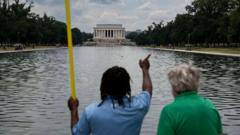
The water has a way of holding everything we prefer not to say out loud. On a crisp morning in the nation's capital, before the tour buses hiss to a halt and the vendor carts begin to wheel out their standard-issue American flags, the Lincoln Memorial Reflecting Pool acts as a vast, two-thousand-foot mirror. It catches the pale marble of the Washington Monument, the shifting weight of the Atlantic sky, and the faces of millions of strangers who stand at its lip, looking for something larger than themselves.
But mirrors are fragile. When you empty them, the illusion breaks. If you enjoyed this article, you might want to read: this related article.
The announcement came down with the sterile efficiency of bureaucratic paperwork: the Reflecting Pool would be drained. To the casual observer, it is a routine maintenance disruption, a footnote in a park ranger’s weekly log. To the political machinery of Washington, however, a dry concrete basin is never just a dry concrete basin. It is a canvas for grievance.
Almost immediately, the empty floor of the pool became the backdrop for a familiar, escalating rhetoric. Former President Donald Trump took to his platform to lay the blame squarely at the feet of "vandals" and agitators, pointing to the cracked algae and the exposed plumbing as physical evidence of a deeper, systemic lawlessness gripping the country. It is a narrative of immediate, external malice—a simple story of bad actors breaking a beautiful thing. For another perspective on this event, check out the latest coverage from TIME.
But look closer at the mud left behind. The truth of how we treat our sacred spaces, and each other, is rarely that simple.
To understand what it means to drain this specific stretch of water, you have to stand where the water used to be. Imagine a park technician—let us call him Robert, a composite of the dedicated National Park Service crews who have scrubbed these stones for decades. Robert knows that the Reflecting Pool does not just collect coins and discarded plastic bottles. It collects the literal runoff of American democracy. It gathers the dust of a thousand protest marches, the feathers of migratory ducks, the spilled coffee of tired commuters, and, yes, the occasional deliberate insult of graffiti or debris.
When Robert looks at the empty pool, he does not see a sudden, catastrophic act of warfare. He sees the slow, grinding wear and tear of a nation that is constantly wrestling with its own identity.
The political impulse to blame "vandals" for every fracture in the public square is comforting. It suggests that if we could just catch the few individuals with the spray cans or the heavy boots, the water would stay clear forever. It removes the burden of maintenance from the community and places it entirely on the shoulders of the transgressor. It turns a logistical challenge into a moral play.
Yet, the history of the Reflecting Pool is a history of constant, necessary renewal. Built in the early 1920s, the pool has always been a temperamental piece of engineering. For decades, it relied on a stagnant system that pumped water directly from the city's domestic supply, leading to massive algae blooms, murky depths, and a persistent odor that defied the grandeur of the surrounding architecture. It was not vandals that turned the water green and choked the pumps over the last century; it was time. It was the simple reality that large, open bodies of water require immense, exhausting care to remain pure.
Consider the great modernization project completed over a decade ago. The pool was completely reconstructed, fitted with a high-tech filtration system that drew water from the nearby tidal basin, recycling it to prevent the very stagnation that had defined its first ninety years. It was a massive investment in infrastructure, a recognition that the symbols of our shared life cannot survive on sentiment alone. They require plumbing. They require money. They require a collective will to keep the pumps running.
When we reduce the maintenance of our national monuments to a shouting match about who ruined them, we lose sight of that collective responsibility. We treat the monument as a static relic rather than a living relationship.
The water is gone now, leaving a grey, ribbed scar stretching between Lincoln and Washington. Without the reflection, the monuments look taller, colder, more detached from the earth. The tourists who walk the perimeter look down into the empty pit with a sense of quiet disappointment. They came to see themselves reflected against the sky, and instead, they are staring at wet silt and pipes.
The temptation to weaponize this emptiness is immense. In a political culture driven by the economy of outrage, an empty pool is a gift-wrapped opportunity to remind the public of what has been lost, to point fingers across the aisle, to signal that the world we once knew is being systematically dismantled by the opposition. It is a short-term strategy with a high emotional yield.
But the real problem lies elsewhere. The real problem is that the narrative of constant vandalism obscures the much quieter, much more dangerous threat facing our public institutions: neglect.
It is easy to rally a crowd against a visible enemy with a crowbar. It is much harder to excite people about the tedious, unglamorous work of fixing valves, clearing filters, and managing the ecological balance of an urban wetland. We are a culture obsessed with the spectacle of destruction, yet deeply bored by the physics of preservation.
The pool will fill again. The water will return, the pumps will hum back to life, and the surface will once more smooth out into that impossible, iconic mirror. The slogans painted on the walls will be scrubbed away by people like Robert, using high-pressure hoses and patience. The deep-seated grievances that used to frame the empty basin will not disappear so easily, however. They will simply sink beneath the surface, waiting for the next time the plugs are pulled and the mud is laid bare for all to see.
We are left standing on the granite edge, looking down at the concrete floor, forced to decide what we see in the absence of the water. We can see a crime scene, or we can see a workplace. We can choose to see a symbol of an empire in terminal decline, targeted by enemies from within, or we can see the messy, repetitive, and entirely normal chore of keeping a democracy clean.
The mirror only tells you what you bring to it.

/https://tf-cmsv2-smithsonianmag-media.s3.amazonaws.com/filer/c6/97/c697b065-e0bd-4970-81ea-819779296b91/u765404inp.jpg)
