The key was cold in her palm.
Eighty-seven years of living leaves a certain weight in the bones, a quiet accumulation of mornings spent watching the light change across the same patch of worn floorboards, of kitchen walls painted in shades of memory, of a life built so thoroughly into the plaster and brick that separating the person from the room feels like tearing moss from a stone.
Her name is Carmen. In the spring, her name was a spark.
When the court officers came to the doorway of her apartment in Madrid, they brought the crisp, unyielding language of paperwork. They brought the blunt force of an eviction order born from an expired contract and a legal system that moves with the cold efficiency of a ledger. They brought a realization that is quietly spreading across modern cities: the simple act of growing old in the place you call home has become a luxury sport, and the penalty for losing is disappearance.
But something unusual happened on that concrete stoop.
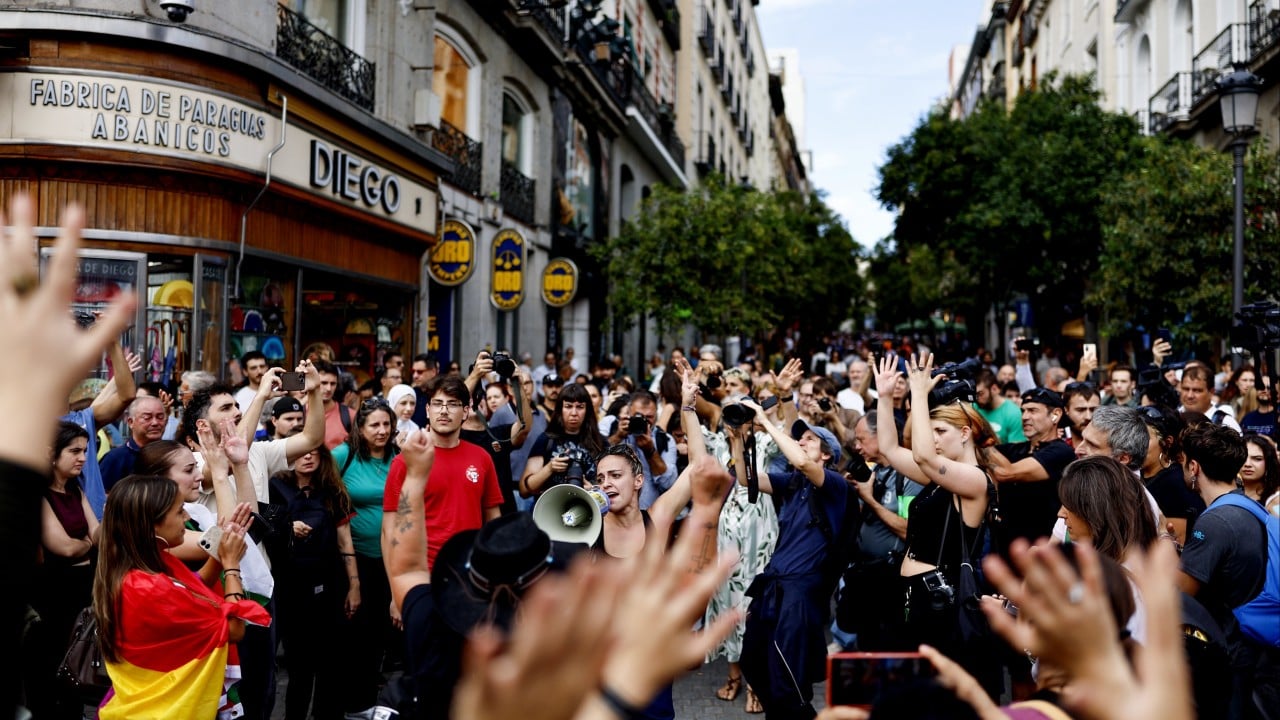
The neighbors did not look away. They did not pull their curtains shut to avoid the awkward theater of displacement. They gathered. They stood shoulder to shoulder in the narrow hallway, blocking the threshold with their bodies. They raised voices that had spent decades whispering pleasantries in stairwells until those voices became a wall. The television cameras arrived, capturing the surreal optics of an octogenarian being carried past a sea of raised fists and flashing placards. Spain watched. The streets surged.
For a moment, the machinery of modern displacement ground to a halt.
We talk about housing crises as if they are weather systems. We speak of market adjustments, soaring rental yields, speculative investment trusts, and square-meter valuations with the detached reverence of meteorologists charting a hurricane. We draw charts. We debate policy adjustments in air-conditioned committee rooms. We treat the city as an abstract financial portfolio, a digital ticker tape scrolling endlessly upward.
Numbers do not bleed. Ledger sheets do not weep.
Consider what happens when the math forgets the human being occupying the decimal point.
Carmen had lived in that apartment for over half a century. The rent she paid belonged to an era before venture capital discovered residential real estate as a high-yield asset class, before neighborhoods were rebranded as lifestyle districts, before the word tenant became synonymous with temporary obstacle. When her original lease agreement encountered the rigid expiration dates of contemporary urban law, the ground beneath her vanished.
It is easy to blame the contract. It is comforting to hide behind the abstract shield of legality. The rules are the rules, the cynic sighs from a comfortable distance, as if laws dropped from the sky like rain rather than being drafted by human hands to serve human priorities.
Look closer at the mechanics of urban displacement.
When neighborhoods transform overnight, the change is rarely organic. It is engineered. Old buildings are acquired by anonymous corporate entities whose primary fiduciary duty is quarterly return, not community cohesion. Leases are allowed to lapse. Rents are adjusted upward to match projections that bear no resemblance to local wages or pensions. The elderly, living on fixed incomes that have stagnated while the cost of living climbs toward the stratosphere, are the first casualties. They are the friction in the engine of modernization. They are the inefficiency to be optimized away.
Except Carmen refused to disappear quietly.
The protests that erupted outside her building were not merely about one apartment. They were an instinctive, collective rejection of a deeper cruelty. They were a declaration that a city is more than a collection of assets; it is a repository of shared history. When you uproot an eighty-seven-year-old woman over a technicality of contract law, you are not just clearing a property. You are burning a library. You are erasing the living archive of a street.
Think of the sensory reality of forced removal.
It is not just boxes and tape. It is the dismantling of identity. It is the morning routine broken into jagged shards. The teacup bought on a honeymoon, now packed into brown corrugated cardboard. The hallway where grandchildren measured their height against the doorframe, now slated for a gut renovation to appeal to digital nomads and short-term tourists. The disorientation is total. For an elderly person, spatial memory is often the last reliable anchor against the erosion of time. Sever that anchor, and cognitive decline often accelerates with terrifying speed. Displacement is a health crisis disguised as a real estate transaction.
And yet, public outrage has a strange power.
It forces the invisible into the glaring light of television broadcasts and political calculations. Municipal leaders, suddenly confronted with the visual of an old woman surrounded by her belongings on the pavement while thousands chant her name outside, remember that elections are won by living voters, not spreadsheet algorithms. Negotiations begin behind closed doors. Emergency funds are identified. Legal loopholes are stretched in the other direction—because where there is political will, the law is remarkably elastic.
Carmen is returning home.
The headlines will call it a victory. And it is. For Carmen, it means sleeping in her own bed, walking down the familiar street where the baker knows her name and the pharmacist checks to see if she needs her prescriptions renewed. It means dignity preserved.
Yet we must be honest about the nature of this victory.
A system that requires massive civil disobedience and viral media outrage just to prevent an eighty-seven-year-old woman from dying in a shelter is a broken system. Exceptional compassion should not be required to correct ordinary injustice. When housing security depends on winning a lottery of public sympathy, the baseline is failure.
Thousands of other Carmens do not make the evening news. Their evictions happen in silence. Their boxes are packed behind closed doors with no cameras rolling, no crowds chanting in the stairwell, no politicians rushing to cut a ribbon of reprieve. They slip away into the periphery of the city, absorbed by the statistical fog of homelessness and urban poverty.
The door of Carmen's apartment is unlocked once more.
She will step inside. She will smell the familiar scent of old wood and floor wax. She will look out the window at the street where her life unfolded. But the rest of us remain outside on the pavement, staring up at the facade, forced to confront a quiet, haunting question.
What happens tomorrow, when the cameras are gone, and the next key turns in the lock?