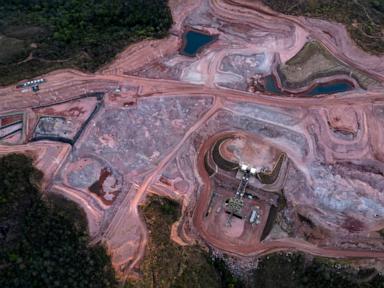
Maria knows the smell of damp earth after a dry spell better than she knows the stock market. For thirty years, her hands have brushed the red soil of Minas Gerais, feeling for quartz, mica, and the quiet, heavy secrets hidden in the ancient crust of Brazil. She is not a politician. She does not sit in the polished leather chairs of the national legislature in Brasília, watching bills crawl through bureaucratic mazes. But when the Brazilian Senate recently passed a new framework regulating rare earth minerals, Maria felt the tremor all the way down to her calloused fingertips.
Nobody talks about the periodic table at the dinner table. We talk about gas prices, rent, the erratic temperament of our Wi-Fi, and whether the local bakery still has those cinnamon pastries we love. Yet every glowing screen in our hands, every whirring motor in an electric vehicle, and every satellite spinning silently in the dark sky depends entirely on a group of obscure elements that most people cannot pronounce. Neodymium. Dysprosium. Praseodymium. They sound like spells from an old fantasy novel, but they are the invisible magnets holding modern civilization together.
For decades, the extraction of these critical elements operated in a legal gray zone. It was a wild frontier. Prospectors dug blindly, environmental protections existed mostly on paper, and foreign conglomerates looked at the country's vast mineral wealth with hungry, impatient eyes. Uncertainty reigned. If you wanted to invest millions of dollars into heavy machinery, processing facilities, and deep-earth exploration, you had to cross your fingers and pray that a sudden judicial ruling wouldn't freeze your assets overnight.
That changed on the Senate floor.
The newly approved legislation does something radical. It brings clarity. It establishes clear rules for rare earth minerals exploration, licensing, and environmental accountability. It tells the world that Brazil is open for business, but on its own terms.
Consider what happens next.
When the red tape thins, capital flows. Mining companies that once hesitated outside the door are now moving their chess pieces onto the board. We are talking about billions of dollars in potential infrastructure investments designed to unearth the building blocks of the green transition. For a long time, the global conversation about these specialized resources was dominated by a single superpower on the other side of the planet. China held the monopoly, controlling not just the mines, but the complex, toxic chemistry required to refine raw ore into usable components.
Monopolies make the world fragile. When one nation holds the switch to the global supply chain, everyone else holds their breath.
Brazil possesses some of the largest unexploited reserves on Earth. Beneath the lush canopy and the sun-baked savannas lie deposits that could shift the geopolitical gravity of the entire industrial world. But owning potential is not the same as realizing it. There is a dark history attached to resource booms in South America. Too often, the wealth is scooped up by distant corporations, shipped across oceans, and processed elsewhere, leaving behind scarred landscapes, polluted rivers, and communities that remain just as poor as they were before the first shovel broke the ground.
Maria has seen this movie before. She remembers the iron ore rushes, the sudden influx of heavy trucks thundering down rural roads, the promises of prosperity that evaporated the moment commodity prices dipped on a Wall Street ticker.
Trust is hard to mine.
The true test of the new Senate regulation will not be found in the celebratory press releases issued by mining executives or the glowing economic projections published in financial journals. It will be found in the rivers. It will be found in the air quality of the towns neighboring the extraction sites. It will be found in whether the local workforce is trained to engineer and manage these high-tech operations, or if they are simply hired to swing pickaxes while the real value leaves the country in shipping containers.
This is where the human element collides with raw geopolitics. We desperately need these elements to build wind turbines that capture the breeze, batteries that store the sun, and defense systems that protect fragile democracies. The green revolution is impossible without heavy rare earths. You cannot decarbonize the global economy using good intentions alone; you need magnets, and magnets need neodymium.
Yet, the irony is sharp enough to draw blood. To save the planet from the catastrophic consequences of fossil fuels, we must tear open the earth in places like Minas Gerais, Goiás, and Amazonas. We must dig. We must refine. We must manage acids, tailing dams, and radioactive byproducts that naturally occur alongside these prized elements.
The Senate's vote is an admission of reality. It acknowledges that pretending these resources do not exist—or leaving them locked in a perpetual bureaucratic standoff—is no longer an option. The world is coming for them, whether Brazil is ready or not.
Step inside a modern laboratory where these materials are studied, and the scale of the challenge becomes starkly clear. A tiny gray chunk of metal sits on a sterile white table. To the untrained eye, it looks like a piece of scrap iron salvaged from an old washing machine. Yet, inside that unassuming lump lies the power to make electric motors smaller, lighter, and vastly more efficient. It is the secret ingredient that transforms a sluggish prototype into a high-performance reality.
Now multiply that single lump by millions.
The global race for technological sovereignty is accelerating. Nations are drawing new battle lines, not with infantry and artillery, but with supply chains and trade agreements. By establishing a formalized framework for exploration, Brazil is attempting to write its own destiny rather than having it dictated by foreign demand. It is a bid to move up the value chain, transitioning from a simple exporter of raw dirt to an active participant in high-tech manufacturing.
Whether this legislative pivot succeeds depends on execution. Corruption can rot the best-designed laws. Corporate negligence can turn regulatory streamlining into an environmental catastrophe. But stagnation is a guarantee of irrelevance.
Back in the soil of Minas Gerais, the wind rustles through the eucalyptus trees. Maria wipes her brow with the back of her hand, looking out over the rolling hills where the next generation of industrial history is about to be written. She does not know the chemical symbols for the elements buried beneath her boots. She does not care about trade deficits or supply chain diversification.
She just wants to make sure her grandchildren can still drink clean water from the well when the afternoon sun dips below the horizon. The law has passed. The machinery is moving into place. The future is being unzipped from the earth, piece by heavy piece, and the rest of the world is watching to see who holds the keys.