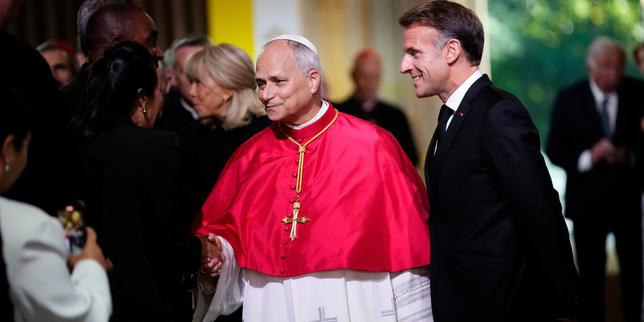
The convergence of sovereign temporal power and transnational spiritual authority at the Palais de l'Elysee during the apostolic journey of Pope Leo XIV to France presents a fascinating case study in institutional signaling. When Emmanuel Macron receives the pontiff, the interaction operates on two distinct planes: immediate domestic political calibration and long-term ideological positioning. Stripped of diplomatic pageantry, this encounter represents a high-stakes transaction where symbolic capital is exchanged for social cohesion, moral validation, and geopolitical leverage.
The Dual-Track Utility of State Diplomacy
State visits between secular leaders and religious heads are rarely passive ceremonial obligations. They serve specific utility functions for both parties. For the head of the French state, hosting the supreme pontiff functions as a mechanism for domestic stakeholder management in a nation governed by strict laïcité yet historically anchored in a Christian cultural matrix.
The mechanics of this utility break down into three distinct vectors:
- Legitimacy Transfer: Association with a global moral authority provides secular leaders with a temporary buffer against domestic friction, temporarily elevating policy agendas above partisan squabbles.
- Social Cohesion Maintenance: In periods of internal societal fracture, institutional religion acts as an alternative network for community stabilization, making state engagement with church leadership a pragmatic exercise in risk mitigation.
- Transnational Soft Power: Alignment on international crises—ranging from climate migration to continental security—amplifies the diplomatic reach of middle powers like France by embedding their foreign policy objectives within universal ethical frameworks.
Conversely, the Vatican utilizes bilateral state summits to secure operational space within secular legal frameworks, negotiate institutional recognition, and project moral imperatives onto legislative bodies.
The Structural Tension Between Laïcité and Papal Authority
France operates under a rigid constitutional framework of laïcité, which structurally separates religious institutions from state apparatuses. This creates an inherent institutional friction whenever a papal visit occurs. The state must navigate the paradox of officially recognizing no religion while simultaneously acknowledging the social and historical weight of Catholicism.
This friction is managed through compartmentalization. The executive branch treats the visit through the lens of international statecraft rather than internal religious practice, framing the pontiff as a head of state equivalent to any secular counterpart. However, this distinction often collapses in the public sphere, where media framing conflates diplomatic protocol with spiritual endorsement.
The analytical challenge for political strategists is measuring the return on investment for such state receptions. While the immediate optical value is high, the longer-term consequence depends entirely on the specific policy alignment communicated during closed-door bilateral talks. When substantive issues such as educational funding, bioethics, or international aid frameworks intersect with papal doctrine, the limits of diplomatic compromise become immediately visible.
Strategic Forecasting of Institutional Engagement
Future interactions between the French executive and the Holy See will increasingly rely on transactional alignment rather than broad ideological harmony. As European demographics shift and institutional religion faces declining domestic participation, the currency of moral authority depreciates unless tied directly to urgent, secularly validated crises.
The effectiveness of these high-level summits will be measured by their ability to produce actionable frameworks on transnational concerns such as ecological preservation and migration management. Leaders who treat these visits as mere photo-opportunities miscalculate the utility of spiritual soft power, whereas those who integrate moral authority into hard policy formulation extract tangible diplomatic dividends.
EN DIRECT – Emmanuel Macron reçoit le pape Léon XIV à l'Élysée
This broadcast recording provides visual documentation of the arrival protocol and initial official statements delivered during the diplomatic engagement at the Elysee Palace.