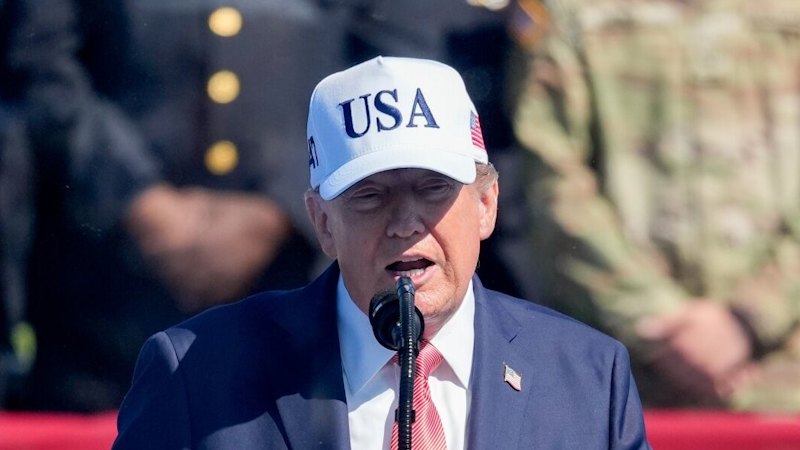
Public discourse often suffers from narrative drift, where historical recounting bends toward personal mythmaking. When high-profile figures recount their proximity to catastrophic national events, these narratives frequently mutate over decades. The recent assertions made by Donald Trump regarding his physical presence and direct extraction from Ground Zero during the September 11 terrorist attacks provide a textbook case study in the anatomy of memory inflation. Deconstructing these claims requires moving past political posturing to examine the structural mechanics of retrospective storytelling, temporal distortion, and institutional verification constraints.
The fundamental discrepancy lies in the divergence between contemporaneous reporting and retrospective amplification. On September 11, 2001, media archives and contemporaneous interviews place Trump approximately four miles away at Trump Tower, commenting via telephone to local media outlets about visual confirmation of the attacks from his high-rise window. Over subsequent years, however, the narrative architecture shifted. What began as observational proximity evolved into operational involvement, culminating in recent accounts describing physical presence on the debris pile, structural peril, and direct extraction by emergency personnel. Learn more on a similar topic: this related article.
The Mechanics of Narrative Migration
To understand how personal histories absorb collective trauma, political scientists analyze three distinct phases of memory evolution:
- Initial Documentation: Immediate, first-person transmission captured via live broadcasts or print journalism. In this phase, temporal and spatial coordinates are constrained by physical reality. For Trump, this phase corresponds to his telephone call to WWOR-TV on the afternoon of September 11, acknowledging visual range rather than physical rescue or structural engagement.
- Narrative Consolidation: The intermediate phase where public figures integrate into the broader iconography of an event. By September 13, 2001, reporting places Trump blocks away from the disaster zone, where he conducted media interviews and referenced the deployment of construction crews. While physical presence near lower Manhattan is established by mid-September, the nature of that presence—whether administrative, observational, or active—remains unverified by emergency command structures.
- Mythological Expansion: The long-tail phase characterized by the removal of friction, bureaucratic oversight, and logistical reality. Decades later, accounts incorporate cinematic elements: structural creaking, tactical evacuation by emergency crews, and leadership of civilian response units.
This trajectory illustrates a broader psychological phenomenon: the subconscious rewriting of personal biography to align with the gravity of a national milestone. Additional analysis by Reuters explores similar views on this issue.
Institutional Verification Versus Anecdotal Testimony
Testing the validity of retrospective claims demands cross-referencing against structural accountability systems. In a chaotic disaster zone like Ground Zero, command was centralized under the New York City Police Department, the Fire Department of the City of New York (FDNY), and federal emergency coordinators.
Operational records and testimonies from ranking officials active on scene, such as former battalion chiefs and police commissioners, establish clear baselines for verification:
- Access Control: The disaster perimeter was strictly managed. Unaffiliated civilian work crews or uncoordinated individuals could not simply deploy heavy labor onto the pile without integration into the unified command structure.
- Documentation Gaps: While high-profile visitors, politicians, and donors did visit the perimeter in the days following the attacks, verifiable logs, official photographs, or emergency response records confirming direct search-and-rescue participation by corporate entities under private direction remain absent.
- Physical Constraints: Accounts of being bodily carried or pulled from the collapse zone due to imminent structural failure describe high-consequence operational events that would have generated incident reports, media coverage, or medical logs, none of which exist for the events described.
When an individual's narrative contradicts the rigid administrative footprint of a disaster zone, the burden of proof shifts to verifiable documentation rather than rhetorical persistence.
The Utility of Strategic Ambiguity
Why do these inflated accounts persist without empirical grounding? In strategic communication, narrative utility often supersedes factual precision. For figures operating in high-stakes public spheres, maintaining a visceral, direct connection to historic trauma serves an ongoing rhetorical function. It positions the speaker not merely as a spectator to history, but as an active participant who shared in the physical peril of the citizenry.
This creates a self-sealing feedback loop. When challenged by fact-checkers or archival records, the narrative is rarely abandoned; instead, it is reframed as a failure of institutional memory or dismissed as partisan antagonism. The public consumer is left to navigate a binary choice: trust the verifiable paper trail of contemporaneous logistics, or accept the fluid, emotionally resonant mythos constructed decades after the dust cleared.
Ultimately, analyzing these claims exposes the fragility of unvetted historical narratives in modern political life. As time separates the present from the foundational traumas of the 21st century, the barrier between documented fact and polished folklore will continue to thin, requiring rigorous structural analysis to maintain the integrity of the record.