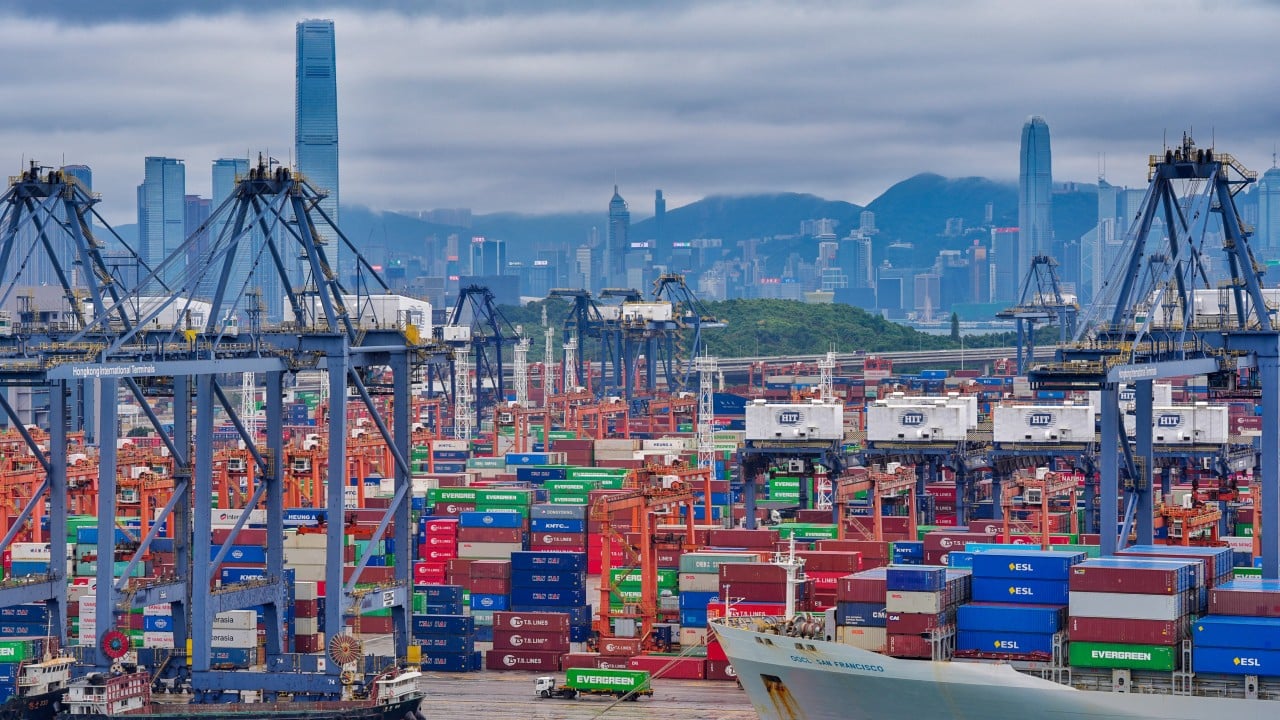
Trade performance metrics function as downstream indicators of upstream structural shifts in global manufacturing. When regional export volumes experience sharp expansion, the underlying driver is rarely a sudden increase in consumer appetite at the destination node. Instead, volume spikes signal a reconfiguration of intermediary logistics, component aggregation, and the velocity of high-value inputs moving through specialized trade hubs. Analyzing the reported 53 percent expansion to a record 641 billion Hong Kong dollars requires stripping away aggregate headline figures to examine the microeconomic mechanics governing trade flows through the Special Administrative Region.
The primary driver behind this statistical anomaly is the accelerated integration of artificial intelligence hardware within regional manufacturing supply chains. Hong Kong operates primarily as an entrepôt and re-export nexus rather than a raw extraction or mass-assembly jurisdiction. Therefore, a massive jump in export value points directly to an escalation in the throughput of high-density electronic components, server racks, graphics processing units, and specialized semiconductor devices destined for enterprise infrastructure deployment across global markets.
The Dual Architecture of Re Export Velocity
Re-export economies depend entirely on inventory turnover speed and value-add logistics coordination. To understand how trade values scale rapidly without a corresponding expansion in physical footprint, one must examine the cost and margin structure of electronics distribution.
Low-value consumer goods generate high volume with compressed margins. Conversely, enterprise-grade AI infrastructure components carry extreme unit values. When global hyperscalers accelerate data center investments, the demand shifts toward high-specification microelectronics. Hong Kong’s trade intermediaries capture this value spike because their operational models are optimized for rapid transshipment, customs clearance optimization, and multi-origin component aggregation.
The mechanics of this throughput rely on three distinct operational variables:
- Component provenance tracking and compliance verification for restricted semiconductor classifications.
- Just-in-time inventory consolidation combining Taiwanese semiconductor fabrication outputs with mainland Chinese assembly nodes.
- Airfreight capacity allocation ensuring minimal dwell time for high-margin, time-sensitive server assemblies.
When demand for computational hardware spikes globally, these three variables interact to compress fulfillment cycles. The result is an immediate reflection in monthly customs data, manifesting as unprecedented nominal value expansion.
Margin Expansion Versus Volume Scaling
A common analytical error is conflating gross export revenue growth with proportional manufacturing output expansion within the reporting territory. Hong Kong does not fabricate the silicon wafers driving this surge. Its economic exposure is centered on trade financing, supply chain orchestration, logistics management, and high-value warehousing.
The unit economics of AI hardware differ fundamentally from traditional consumer electronics. Traditional goods suffer from rapid price decay and high elasticity. AI infrastructure components exhibit inelastic enterprise demand coupled with steep supplier concentration. Because a small number of fabrication facilities control advanced chip output, supply chain bottlenecks push unit prices upward.
[Silicon Fabrication] --> [Logistics Aggregation: Hong Kong] --> [Global Hyperscaler Deployment]
        |                                    |                                    |
(High Unit Cost)                  (Value-Add Coordination)                (Inelastic Demand)
This pricing power flows directly through the balance sheets of trading firms operating within the hub. Consequently, the 53 percent surge represents a compound effect of increased physical shipment counts and significantly higher per-unit pricing on advanced technological inputs.
The Structural Bottlenecks of Tech Centric Trade Hubs
Relying on high-value technology exports introduces distinct vulnerabilities that standard macroeconomic models often overlook. Trade hubs specializing in computational hardware are exposed to regulatory friction, geopolitical risk factors, and capital expenditure cycles dictated by a handful of technology conglomerates.
Regulatory controls on semiconductor exports impose strict compliance overheads. Intermediaries must navigate shifting legal frameworks regarding destination verification and dual-use technology classifications. This creates a high barrier to entry, protecting established logistics operators with sophisticated compliance infrastructure while simultaneously introducing friction that can abruptly stall trade velocity if regulatory interpretations shift.
Furthermore, capital expenditure cycles in the technology sector are notoriously volatile. Hyperscale cloud providers scale infrastructure deployment aggressively during phases of model training expansion, but expenditure plateaus occur once baseline capacity is established. Trade data driven heavily by a single technological sub-sector risks sharp mean reversion once the initial wave of global data center buildouts matures.
Logistics Optimization as a Competitive Moat
The ability to sustain high-value throughput through an entrepôt depends on the operational efficiency of local trade infrastructure. Traditional logistics models rely on predictable schedules and stable warehousing costs. The modern trade environment for high-end technology requires real-time inventory visibility, advanced security protocols for high-value cargo, and seamless modal shifts between maritime freight and air cargo.
Operators who successfully capture margin in this environment invest heavily in predictive analytics to manage dwell times. Minimizing the duration cargo spends stationary within the jurisdiction reduces inventory holding costs and protects against rapid obsolescence risks inherent in electronic components.
The operational focus shifts from physical asset ownership to software-driven orchestration. Managing customs documentation digitally, automating compliance checks through machine learning classifiers, and integrating directly with carrier booking APIs allows firms to scale transaction volume without a linear increase in headcount or physical footprint.
Capital Allocation and Forward Execution
The current surge in trade metrics confirms that technology infrastructure deployment acts as the primary engine for regional trade value expansion. However, treating this boom as a permanent baseline ignores the cyclicality inherent in capital expenditure-driven supercycles.
To maintain competitive positioning amidst fluctuating global demand, trade intermediaries must diversify their component intake pipelines while hardening their compliance infrastructure against regulatory fragmentation. Firms operating within this nexus should reallocate capital away from legacy warehousing expansion and toward automated inventory tracking systems and advanced risk-mitigation analytics. This ensures operational resilience when the current hardware acceleration cycle inevitably transitions into a phase of capacity digestion.