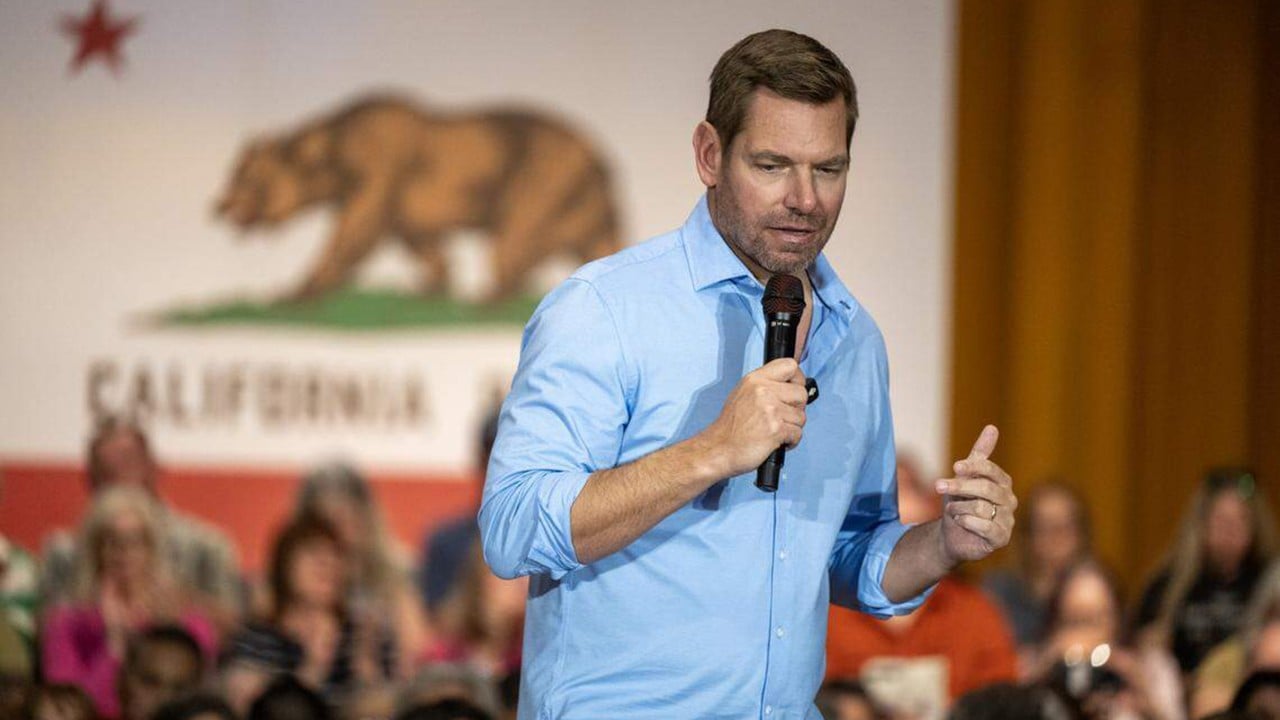
The air in Sacramento during an election cycle usually tastes of expensive espresso and nervous sweat. It is a thick, electric atmosphere where ambition is the only currency that matters. Eric Swalwell knew that scent better than most. He had spent years grooming himself for the marble halls of the Governor’s Mansion, building a political identity that felt, to many, like the inevitable next step for a man who had already conquered the national stage in Congress. He was the young gun. The fighter. The social media savvy representative who knew exactly how to clip a soundbite for maximum impact.
Then the silence came. It wasn't the quiet of a successful rally or the hush of a strategy room. It was the heavy, suffocating silence of a campaign oxygen supply being cut off in real-time.
When Swalwell announced he was suspending his bid for California governor, he didn't lead with the policy disagreements or the "need to spend more time with family" trope that politicians usually trot out like tired ponies. He couldn't. The weight of sexual assault allegations had become a gravity well from which no political career, no matter how carefully curated, could escape.
The Cracks in the Foundation
Political campaigns are built like glass cathedrals. They are towering, magnificent to look at, and incredibly fragile. For months, whispers had circulated through the corridors of power, shifting from vague rumors to specific, harrowing accounts. The allegations against Swalwell weren't just a political hurdle; they were a fundamental challenge to the image he had projected—the protector of institutional integrity and a champion for modern values.
Consider the life of a staffer in that environment. Imagine a young intern, twenty-two years old, fueled by the belief that they are helping a visionary change the world. They stay up until 2:00 AM drafting press releases. They skip meals. They live on adrenaline and the promise of a better California. When news like this breaks, the betrayal isn't just political. It is visceral. It is the sound of a dream shattering on a cold tile floor.
The allegations reached back into the past, pulling at threads that Swalwell likely thought were tucked away. But in the digital age, the past has a way of refusing to stay buried. It breathes. It waits. And when the spotlight is brightest, it steps into the frame.
The Mathematics of Disgrace
Politics is a game of numbers, but not always the ones you see on a ballot. It’s the math of donor confidence. On Tuesday, a donor might write a check for $50,000 because they believe in the trajectory of a rising star. On Wednesday, after a headline breaks, that same donor is calling their lawyer to see if they can claw the money back.
The math for Swalwell stopped adding up.
Polls are often dismissed as fleeting, but they act as a heartbeat monitor for a campaign. When the numbers plummeted, it wasn't just that voters were angry; it was that they were moving on. In a state as massive and diverse as California, the attention span of the electorate is a precious resource. Once you lose the benefit of the doubt, you lose the room. And once you lose the room, you are just a man standing on a stage talking to ghosts.
There is a specific kind of agony in watching a campaign's momentum reverse. It’s like watching a film run backward. The offices empty out. The yard signs are gathered like fallen leaves. The phone stops ringing. Swalwell, who once seemed to have a direct line to the pulse of the Democratic party, suddenly found himself on the outside looking in.
The Human Cost of the Allegations
We often talk about these events in terms of "optics" or "polling hits." We use sanitized language to describe messy, human trauma. But behind every headline about a suspended campaign, there are real people whose lives have been altered.
There are the accusers. To come forward against a sitting Congressman, a man with a national platform and a war chest of millions, is an act of terrifying bravery. It involves a level of scrutiny that most people cannot fathom. Their lives are dissected by pundits, their motives questioned by anonymous trolls, and their trauma turned into a talking point for the opposing party. This isn't a game to them. It is a reckoning.
Then there is the candidate himself. Even if we strip away the political mask, there is a human being sitting in the center of a storm of his own making. The ego required to run for Governor of California is immense. To have that ego dismantled in the public square is a unique form of punishment. It is a slow-motion car crash where the driver is also the audience.
The shift in tone was unmistakable. The fiery rhetoric about the future of the Golden State was replaced by the clipped, legalistic language of a man trying to save what remained of his reputation. Every word was measured. Every statement was vetted. The spontaneity that had made him a social media star was gone, replaced by a defensive crouch.
The Power Vacuum
California is a state that abhors a vacuum. The moment Swalwell stepped back, the space he occupied was instantly filled by others. Ambition is a predatory thing. For every candidate who falls, three more are waiting in the shadows, ready to claim the donors, the volunteers, and the oxygen.
The tragic irony of the Swalwell campaign is that it began with such high-minded ideals. He spoke of a new generation of leadership. He spoke of accountability. Yet, he was undone by the very standards of accountability he helped popularize. The "Me Too" era didn't just change the rules of the game; it changed the board itself. A single credible allegation can now do more damage than a million-dollar attack ad.
It makes one wonder about the nature of power. Does it corrupt, or does it simply reveal? For Swalwell, the revelation was devastating. The gap between the public persona and the private allegations became a canyon that no bridge could span.
The Ghost of the Campaign
Walk through the streets of San Francisco or Los Angeles a month from now, and you might still see a stray "Swalwell for Governor" sticker on a lamppost. It will be peeling at the edges, faded by the sun. It will be a relic of a future that never happened.
Political careers rarely end with a bang. They end with a press release sent out in the late afternoon, hoping to catch the tail end of the news cycle. They end with a staffer locking the door to a satellite office for the last time. They end with the realization that the path forward has simply vanished.
The "Golden Dream" of the Swalwell governorship was always a fragile thing. It was built on the idea that a politician could be everything to everyone—a brawler in Washington and a healer at home. But healing requires trust. And trust is the one thing you can't buy, you can't spin, and once it's gone, you can never truly get it back.
The sun sets over the Pacific just as it always has. The state moves on. The next scandal is already brewing in some other office, under some other fluorescent light. But for a brief moment, the fall of Eric Swalwell serves as a stark reminder that in the theater of politics, the most dangerous thing you can bring onto the stage is your own past.
The curtain didn't just fall; it was torn down. And the man standing behind it was suddenly very small, very alone, and very quiet.