The wind off the Irish Sea doesn't gently greet you. It bites. On a Tuesday morning that felt like every other gray, damp Tuesday in Pembrokeshire, the sand was the color of wet slate. Dog walkers kept their chins tucked into their collars. The horizon was a blur of charcoal and steel.
Then, the shoreline began to glow. Learn more on a similar issue: this related article.
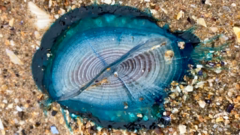
It started as a speck of impossible electric blue against the dull brown kelp. Walk closer, and the speck multiplied. Dozens, then hundreds, of vibrant, balloon-like creatures were stranded on the tide line. They looked like blown glass, or perhaps dropped alien jewelry, shifting under the weak British sun.
For the locals who stumbled upon them, the first instinct was wonder. The second was a primal, correct urge to step back. Additional analysis by Travel + Leisure delves into comparable views on this issue.
What had washed ashore on the beaches of Wales wasn't a single creature, nor was it a standard jellyfish. It was Physalia physalis—the Portuguese man-of-war. To see them pinned to the Welsh sand is to witness a profound collision between tropical mystery and the shifting realities of our changing seas. It is beautiful. It is also a warning.
The Illusion of the Lonely Sailor
To understand what hit the Welsh coast, we have to dismantle how we look at life in the ocean.
When you look at a man-of-war, your brain registers an individual. You see a translucent, blue-and-purple float—the pneumatophore—acting as a sail, and a trailing mass of dark tentacles below. But biology reveals a stranger truth. This is not one animal. It is a siphonophore, a living, floating city of four distinct types of highly specialized organisms called zooids.
They cannot survive without each other. One part forms the sail, filled with carbon monoxide and air, keeping the colony afloat. Another group comprises the dactylozooids, the hunters that deploy the stinging tentacles. A third group handles digestion, while the fourth dedicates itself entirely to reproduction. They are bound together in a codependency so absolute that the lines between individual and community erase entirely.
Imagine a village where one person breathes for everyone, another cooks, and a third defends the perimeter. It sounds like science fiction. On the Welsh sand, it is merely Tuesday.
But why are they here, thousands of miles from their usual warm, tropical haunts?
The answer lies in their design. The man-of-war does not swim. It has no propulsion, no steering wheel, no internal engine. It is entirely at the mercy of the wind and the currents. The sail is even set slightly to the left or the right, ensuring that a pod of them will scatter in different directions when the wind blows, a brilliant evolutionary strategy to prevent the entire population from wiping out in a single storm.
Lately, the winds are changing. The Atlantic is warming. The conveyor belts of ocean currents are shifting their tracks, dragging these fragile, venomous armadas out of the deep ocean and slamming them into the rocky shores of the UK.
A Stinger That Outlives Its Host
Walk down to the shoreline with anyone who grew up by the British seaside, and they will tell you about jellyfish. They will talk about the translucent moon jellies that feel like wet plastic, harmless and mundane.
The Portuguese man-of-war is an entirely different beast.
The tentacles trailing beneath that gorgeous blue sail can stretch up to thirty feet in the open ocean. They are loaded with nematocysts, microscopic coiled darts packed with a potent neurotoxin. When a fish brushes against them, the darts fire automatically. It is a mechanical reflex, requiring no conscious thought from the creature.
That means the danger doesn't evaporate when the creature dies.
A man-of-war stranded on a Welsh beach, drying out under the sky, remains fully armed. A curious child poking at the blue balloon, or a dog sniffing the strange debris, will trigger the exact same venomous response as if they had dived into the middle of the Sargasso Sea. The sting is notorious. It causes agonizing, whip-like red welts across the skin. In severe cases, the neurotoxin can cause respiratory distress or cardiac complications.
Consider the reality of a local coastal community. Tourism is the lifeblood of these villages. The beaches are playgrounds. Suddenly, the sand is littered with beautiful, toxic landmines.
The immediate reaction on social media is often panic, followed quickly by bad advice. For decades, folklore has dictated that the ultimate cure for a jellyfish sting is urine. It is a myth that refuses to die, popularized by television shows and campfire talk.
The science is clear: do not do this.
Pouring urine, or even fresh water, over a man-of-war sting can alter the chemical balance around the remaining nematocysts on the skin, causing them to fire all at once and release even more venom. Instead, the protocol is remarkably simple yet rarely known. Carefully remove the tentacles with tweezers or the edge of a plastic card—never bare hands. Then, immerse the affected area in hot water, as hot as can be tolerated, for twenty minutes. The heat breaks down the protein-based toxins, neutralizing the pain far better than any old wives' tale.
The Changing Guard of the Atlantic
It is easy to dismiss this as a freak occurrence, a one-off footnote in a local newspaper. But the frequency of these sightings points to a larger, quiet transformation happening just beyond our sightlines.
The oceans are warming at a rate that defies historical precedent. As the water temperatures rise, tropical and subtropical species are finding the northern latitudes far more hospitable than they used to be. At the same time, severe Atlantic storms are increasing in frequency and intensity, acting as giant fans pushing the surface-dwelling man-of-war straight toward the European continent.
They are the scouts of a changing ecosystem.
When you stand on a beach in Pembrokeshire or Anglesey and look at these creatures, you are looking at the physical manifestation of a shifting planet. The boundaries we draw on maps mean nothing to the sea. The warm waters are moving north, and they are bringing their residents with them.
There is a profound vulnerability in seeing something so perfectly adapted to the deep, endless ocean trapped in the mundane environment of a Welsh tideline. Out there, in the blue water, the man-of-war is a masterpiece of collective survival, drifting effortlessly, harvesting the riches of the sea. Here, on the sand, it is reduced to a puddle of melting gel, a hazardous curiosity for passersby.
The tide eventually turns. The water rushes back in, tumbling the remaining blue sails into the surf, breaking them apart or carrying them back out into the cold gray. The beachcombers move on, their pockets filled with driftwood, their eyes still searching the shoreline for that next flash of impossible, neon blue. We are left with the realization that the line between our familiar world and the wild, untamed deep is growing thinner by the day.