The coffee pot was still warm when the floorboards began to scream.
It is a sound few people ever truly prepare for, a deep, guttural groan that begins miles beneath the soil and vibrates upward through the soles of your feet before it ever reaches your ears. In a fraction of a second, the concrete walls that have kept you safe for decades transform into a shifting, volatile trap.
When the tectonic plates shifted beneath Venezuela, they did not just break the ground. They broke the fragile architecture of nearly a thousand lives. The official tally stands at 920 dead. But numbers are cold things. They are sterile. They fit neatly into spreadsheets and news tickers at the bottom of a television screen, but they fail entirely to capture the suffocating smell of pulverized brick, or the specific agonizing texture of the quiet that follows a disaster.
Consider a hypothetical family, much like the hundreds currently waiting outside collapsed structures in towns like Cariaco and Cumana. Let us call the mother Sofia. Just moments before the first tremor, she was watching her son tie his shoes for school. It was an ordinary Tuesday. The sun was tracing its familiar arc across the coastal sky. Then, the world violently tilted.
The ceiling came down in a single, thunderous wave of grey dust.
The Geography of Waiting
When a major earthquake strikes, the immediate aftermath is defined not by noise, but by a sudden, terrifying absence of it. The car alarms eventually wail, and the sirens echo in the distance, but in the immediate vicinity of a collapse, people hold their breath. They listen for the scratching of fingernails against drywall. They listen for a muffled cough.
For the families of the 920 victims, that silence has become a permanent state of being.
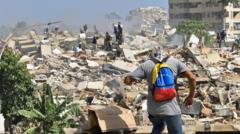
Imagine standing before a mountain of rubble that used to be your local grocery store, your church, or your child’s classroom. The physical reality of concrete is unyielding. A single square meter of slab weighs thousands of pounds. Without heavy machinery, which is often delayed or entirely absent in rural regions struggling with infrastructure, your hands are your only tools.
People dig until their skin is raw and their nails bleed. They do this because the alternative—waiting for an official rescue team that might be hours or days away—is entirely unthinkable.
The structural integrity of a building is something we take for granted every single day. We walk into offices, we sleep in apartments, and we trust that the math behind the mortar holds true. But when regional fault lines release centuries of pent-up kinetic energy, every shortcut ever taken in construction is laid bare. Brick structures without reinforced steel rebar do not just crack; they explode outward, pancaking layer upon layer until there is no air left between the floors.
The Invisible Network of Anxiety
As the hours drag into days, the disaster changes shape. It moves from a localized physical crisis into a sprawling, psychological nightmare that stretches across oceans.
Venezuela’s recent history means that millions of its citizens live abroad, scattered across South America, Miami, Spain, and beyond. When the news of the 920 casualties broke, the international phone lines jammed almost instantly. For those living in the diaspora, the distance becomes an physical weight.
You call, and the line is dead. You send a text message, and the single checkmark remains unread for twelve hours. Twenty-four hours. Forty-eight hours.
The mind fills that digital silence with the worst possible imagery. You scroll through social media feeds, desperately looking at shaky video clips filmed by bystanders, zooming in on the backgrounds of photos to see if a familiar blue door or a recognizable street corner appears in the ruins.
This is the hidden tax of a natural disaster. The trauma radiates outward, infecting everyone who has ever loved someone in the strike zone. The panic is contagious, fueled by a lack of information and the terrifying realization that a normal life can be erased in less than two minutes.
The Reality on the Ground
Medical facilities in the affected regions were already stretched thin before the ground moved. Now, they operate under conditions that resemble a field hospital in a war zone.
Doctors and nurses work by the light of smartphones when the power grid fails, treating crush injuries, compound fractures, and severe shock. The triage process is brutal. Decisions must be made in seconds about who can be saved and who must be comforted while they pass away.
Behind each of the 920 fatalities is a web of secondary collapses. The local baker who kept the neighborhood fed. The teacher who knew every child's name. The grandmother who held the history of a block in her memories. When you lose that many people simultaneously, the social fabric of a community doesn't just fray; it snaps.
The economic reality of rebuilding after such an event is a mountain that few communities know how to climb. Insurance is a luxury that few possessed. Government aid is a promise that often thins out by the time it reaches the periphery of the country. For survivors, the immediate future is not about rebuilding a life, but simply finding a clean source of water and a plastic tarp to keep the night dew off their children.
Beyond the Dust
We look at disasters through the lens of statistics because it protects us from the sheer scale of the grief. It is easier to process the number 920 than it is to look into the eyes of a single father who has lost everything he spent his life building.
But the truth demands that we look closer.
The earth will eventually stop shaking. The dust will settle, washed away by the tropical rains. The news trucks will pack up their satellite dishes and move on to the next breaking story, leaving the survivors behind to navigate the quiet ruins of their lives.
A plastic doll sits face down in the grey mud of a collapsed sidewalk, its bright pink dress completely coated in concrete dust, while a few feet away, a group of neighbors quietly lifts a heavy beam, hoping against all logic to find a sign of life beneath the wreckage.