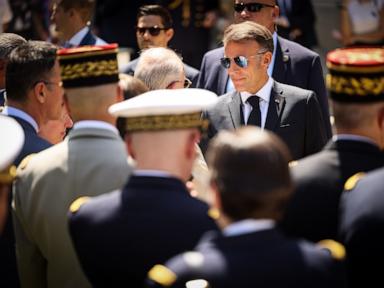
The heat radiating from the asphalt of the Champs-Élysées on a mid-July morning is a physical force. It rises in visible, shimmering waves, distorting the grand perspective that stretches from the Arc de Triomphe down to the Place de la Concorde. Under normal circumstances, this is the stage for a grand theatrical display of French national pride. Bastille Day is a ritual of brass bands, spotless white gloves, and the heavy, mechanical rumble of Leclerc tanks. It is a day when France looks into the mirror and sees its own revolutionary ideals reflected back in polished brass and tricolor smoke.
But on this particular July morning, the mirror showed something else.
If you stood close enough to the steel barricades, past the security checkpoints and the chatter of tourists clutching melting ice creams, you could hear a different rhythm in the marching boots. It was not the familiar, synchronized swing of the French Foreign Legion or the Saint-Cyr military academy. It was a collective cadence borne by soldiers who had traveled from the edge of the continent.
To understand why this matters, one has to look closely at the eyes of the men and women leading the procession. They did not come to Paris for a holiday. They came because the ground beneath their own homes had begun to tremble.
The Weight of a Lithuania Flag on French Soil
Consider a young officer. We can call him Jonas, a lieutenant in the Lithuanian Land Forces. He is a hypothetical composite of the young men marching that day, but his background is grounded in the stark reality of the Baltic states. Jonas grew up in Vilnius. His grandmother still remembers the sound of Soviet tanks rolling through the streets in 1991, the smell of diesel, and the terrifying silence of the radio stations going dead. For Jonas, peace has never been a permanent state of nature. It has always been a fragile agreement, signed in ink but defended with steel.
As Jonas stood at attention on the Parisian pavement, his fingers gripped the staff of his national flag. His uniform was heavy, designed for Baltic winters rather than the oppressive heat of a Parisian summer. Sweat dripped down his neck, but he remained absolutely motionless.
Behind him stood soldiers from Estonia, Latvia, Poland, the Czech Republic, Slovakia, Hungary, Romania, and Bulgaria. Nine nations from NATO’s eastern flank. In any other year, their presence in the heart of France would have been a polite diplomatic gesture, a footnote in a defense ministry press release.
Not now.
With the war in Ukraine raging just a few hundred miles to the east, their march down the most famous avenue in the world was a physical declaration of solidarity. The message was unmistakable: an attack on the eastern border of Europe is an attack on the cafes of Paris, the canals of Amsterdam, and the plazas of Madrid.
The contrast was jarring. Around them, Paris was dressed in its summer best. Families sat on balconies, sipping chilled rosé. Children sat on their parents' shoulders, waving tiny paper flags. Yet, the presence of these Eastern European troops brought the cold shadow of the Donbas trenches directly into the heart of Western Europe. It was a reminder that the comfort of the West is purchased with the vigilance of the East.
The Illusion of Distance
For decades, Western Europe treated defense as a historical relic. The Cold War was over, the end of history had been declared, and the threat of large-scale industrial warfare on the continent felt as remote as the Napoleonic Wars. Budgets were slashed. Regiments were disbanded. Military planners spoke of "peace dividends" as if security were a stock market investment that only went up.
Then came February 2022.
The illusion shattered in a single morning. Suddenly, the distances that seemed so vast on a map shrank to nothing. Paris is only a three-hour flight from Kyiv. The tanks rolling through the mud of Eastern Europe were not a distant news report; they were a direct threat to the stability of the entire continent.
This parade was the physical manifestation of that realization.
When the French fighter jets tore through the sky, leaving their signature trails of blue, white, and red smoke, they were followed by a silence that felt heavier than the roar of their engines. The crowd, usually boisterous and quick to cheer, seemed to catch its breath.
An elderly Parisian woman named Chantal, standing near the front of the crowd, watched the Eastern European flags pass by. She did not know the specific insignia of the Polish or Estonian regiments. But she understood the gravity. She had lived long enough to remember when Europe was divided by an iron curtain, and she knew that history has a terrible habit of repeating itself if people grow complacent.
"It makes you realize," she whispered to her neighbor, "that we are not as safe as we think."
The Language of Symbols
In geopolitics, symbols are a currency. They can be traded, invested, or squandered. By placing the soldiers of the eastern flank at the very front of the Bastille Day parade, France was spending its symbolic capital in a highly calculated manner.
This was not just about showing support for Ukraine; it was about reassuring those allies who live in the direct shadow of Russian ambition. For a country like Estonia, with a population smaller than that of Paris, the sight of their soldiers leading the march down the Champs-Élysées is not mere pageantry. It is a public commitment. It is France saying, We see you. We are with you. Your borders are our borders.
Critics of military parades often dismiss them as expensive, outdated displays of jingoism. They argue that the money spent on marching bands and fuel would be better used elsewhere. But they misunderstand the human need for ritual. When the world is shifting, when the old rules no longer apply and the future looks uncertain, people need to see who stands beside them.
The soldiers from Poland and the Baltics did not march with the relaxed stride of troops on a ceremonial detail. They marched with a taut, disciplined focus. Their presence was a reminder of the sheer physical effort required to maintain the peace that Western Europeans have taken for granted for three generations.
The Quiet Return to Reality
As the afternoon sun reached its peak, the parade drew to a close. The crowds began to disperse, drifting toward the shade of the Tuileries Gardens or the cool interiors of nearby cafes. The smell of aviation fuel lingered in the warm air, mixing with the scent of roasted chestnuts and car exhaust.
For the soldiers of the eastern flank, the march was over, but their duty was not. They would return to their bases, to the forests of Lithuania, the plains of Poland, and the shores of the Black Sea. They would return to the daily, unglamorous work of patrol, training, and preparation.
The cobblestones of Paris had gone quiet again, but they carried the invisible imprint of thousands of boots that had marched from the east. The parade was a brief moment of unity, a glittering spectacle in the summer heat. But as the flags were packed away and the barriers were dismantled, the true stakes remained clear.
The peace of Europe is no longer a given. It is a line held by young men and women standing guard in the cold, wet forests of the east, waiting to see if the rest of the world will stand with them when the parade is over and the music stops.