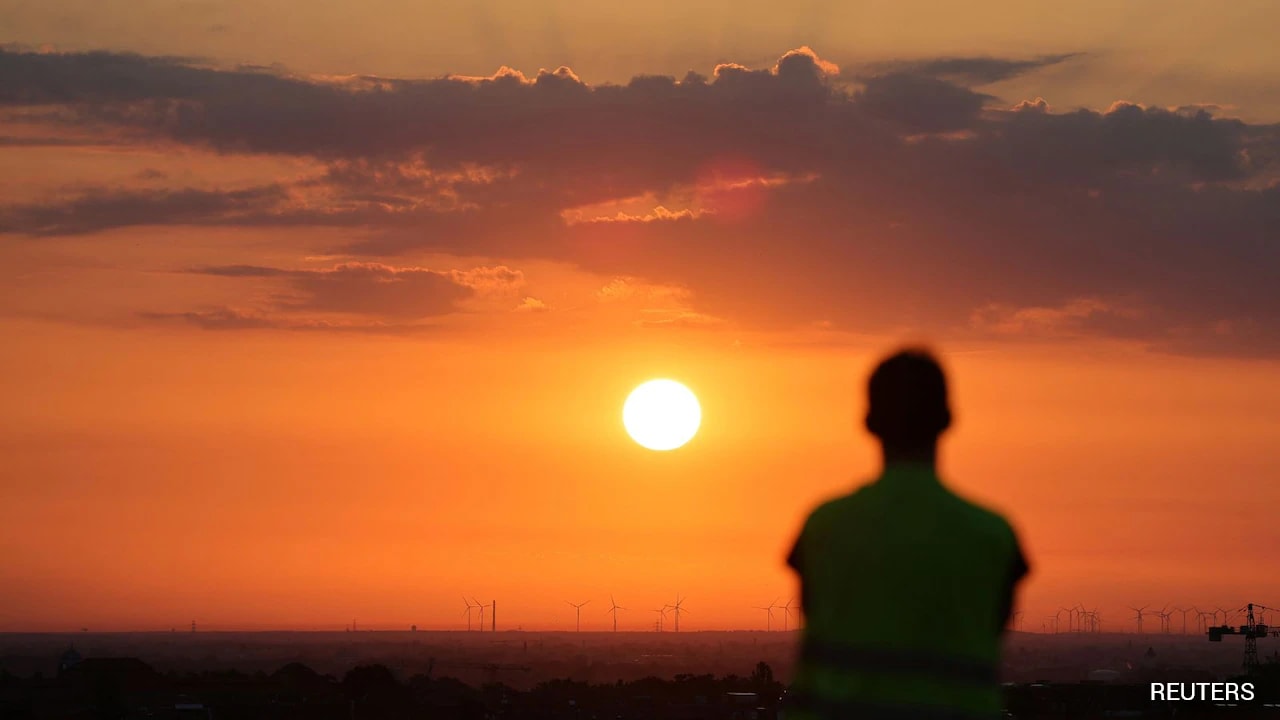
The fan in the corner of the room did nothing but rearrange the heavy, suffocating air. It was 3:00 PM in Lingen, a small city in lower Saxony, Germany, and the thermometer outside the window read a number that felt less like a weather report and more like a threat.
41.3 degrees Celsius. That translates to 106.3 degrees Fahrenheit.
In a region built for cool rains and mild summers, this was uncharted territory. It became the highest temperature ever reliably recorded in Germany. But data points on a meteorologist’s computer screen cannot capture what happens to a community when the climate shifts from comfortable to combative. The numbers do not show the quiet panic of an elderly neighbor whose apartment has no air conditioning, or the sound of tram lines groaning under thermal expansion.
To understand the reality of a record-breaking heatwave, you have to look past the headlines and stand on the melting pavement.
The Weight of the Air
Consider a hypothetical resident named Clara. She is seventy-two years old, living in a charming, brick-faced apartment building constructed in the 1950s. Like roughly ninety percent of households in Germany, her home lacks active cooling systems. European architecture historically focused on keeping heat in to survive bitter winters. Thick insulation, double-glazed windows, and solid masonry work beautifully in January.
In July, those same engineering marvels turn homes into ovens.
By noon, Clara’s apartment had trapped the morning radiation. The walls felt warm to the touch, radiating energy inward. For the human body, a sustained ambient temperature above forty degrees is not just uncomfortable; it is a biological tax. The heart pumps faster, straining to push blood to the skin where sweat can evaporate and cool the system. But when the air itself is a thermal barrier, the mechanism fails.
Outside, the city fell into an eerie, mid-afternoon silence. It was the kind of quiet usually reserved for heavy blizzards. Businesses closed early, not out of laziness, but out of necessity. Computers overheated in offices. The local infrastructure, designed for a temperate climate zone, began to show signs of structural fatigue.
When Infrastructure Relents
We often treat the built environment as a permanent fixture, an immovable backdrop to our daily lives. It isn't. It is calibrated to a specific range of environmental variables. When you exceed those variables, the material world behaves in strange, unpredictable ways.
Rail networks face immediate jeopardy during extreme heat events. Steel rails absorb solar radiation efficiently, often reaching temperatures twenty degrees hotter than the surrounding air. As the metal expands, it exerts immense pressure against the railroad ties. If that pressure exceeds the structural limits of the ballast holding it in place, the track kinks. A literal bend appears in the iron. Trains must slow to a crawl, or stop entirely, to prevent catastrophic derailments.
On the waterways, the situation was equally critical. The Rhine, the industrial artery of Western Europe, suffers dual blows during a severe heatwave. Glaciers in the Alps melt faster initially, but prolonged heat without rainfall causes river levels to plummet. Cargo barges are forced to cut their loads by half—sometimes more—to avoid scraping the riverbed. Supply chains stutter. Power plants that rely on river water for cooling must dial back operations because returning boiling water to the ecosystem would decimate the local fish populations.
This is the invisible network of cause and effect. A spike on a thermometer in Lingen ripples through the energy grid, the transport sector, and the local pharmacy line.
Shifting the Baseline
For decades, global summers were predictable affairs. There were hot days, certainly, but they were anomalies bounded by weeks of temperate relief. What we are witnessing now is not a temporary deviation from the norm, but the establishment of a terrifying new baseline.
The human capacity for adaptation is vast, but it relies on predictable patterns. When the anomalies become the routine, the psychological toll begins to mount. There is a specific vulnerability in realizing that your home—the place designed to shield you from the elements—has become a liability.
As night fell in Lingen, the temperature refused to drop. The concrete and asphalt that paved the city spent the dark hours releasing the energy they had absorbed all day. This is the urban heat island effect, a phenomenon where metropolitan areas remain significantly warmer than their rural surroundings. The relief of a cool evening never arrived.
Clara sat by her open window, waiting for a breeze that didn't exist. The air was dead, thick with the scent of dry dust and stressed vegetation. Across the continent, thousands of people were doing exactly the same thing, watching the sky, waiting for the anomaly to break, and wondering silently if this was simply what August would look like from now on.