The river does not keep records, but the families waiting on the muddy banks of the Essequibo have spent days counting.
They count the hours since the heavy wooden boat vanished beneath the black surface. They count the missing. And now, as state officials revise the body count upward once again, they count fifty-three wooden caskets laid end-to-end in the humid coastal air.
It began on a night that felt unremarkable. In the small river towns of Guyana, where dense jungle gives way to wide, murky waterways, the ferry is not a luxury or a scenic detour. It is the artery of existence. Farmers hauling crates of cassava, mothers holding sleepy children by the wrist, traders carrying cash in worn canvas belts—they all board the vessels because there are no roads through the emerald wall of the interior.
When the ferry pulled away from the slipway, crammed beyond its breath with human cargo and diesel containers, no one thought they were stepping into history. They were just trying to get home.
The Weight of the Unseen
Disaster in a remote stretch of water rarely arrives with the theatrical roar seen in movies. It comes as a sudden, sickening tilt. A shifting load. A wave creeping over a low gunwale that should have sat six inches higher above the tide.
Consider a hypothetical passenger named Devain. He stands near the stern, his boots slick with water that shouldn't be there. He notices that the engine sounds strangled, straining against a tonnage the hull was never designed to bear. Around him, seventy, perhaps eighty people are squeezed into a space meant for forty. There are no life jackets within reach—only fuel drums, sacks of grain, and the low, anxious murmur of passengers realizing, simultaneously, that the deck beneath their feet is losing its fight against gravity.
When the capsize happened, it was fast.
The river swallowed the boat in minutes. The darkness swallowed everything else.
In the immediate aftermath, early bulletins reported a dozen dead. Then twenty. Then thirty-four. Standard emergency reporting often treats these changing figures as technical updates—a simple matter of administrative record-keeping as divers search the silt. But behind every increment in that death toll is a terrible sequence of discovery: a body pulled from a tangled knot of submerged rope, a child identified by a silver bracelet, a family watching from the shore as their last fragile hope evaporates.
The official count now stands at fifty-three. It remains provisional, a polite bureaucratic word that acknowledges a devastating truth: the river may still be holding secrets.
Why the Water Claims So Many
To understand how a domestic ferry trip turns into a mass grave, one has to look past the immediate cause—the sudden roll, the failed engine—and examine the quiet, systemic failures that lay the trap long before the vessel ever leaves the dock.
In regions where rivers serve as highways, safety regulations often exist purely on paper. Inspections are sporadic. Overloading is not an exception; it is the business model. Operators know that every extra passenger squeezed onto the deck represents pure profit, while local authorities, stretched thin across vast distances, frequently look the other way.
Then there is the physical reality of the water itself. The Essequibo is vast, powerful, and thick with runoff from the rainforest. Falling into it at night in full clothing, amidst a panic of thrashing limbs and sinking baggage, is disorienting beyond measure. Even strong swimmers find themselves pulled down by the weight of their own boots or trapped beneath an overturned hull.
When safety equipment is missing or locked away to prevent theft, survival ceases to be a matter of skill. It becomes a matter of raw, brutal luck.
The Echoes on the Shore
In the capital and the provincial outposts, official statements express profound sorrow. Investigations are promised. Task forces will be formed. Committees will convene to draft tighter maritime protocols.
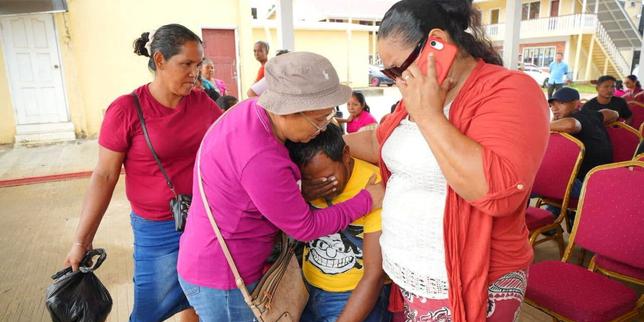
Yet on the riverbanks, the atmosphere is defined not by statements, but by a heavy, motionless grief.
In these communities, fifty-three lives is not an abstract statistic to be analyzed in a government ministry. It is the local shopkeeper who will never open his doors again. It is three generations of one family wiped out in a single evening. It is an entire generation of young people whose absence leaves a permanent void in the social fabric of the settlement.
The real tragedy of maritime disasters in developing regions is their terrible predictability. The warnings are almost always voiced years in advance by local residents who point at rusted hulls and overcrowded decks, knowing that one day the math will fail.
The river carries on, thick and quiet, reflecting the heavy gray sky of the Guiana Shield. The search crews will eventually wrap up their work. The news cameras will pack away their lenses and move on to the next crisis. But long after the official tally is finalized and filed into government archives, the people of the Essequibo will sit by the water's edge, watching the current sweep past, waiting for answers that the water will never return.