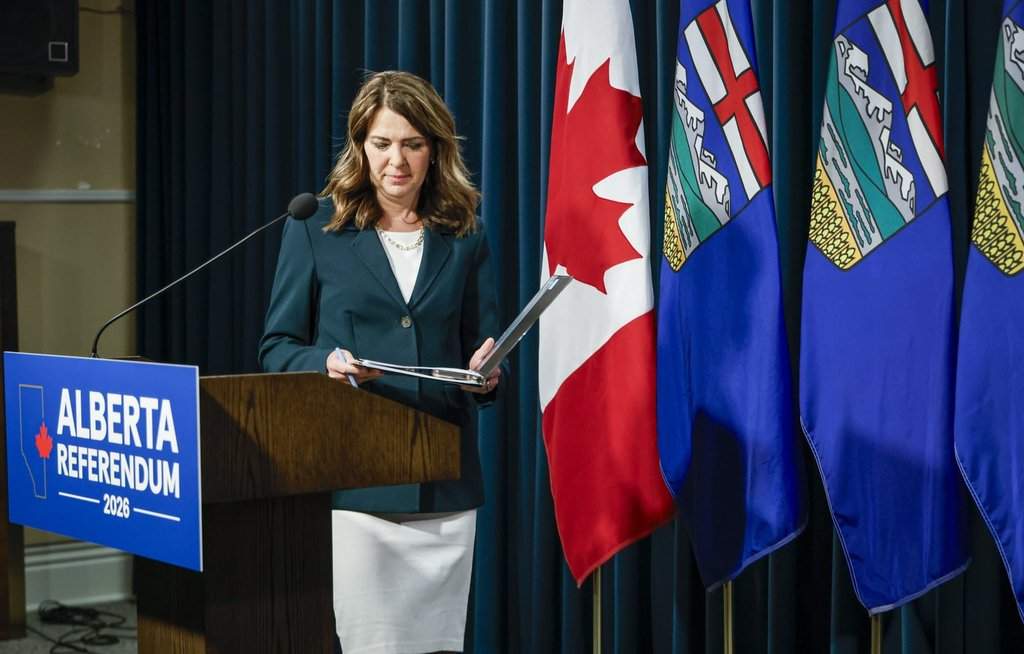
A microphone does not equal accountability. A podium does not equal candor. Yet every time Alberta Premier Danielle Smith steps up to take questions after a separation vote, the press gallery treats the event like a constitutional reckoning.
It is theater. Expensive, high-stakes theater.
Standard political coverage frames the first post-referendum press availability as a moment of truth. Reporters count how many questions she answers. Critics tally how often she pivots. Supporters cheer her toughness under fire. Everyone plays their assigned role in a script written decades ago, completely missing the structural reality underneath the noise.
If you spend enough years watching constitutional standoffs, referendum post-mortems, and intergovernmental brinkmanship up close, you stop listening to the words at the podium and start watching the incentives behind them. I have watched political strategists and corporate boards burn millions of dollars misreading referendum aftermath because they treated a ballot result as a finished transaction rather than an opening bid. They bought the press narrative hook, line, and sinker.
They got wiped out.
The Lazy Consensus Around Post-Vote Press Conferences
The conventional wisdom goes something like this: a separation vote happens, tensions run high, and the premier finally faces reporters to explain what comes next. The assumption is that this first Q&A will reveal the government's real hand—whether separation is dead, accelerating, or morphing into a fresh round of Ottawa-versus-Edmonton warfare.
That assumption is lazy. Worse, it is backwards.
A premier's first press availability after a separation vote is rarely where real strategy is unveiled. By the time reporters get their turn at the mic, the actual moves have already been coordinated behind closed doors, or they are deliberately being kept ambiguous so nobody can pin down a binding commitment. Taking questions is a pressure-release valve, not a policy blueprint.
To understand why, you have to separate three distinct concepts that commentators routinely mash together:
- Secession is the legal and political act of withdrawing territory from a sovereign state, governed by domestic constitutional rules, international recognition, and hard negotiating realities.
- Sovereignty is supreme authority over a territory and its internal affairs, which in a federation like Canada is already divided—contested rather than held exclusively by one level of government.
- Leverage is the ability to extract concessions from an opponent by making the cost of saying no higher than the cost of saying yes.
When people talk about Alberta separation, they almost always talk as if sovereignty and leverage are the same thing. They are not. A province can have zero realistic path to full secession and still wield massive leverage inside a federation—provided it knows how to use constitutional friction without blowing up its own economy.
Why Voters and Reporters Ask the Wrong Questions
Scroll through any post-vote commentary and you will see the exact same questions recycled over and over. Will she push for another vote? How will Ottawa respond? Is national unity hanging by a thread?
Those questions are traps. They assume the separation vote settled a binary question—in or out—when modern referendum politics almost never works that way. In constitutional disputes across federations, from Quebec to Scotland to Catalonia, referendum results rarely end the argument. Instead, they reprice political risk. Every actor—premiers, prime ministers, bond traders, pipeline operators, ordinary voters—updates what they think is possible and what they think is tolerable.
Consider a thought experiment. Imagine a scenario where a separation vote produces a sharp regional split—say, a decisive result in certain ridings or demographic brackets, paired with a narrower overall margin or heavy turnout in energy-producing hubs. If the premier stands at a podium and declares the issue completely dead, she hands leverage back to federal negotiators and alienates her most mobilized base. If she declares an immediate march toward exit, she triggers capital flight anxiety, legal challenges, and institutional pushback before a single treaty is drafted.
So what does a seasoned political operator do at that first press conference?
She manages expectations while preserving optionality. Every dodged question is a closed door kept slightly ajar. Every sharp retort at a reporter is aimed at an off-camera audience—voters, cabinet ministers, federal counterparts—who care far more about posture than verbatim answers.
The Real Mechanics Behind the Podium
Political scientists who study federalism and territorial politics—scholars like Ronald Watts, André Lecours, and Daniel Béland—have spent decades showing that decentralized federations run on ongoing bargaining, not one-off finality. Constitutional text sets the rules of the game, but fiscal transfers, natural resource jurisdiction, policing, pensions, and tax collection are where power actually lives.
In Canada, Alberta's position is uniquely paradoxical. On paper, provincial powers over natural resources under Section 92A of the Constitution Act, 1982 give Edmonton substantial authority over its signature industry. In practice, interprovincial infrastructure, federal environmental and regulatory reach, export market access, and national fiscal arrangements mean Alberta cannot treat its economy as an island without paying steep transition costs.
A separation vote highlights that tension. It signals frustration with Ottawa, fiscal grievances, and cultural or economic alienation. Yet a vote tally—whatever the exact number—does not magically build tidewater pipelines, rewrite Indigenous treaty obligations, establish a stable currency, or guarantee seamless trade access overnight.
Anyone who watches a premier take questions after a vote and expects a neat ledger of "pro-exit" versus "anti-exit" math is reading the wrong manual. A referendum result in a federation is a bargaining chip tossed onto a crowded table. The press conference is just the dealer announcing the stakes while keeping the next card face down.
Answering the Questions Everyone Actually Searches
When a story like this breaks, readers type predictable queries into search bars. Most of those queries rest on shaky premises.
"Does taking questions mean the premier is backing down or doubling down?"
Neither—at least not cleanly. In high-stakes politics, availability is a tactical choice. Going silent looks evasive and lets opponents frame the narrative unchallenged. Taking questions lets a leader project command, test talking points in real time, and signal strength to supporters. Reading "backing down" or "doubling down" into a single Q&A usually says more about the reader's bias than the speaker's plan.
"Could a separation vote actually lead to Alberta leaving Canada?"
Legally and practically, the road from a provincial vote to actual independence is long, contested, and packed with unresolved hurdles. In Canadian constitutional history, the Supreme Court's 1998 Quebec Secession Reference established that a clear majority on a clear question would trigger a duty to negotiate, not an automatic exit—and that secession would require constitutional amendments and negotiations covering borders, debt, assets, and Indigenous rights. Treating a separation vote like a flipping light switch ignores decades of constitutional law and economic friction.
"Why do separation votes keep happening if independence is so hard?"
Because you do not need to win independence to win concessions. In federated systems, credible grievances backed by organized political pressure can shift federal tone, reshape fiscal debates, or rally regional solidarity. Sometimes the threat of walking out the door is used to get a better seat at the table.
Where My Contrarian Read Can Go Wrong
Being contrarian is easy when you are sitting on the sidelines throwing stones. Being right is harder.
There is a real risk in dismissing a separation vote and its aftermath as "just leverage" or "just theater." Political movements sometimes surprise the people who think they have them boxed in. Grievances that politicians treat as tactical bargaining chips can harden into genuine, generational identity shifts. Misreading voter anger as mere negotiating posture is one of the classic blunders of entrenched elites—right up until the moment an unlikely coalition pulls off something analysts swore was impossible.
A contrarian read also risks sounding cynical to the point of nihilism. Voters who cast ballots in a separation vote aren't all playing 4D chess with constitutional theory. Many are frustrated about cost of living, federal policy, representation, or economic fairness. Reducing every voter's motive to elite power games misses the human friction driving the politics in the first place.
What Smart Observers Should Do Instead
If you want to understand what happens after a separation vote—whether you run a business in Western Canada, manage capital, or just refuse to be spoon-fed spin—stop treating the premier's Q&A as a verdict. Treat it as a signal.
- Track the policy levers, not the applause lines. Watch what happens to provincial legislation, tax and royalty frameworks, intergovernmental litigation, and administrative capacity in the weeks after the press conference. Speeches are cheap; statutory and institutional moves cost real political capital.
- Watch how Ottawa responds in quiet channels. Federal silence, legal posturing, or targeted fiscal moves tell you far more about perceived risk than television soundbites.
- Price the transition costs honestly. Whether someone cheers or dreads separation, real-world outcomes depend on hard constraints: trade routes, regulatory certainty, labor mobility, courts, and public finances. Slogans do not balance a budget or move a barrel of oil.
- Separate short-term spin from long-term shifts. One press conference will not decide the next twenty years. Look for durable changes in voter turnout, party alignment, and public trust rather than day-two hot takes.
Politicians love a microphone when they want to look in control. Smart readers pay attention to what changes once the cameras turn off.