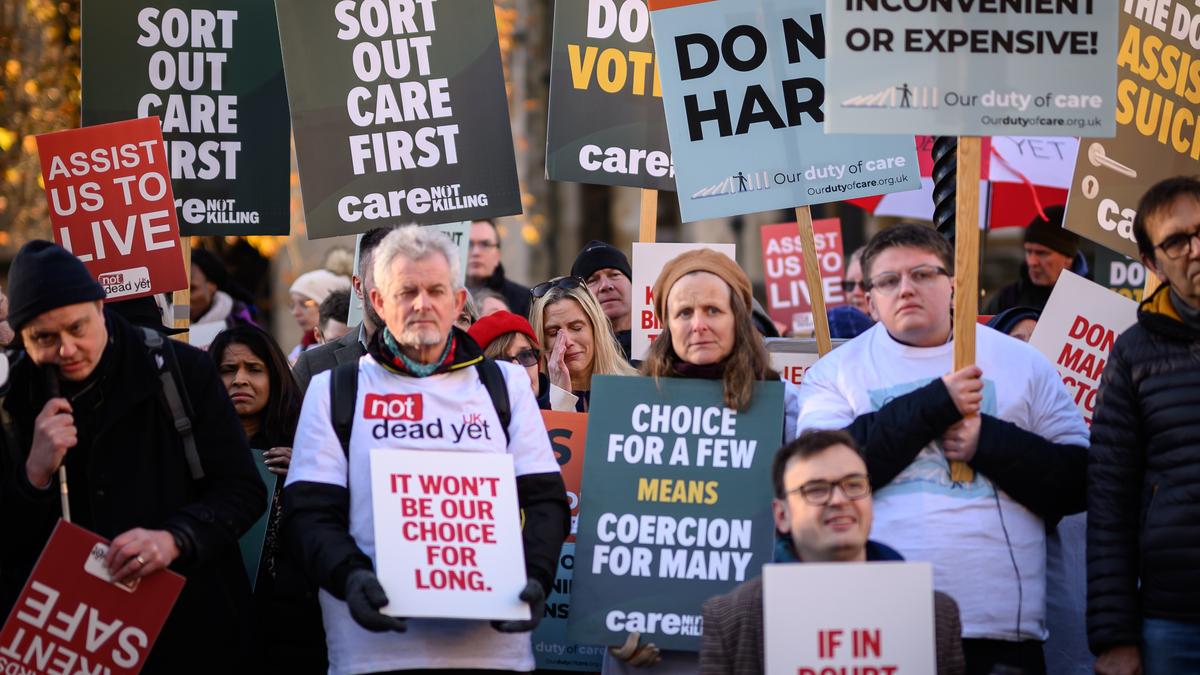
The media coverage surrounding France’s legislative push toward legalized assisted dying follows a script so tired it belongs in a museum. On one side, you have the self-styled champions of human rights, framing the bill as the ultimate triumph of individual autonomy and compassion. On the other, religious traditionalists and conservative lawmakers warn of moral decay and the sanctity of life.
This binary framing is a intellectual scam. It hides the grimmest reality of modern state-sponsored medicine.
The French debate, much like the legislative shifts we have seen in Canada, Belgium, and the Netherlands, is not a victory for human liberty. It is a highly convenient, cost-effective pressure valve for a collapsing public healthcare system. When states fail to fund palliative care, understaff hospitals, and price the elderly out of long-term support, offering a lethal prescription is not "mercy." It is medical abandonment masquerading as progressive choice.
The Illusion of Free Will in an Austerity State
To understand why the mainstream consensus on assisted dying is dangerously naive, we have to look at the mechanics of choice. True autonomy does not exist in a vacuum. A decision is only free if the alternatives are viable.
Imagine a terminal cancer patient in a provincial French town. Under the current, strained system, they face months-long waiting lists for specialized pain management. Palliative care units are chronically underfunded, understaffed, and concentrated in wealthy urban centers. The patient's family is buckling under the financial and emotional weight of at-home care, receiving little to no state assistance.
When you hand that patient a state-sanctioned option to end their life, you are not expanding their choices. You are narrowing them to a single, path-of-least-resistance exit.
In Canada, where the Medical Assistance in Dying (MAID) program has expanded rapidly since 2016, we have already seen this play out with terrifying clarity. Human rights groups have documented cases of disabled and chronically ill patients applying for MAID not because they wanted to die, but because they could not secure affordable housing, disability support, or specialized medical treatments.
I have spent years analyzing health policy and watching governments manage budgets. When a state budget director looks at the rising cost of end-of-life care—which historically consumes a massive percentage of total lifetime healthcare spending—and compares it to the negligible cost of a lethal injection, the bureaucratic math is brutal. Assisted dying is the cheapest medical intervention on the books. Elevating it to a constitutional right or a progressive milestone is an extraordinary act of cognitive dissonance.
The Failure of Palliative Care is the Real Crime
The proponents of the French bill argue that assisted dying is a necessary last resort for intractable physical suffering. This claim ignores the modern reality of palliative medicine.
Ask any veteran palliative care physician. With aggressive pain management, continuous deep sedation, and comprehensive symptom control, physical pain can be managed in the vast majority of terminal cases. The actual driver of the desire for assisted dying is rarely physical pain that medicine cannot touch; it is existential distress, fear of being a burden, and the loss of autonomy.
These are psychological and social problems, not biological ones. Instead of addressing these fears with robust social safety nets, psychological support, and community care, the state offers a chemical solution.
France has historically lagged behind other European nations in its palliative care infrastructure. In 2023, French government reports admitted that nearly half of the patients who required palliative care did not receive it. Rather than pouring billions into fixing this structural shame, lawmakers spent months debating the legal mechanics of ending life. It is the legislative equivalent of refusing to fix a leaking roof and instead passing a law that legalizes letting the house drown.
Dismantling the "Slippery Slope" Fallacy
Opponents of assisted dying often rely on the traditional "slippery slope" argument, warning that we will soon be euthanizing people for minor ailments. This argument is easily dismissed by liberals as alarmist.
But the slope is not a logical fallacy. It is an economic certainty.
When you establish that a citizen has a right to end their life to avoid suffering, you cannot logically restrict that right to the terminally ill without committing discrimination. This is not speculation; it is the legal trajectory of every single jurisdiction that has legalized the practice.
- Phase 1: The Strict Guardrails. Legalization is introduced only for mentally competent adults with terminal illnesses who face imminent, unavoidable death. France is currently trying to position its bill in this category.
- Phase 2: The Expansion. Human rights lawsuits argue that keeping the option from those with non-terminal, chronic physical illnesses is discriminatory. The courts agree, and the criteria expand.
- Phase 3: The Mental Health Conundrum. The criteria expand further to include psychiatric suffering, depression, and early-stage dementia.
- Phase 4: The Socioeconomic Capture. The practice becomes a normalized response to poverty, isolation, and systemic medical failure.
In Belgium and the Netherlands, patients with severe psychiatric conditions, including young adults with treatment-resistant depression, are routinely euthanized. In Canada, the government repeatedly delayed the expansion of MAID to sole mental illness, not because of moral objections, but because they realized they lacked the psychiatric infrastructure to handle the demand.
When you turn suicide into a medical service, you transform it from a tragedy to be prevented into a right to be accommodated. The state's duty of care is quietly replaced by a duty of administrative efficiency.
The Silent Coercion of Vulnerable Populations
The most insidious aspect of this legislation is how it shifts the burden of proof onto the weak.
Under a system where assisted dying is illegal, the default expectation is that society will care for you until the natural end of your life, regardless of how difficult or expensive that care becomes.
Once assisted dying is normalized and institutionalized, the dynamic flips. The terminally ill, the disabled, and the elderly are forced to justify why they are choosing to remain alive. They are acutely aware of the financial drain they place on their families and the physical toll on their caregivers. They know they are occupying a hospital bed that a younger, healthier patient could use.
This creates a climate of silent, systemic coercion. No doctor has to suggest death; the patient internalizes the pressure themselves. They choose death out of a warped sense of altruism. A society that allows its most vulnerable members to feel that their death is a favor to their loved ones has failed on a fundamental level.
The Hypocrisy of the Medical Establishment
For millennia, the foundational principle of medicine has been to do no harm. The professional boundary between healing and killing is what allowed patients to trust doctors with their lives.
Legalizing assisted dying crosses this line, turning the physician into both a judge of a life’s worth and an executioner. It corrupts the patient-doctor relationship. When a doctor enters a hospital room, their sole focus should be on how to optimize the patient's remaining life. The moment they are also tasked with evaluating whether that patient is a candidate for death, the therapeutic alliance is fractured.
We are already seeing the consequences of this shift. In countries with permissive euthanasia laws, medical students are increasingly hesitant to enter palliative care, while elder care facilities are transforming into places where residents worry about the underlying motives of their medical teams.
Stop Treating Death as an Individual Consumer Choice
The current debate in France is framed as a triumph of individual rights. It is nothing of the sort. It is a capitulation. It is the ultimate admission that the state has given up on providing the social, economic, and medical support necessary to make the end of life bearable.
If we want to talk about dignity, we must talk about funding. We must talk about training more palliative care specialists, building more hospices, and guaranteeing that no human being ever feels that their death is a financial necessity for their family or their country.
Until we can guarantee that every citizen has access to world-class pain management and dignified end-of-life care, passing bills to make state-assisted death easier is not progressive. It is a moral failure disguised as progress, designed to save money while the public applauds.
Stop celebrating the right to die when we have yet to secure the right to be cared for.