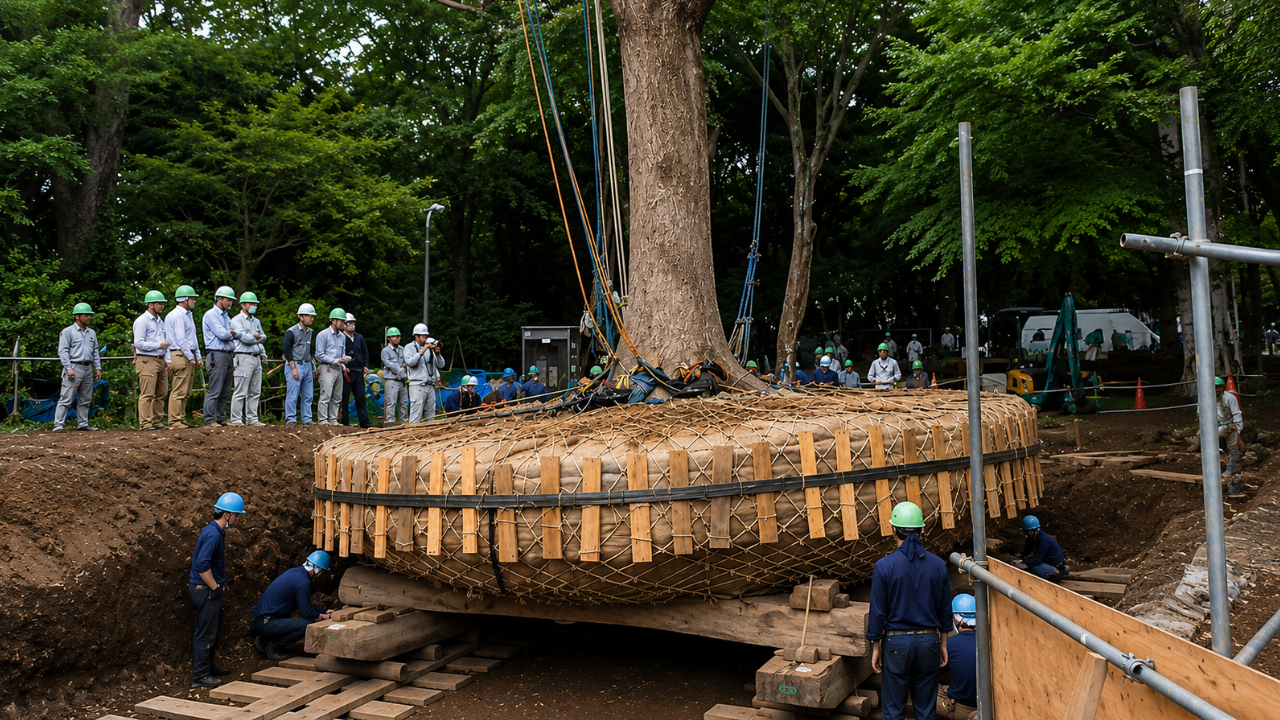
When mega-developers in Tokyo blueprint a new skyscraper district, a century-old camphor or ginkgo tree standing in the way is rarely met with a chainsaw. Instead, a specialized team of arborists spends months executing nebihori (root excavation) and nemawashi (root-pruning) to prepare the giant for relocation. Western media frequently romanticizes this practice as an unbroken, spiritual reverence for nature. The reality is far more transactional. Moving a 300-year-old tree is an agonizingly slow, multi-million-yen logistical nightmare driven by a complex mix of strict local zoning laws, corporate image laundering, and a desperate attempt to retain vanishing green spaces in the world’s densest urban centers.
Japan does not cut down these ancient trees because doing so carries immense bureaucratic, financial, and social penalties. However, treating the practice of toshiki-iju (urban tree transplantation) as a pure triumph of environmentalism ignores the brutal math and ecological compromises happening behind the construction fences.
The Brutal Physics of Moving a Giant
Moving a tree that weighs forty tons requires more than just a big crane. It is a slow, surgical operation that often takes up to six months of preparation before the tree even leaves the soil.
The process begins with nemawashi. Workers carefully dig a trench around the root ball, cutting back major structural roots while preserving the smaller feeder roots closer to the trunk. This triggers the tree to grow a dense network of new, localized roots within a concentrated root ball. If a developer skips this step and simply yanks the tree out, the specimen will almost certainly die of shock within a year.
[Phase 1: Nemawashi] -> Trench dug, major roots pruned to stimulate localized growth.
[Phase 2: Nebihori]  -> Soil excavated, root ball wrapped tightly in burlap and rope.
[Phase 3: Transport] -> Heavy cranes and multi-axle trailers move the tree at night.
[Phase 4: Planting]  -> Insertion into engineered soil with subterranean anchors.
Once the new root system stabilizes, the nebihori phase begins. The root ball is wrapped tightly in straw matting and natural ropes, forming a massive, compact bulb. Transporting these giants through Tokyo or Osaka requires midnight operations, police escorts, and the temporary dismantling of overhead power lines.
The survival rate of these transplanted ancients sits at around 70% to 85%, depending on the species. Ginkgos and camphors tolerate the shock relatively well. Ancient pines and cedars frequently succumb to subterranean fungal infections or hydration failure years after the move. It is a high-stakes gamble where a single miscalculation can turn a living monument into a towering piece of dead wood.
The Financial Realities and Corporate Greenwashing
Preserving an ancient tree is rarely a spontaneous act of corporate goodwill. It is a calculated cost of doing business under Japanese urban planning frameworks.
Under local government ordinances, major developers face strict "green percentage" quotas (ryokuritsu). If a new commercial complex fails to allocate a specific ratio of its footprint to living vegetation, the project cannot proceed. Planting saplings satisfies the legal requirement, but it does nothing to appease local community boards or historical preservation societies who view ancient trees as neighborhood deities (kodama).
The Ledger of a Tree Relocation
To understand why a developer spends millions on a single tree, look at the alternative costs:
| Expense Item | Estimated Cost (Yen) | Estimated Cost (USD) |
|---|---|---|
| Six Months of Manual Arborist Labor | ¥5,000,000 - ¥8,000,000 | $33,000 - $53,000 |
| Heavy Machinery and Midnight Transport | ¥12,000,000 - ¥20,000,000 | $80,000 - $133,000 |
| Post-Transplant Soil Engineering & Monitoring | ¥3,000,000 | $20,000 |
| Total Estimated Cost Per Tree | ¥20,000,000 - ¥31,000,000 | $133,000 - $206,000 |
While these figures seem staggering, they represent a fraction of a percent of a multi-billion-yen skyscraper budget. By allocating funds to save a historical tree, a developer buys immediate public goodwill, avoids protracted legal battles with conservationists, and secures fast-tracked municipal approvals. The saved tree becomes the centerpiece of the new plaza, heavily featured in marketing brochures to project an image of eco-friendly corporate citizenship.
The Ecological Loss in the Shadow of the Skyscraper
There is a distinct difference between saving a tree and saving an ecosystem. When an ancient tree is uprooted from its original soil, the delicate network of mycorrhizal fungi, local insect populations, and avian nesting habits is permanently shattered.
An ancient tree is not an isolated object. It is the anchor of a localized biological web. Depositing that same tree into an engineered concrete planter box atop a subterranean shopping mall parking garage reduces a living organism to an architectural ornament. The tree may survive, but its ecological function is fundamentally castrated.
Furthermore, this obsession with saving high-profile individual trees often serves as a smokescreen for broader environmental destruction. While a developer may spend a fortune relocating a singular, photogenic 200-year-old ginkgo, they simultaneously clear-cut hundreds of smaller, unclassified trees, shrubs, and green patches across the project site. The public celebrates the survival of the giant while ignoring the quiet erasure of the surrounding urban canopy.
A System of Compromise
The Western perception of Japanese tree relocation often leans heavily on the concept of Shinto animism—the belief that spirits inhabit ancient natural structures. While cultural heritage undoubtedly plays a role in public resistance to tree felling, the modern mechanics of nemawashi are governed by cold, hard pragmatism.
Municipalities use these ancient trees as leverage. Developers use them as public relations shields. Arborists view them as complex engineering puzzles.
This system keeps centuries-old genetic material alive in an environment that would otherwise pave it over, but it is not a perfect blueprint for global conservation. It is a highly specialized, wildly expensive compromise born of extreme land scarcity. When a society has run out of space to build around nature, it has no choice but to lift nature out of the ground, move it down the road, and hope the roots take hold before the concrete dries.