The wind off the Alberta plains does not care about your political affiliations, your quarterly earnings reports, or your grandchildren's inheritance. It cuts straight through a heavy canvas jacket at forty below zero, carrying the smell of frozen earth and distant pump jacks. Stand out there long enough in the winter quiet, watching the pale sun drag itself in a low, exhausted arc across the southern horizon, and you start to think about weight.
Not the weight of the snow drifting against the fence posts. The weight of invisible things. Recently making headlines recently: Why Saving That Crumbling Train Depot Is a Massive Waste of Money.
Every minute of every day, heavy industry across western Canada exhales a staggering volume of carbon dioxide. It rises from sulfurous stacks, steams out of processing plants, and pours from the bellies of heavy machinery hauling bitumen out of the earth. We cannot see it. For generations, that was the grand illusion of the modern economy: if you cannot see the exhaust, it essentially does not exist. It just drifts up into the great blue dome of the atmosphere and becomes somebody else’s weather.
Except the weather has started talking back. Additional insights into this topic are explored by Harvard Business Review.
To understand what is happening quietly on the flat, frozen acreage of central Alberta right now, you have to look past the corporate press releases and the dry engineering jargon. Forget the acronyms for a moment. Look at a pipe. A simple, thick-walled steel pipe buried deep beneath the black dirt and the stubborn wheat stubble.
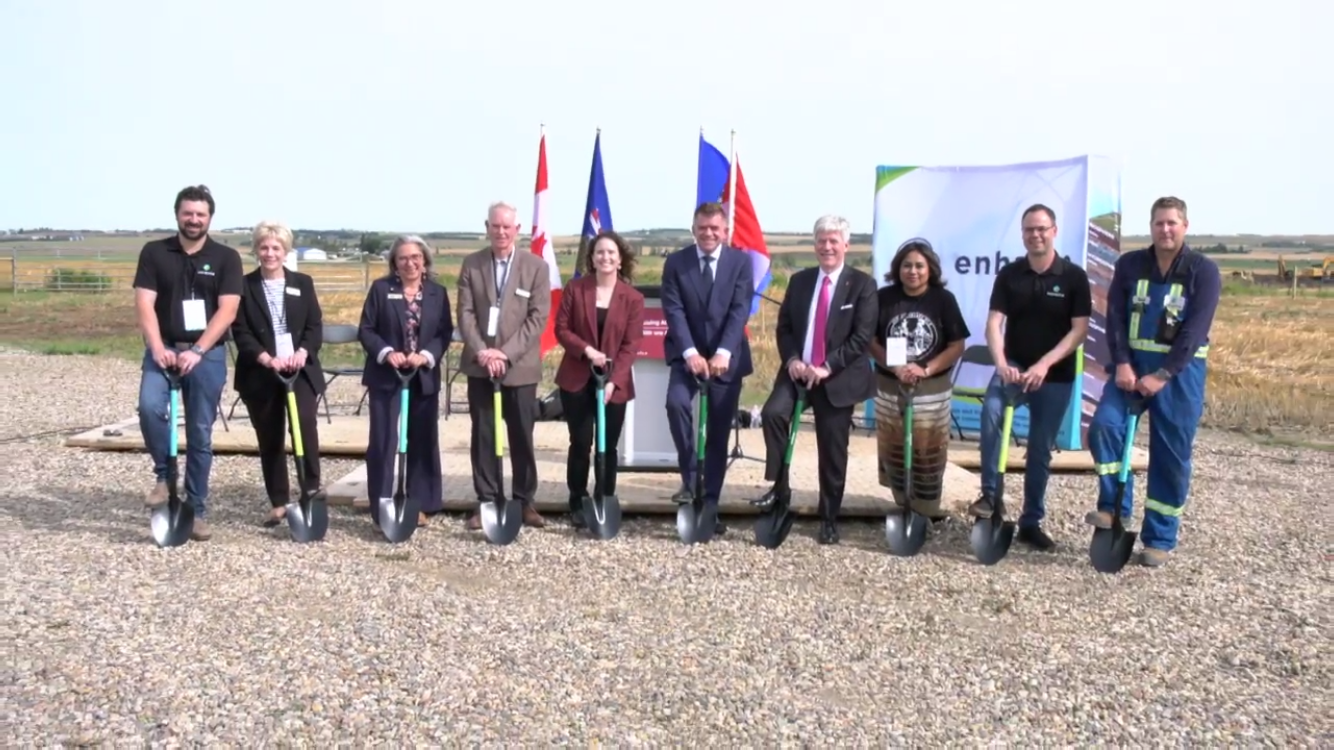
That pipe is the spine of what is tracking to become the largest carbon capture hub in Canada.
Call it an engineering marvel if you like boardrooms and hardhats. Call it a desperate accounting trick if you prefer political theater. But on the ground, where the frost heaves the gravel roads and the coyotes howl across the stubble fields at dusk, it looks like something entirely different. It looks like a monument to human stubbornness. We spent a century learning how to suck things out of the deep earth with terrifying efficiency. Now, we are trying to figure out how to push them back down.
Consider what happens next when you try to shovel millions of tons of industrial gas back into the ancient bedrock.
It is not as simple as pumping air into a bicycle tire. Carbon dioxide behaves strangely under immense underground pressure. At certain depths, squeezed by miles of sedimentary rock and ancient, salty brine water, it turns into a supercritical fluid—something half-liquid, half-gas, sloshing quietly through microscopic pores in the rock strata like water through a very dense, very heavy sponge.
To make this happen on a continental scale requires a logistics chain so complex it makes your head spin. Picture a sprawling web of gathering lines snaking across municipal districts, collecting emissions from upgraders, refineries, and fertilizer plants before they ever leave the stack. These facilities are spending billions of dollars to capture the gas at the source, scrubbing it out of industrial exhaust streams using chemical solvents that act like high-tech flypaper.
Once trapped, the gas is dehydrated, compressed until it groans, and sent rushing through those buried arteries at high pressure. Its destination is a deep geological formation known as the Basal Cambrian Sandstone, lying thousands of meters beneath the surface. This is not a hollow cavern left behind by ancient miners. It is an immense, porous layer of sandstone sealed safely beneath thousands of feet of impermeable shale—a natural vault that has held fluids captive for hundreds of millions of years.
Critics look at this entire operation and shake their heads. They call it a lifeline for fossil fuels, a very expensive band-aid slapped over a compound fracture. They are not entirely wrong to be suspicious. When an oil and gas jurisdiction invests heavily in a technology that lets it keep burning hydrocarbons while burying the evidence, cynicism is the most rational response on the menu.
Let us be completely honest about the contradictions here. The people building this hub are the same ones who dug the hole in the first place. They are oil companies, engineering syndicates, and utility providers operating under the harsh glare of decarbonization deadlines and shifting global markets. They are not environmental philanthropists waking up with a sudden burst of ecological conscience. They are pragmatists reading the handwriting on the wall of international trade agreements, carbon taxes, and investor demands. If they cannot clean up their barrels, nobody will buy them. Survival is a powerful motivator.
Yet, walking the perimeter of these industrial sites, the human element emerges through the cracks in the corporate rhetoric.
Meet Sarah. Let us call her that, though she represents dozens of senior reservoir engineers working late into the night in downtown Calgary office towers lit by the neon glow of computer monitors. Sarah grew up in a small town near Red Deer where half the neighbors worked on rigs and the other half farmed. She holds a master’s degree in geomechanics and carries the quiet, unassuming posture of someone who has spent her life solving hard math problems that do not care about human opinions.
"People think we are just sticking a straw in the ground and blowing bubbles," she told me once, staring at a three-dimensional seismic model of the underground rock layers glowing on her screen. Her eyes were bloodshot from a week of continuous simulation runs. "They do not realize the microscopic precision required. We have to map fractures you could fit a human hair into, across a footprint the size of a small European country. If we miss by an inch in our pressure models over a thirty-year timeline, the entire containment strategy fails."
She isn't speaking as a corporate PR spokesperson. She speaks like a high-wire artist checking her safety harness for the fourth time before stepping out onto the cable. There is a palpable weight of responsibility on the shoulders of these technical teams. They know the stakes. If this hub leaks—if the monitoring wells detect even a fraction of a percent of migrating gas—the blowback will be instantaneous, lethal to public trust, and catastrophic for the industry's social license to operate.
This brings us to the core tension of the central Alberta carbon capture hub. It is a massive, multi-billion-dollar bet on human ingenuity versus geological uncertainty.
The numbers being bandied about by project architects like Pathways Alliance are staggering. They talk about capturing millions of tons of CO2 annually by the end of this decade. To visualize that volume, imagine every stadium seat in a major metropolitan hockey arena filled not with fans, but with towering blocks of solid dry ice, multiplied by a thousand, buried forever beneath the frost line.
Can they pull it off? The engineering is sound in theory, tested on smaller projects around the world from Norway to Saskatchewan's Boundary Dam. But scaling it up to handle the emissions profile of an entire regional oil patch is uncharted territory. It requires unprecedented cooperation between fierce corporate competitors who usually spend their days fighting over mineral rights and pipeline tariffs. It requires regulatory frameworks that do not yet fully exist, and billions of dollars in public-private cost-sharing that triggers fierce debates in legislative assemblies from Edmonton to Ottawa.
The political crossfire is fierce. Environmentalists argue that every dollar spent on burying emissions is a dollar stolen from the transition to wind, solar, and green hydrogen. They point out that carbon capture is energy-intensive; running the compressors and pumps requires power, which sometimes comes from natural gas plants, creating a strange loop of emissions just to capture emissions.
On the other side of the aisle, economists and energy planners argue that wishing away heavy industry is a luxury reserved for people who do not rely on a paycheck from the energy sector. They point out that the world will still need cement, steel, fertilizers, and liquid fuels for aviation and shipping for decades to come. If you cannot stop the emissions at the source, trapping them before they enter the atmosphere is not just an option—it is the only math that adds up in time to meet global climate targets.
Both sides are trapped in the same room, glaring at each other across a table groaning under the weight of an unprecedented planetary crisis.
Meanwhile, out on the frozen prairie, the construction crews keep welding pipe. Giant yellow cranes lift prefabricated compressor modules into place against a slate-gray sky. Heavy diesel engines rumble to life in the sub-zero dawn, their exhaust pluming white against the horizon like tiny, fleeting clouds of proof that human activity leaves a mark wherever it goes.
We are entering an era of radical subterranean engineering. For centuries, our relationship with the earth was strictly extractive. We went down to pull things out—coal, oil, water, gold. Now, we are learning to treat the deep earth as a graveyard for our own waste, a vast subterranean archive where we can bury our atmospheric sins out of sight and, hopefully, out of mind.
It is a humbling enterprise. It forces us to confront the sheer scale of our industrial metabolism. When you calculate the volume of carbon we pump into the air every single day, trying to catch it all feels like trying to empty a swimming pool with a teaspoon.
Yet the alternative—doing nothing while the atmospheric thermostat ratchets upward year by relentless year—is no longer an intellectual abstraction. You can taste it in the smoke of summer wildfire seasons that now stretch into months of orange hazes across these very same plains. You can measure it in the retreating glaciers of the nearby Rockies, weeping their final meltwater into dying trout streams.
So they build the hub.
They pour the reinforced concrete foundations deep into the frozen clay. They weld the heavy steel seams with X-ray precision. They write lines of computer code that monitor pressure drops and seismic tremors down to the decimal point, watching over the sleeping earth like electronic sentinels.
And as the winter sun dips below the horizon, painting the snowfields in shades of violet and bruised amber, the silence returns to the Alberta flatlands. The pump jacks nod their heavy iron heads in rhythm with a mechanical heartbeat older than most living memories. Deep below them, invisible and silent, the first test volumes of captured carbon begin their slow, permanent migration into the dark, ancient stone, tucked away safely beneath the restless surface of a changing world.